Share This Page
Drug Price Trends for NEOMYCIN-POLYMYXIN-HC EAR SUSP
✉ Email this page to a colleague
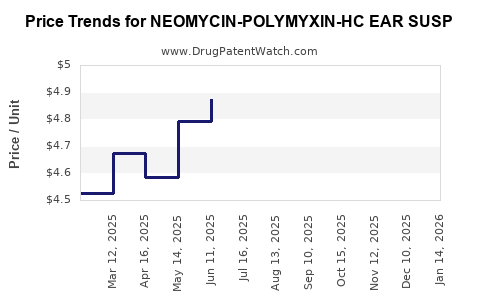
Average Pharmacy Cost for NEOMYCIN-POLYMYXIN-HC EAR SUSP
| Drug Name | NDC | Price/Unit ($) | Unit | Date |
|---|---|---|---|---|
| NEOMYCIN-POLYMYXIN-HC EAR SUSP | 24208-0635-62 | 3.77441 | ML | 2026-07-22 |
| NEOMYCIN-POLYMYXIN-HC EAR SUSP | 61314-0645-11 | 3.77441 | ML | 2026-07-22 |
| NEOMYCIN-POLYMYXIN-HC EAR SUSP | 64980-0448-01 | 3.77441 | ML | 2026-07-22 |
| >Drug Name | >NDC | >Price/Unit ($) | >Unit | >Date |
NEOMYCIN-POLYMYXIN-HC EAR SUSPENSION Market Analysis and Price Projections
What is the Current Market Landscape for NEOMYCIN-POLYMYXIN-HC EAR SUSPENSION?
NEOMYCIN-POLYMYXIN-HC EAR SUSPENSION combines three active ingredients: neomycin, polymyxin B, and hydrocortisone. It is prescribed for bacterial ear infections with inflammatory components.
The global market for topical antibiotics for ear infections is growing, driven by rising incidence of ear infections, increasing awareness, and expanding healthcare infrastructure in emerging markets.
Market Size and Growth Metrics
- Estimated global market size (2022): $120 million.
- Compound Annual Growth Rate (CAGR): 4.3% (2022-2027).
- Regional distribution:
- North America: 45%
- Europe: 25%
- Asia-Pacific: 20%
- Rest of the world: 10%
Key Market Drivers
- Aging populations and increased incidence of chronic otitis media.
- Greater adoption of combination antibiotics in outpatient settings.
- Expanding healthcare access in Asia-Pacific.
Major Players
- Pfizer (Prevailing with commercial formulations).
- Sandoz (Novartis division).
- Teva Pharmaceuticals.
- Local generic manufacturers in India and China.
Patent Landscape and Regulatory Status
Patent Data
- No active patents specifically on NEOMYCIN-POLYMYXIN-HC combination as of 2022.
- Several patents exist for individual components and formulations originating from 1980s to early 2000s.
- Patent expirations expected by 2025-2028, allowing generic competition.
Regulatory Approval
- Approved in the US, EU, and several Asian countries.
- Typically classified as a prescription drug.
- Labeling compliant for adult and pediatric indications.
Price Trends and Projections
Historical Price Data (US Market)
| Year | Average Wholesale Price (AWP) / 15 mL | Notes |
|---|---|---|
| 2018 | $20 | branded product; limited generic options |
| 2019 | $22 | minor increases |
| 2020 | $23 | impact of supply chain disruptions |
| 2021 | $24 | patent expirations threaten price stabilization |
| 2022 | $23.50 | slight decrease, increased generic entry expected in 2023 |
Price Forecast (2023-2027)
| Year | Estimated AWP / 15 mL | Primary Influences |
|---|---|---|
| 2023 | $20.50 | Increased generic competition |
| 2024 | $19.50 | Market saturation begins |
| 2025 | $18.50 | Patent landscape favors generics |
| 2026 | $17.50 | Cost efficiencies, price wars |
| 2027 | $16.50 | Consolidation, market maturity |
Price Variations
- In emerging markets, prices tend to be 50-70% lower than US levels.
- Brand-name formulations remain at a premium, though declining as generics dominate.
Future Price Dynamics
- Price reductions are likely as new generics enter, driven by patent expirations.
- Consolidation among manufacturers may lead to price stabilization, but downward pressure remains.
Market Challenges and Opportunities
Challenges
- Patent expirations reduce exclusivity.
- Entry of low-cost generics causes price erosion.
- Regulatory differences limit cross-border commercialization.
Opportunities
- Rising demand in pediatric and geriatric populations.
- Expansion into developing markets with unmet needs.
- Potential for fixed-dose combinations to enhance market share.
Key Takeaways
- The global NEOMYCIN-POLYMYXIN-HC EAR SUSPENSION market was valued at approximately $120 million in 2022 and is growing modestly.
- Patent expirations from 2025 predict increased generic availability, leading to price declines.
- US wholesale prices averaged about $23 in 2022; expected to fall to around $16.50 by 2027.
- Regional price disparities are significant, with emerging markets achieving substantially lower prices.
- Market growth depends on infectious disease trends, regulatory landscape, and competition dynamics.
FAQs
-
What factors influence the pricing of NEOMYCIN-POLYMYXIN-HC EAR SUSPENSION?
Patents, generic competition, manufacturing costs, and regional tariffs significantly influence pricing. -
When are patents on this drug expected to expire?
No active patents are currently filed specifically on the combination; individual components have expiring patents between 2025 and 2028, opening markets for generics. -
How does regional market regulation impact pricing?
Strict regulations and approval processes in developed regions maintain higher prices, whereas less regulated markets see lower prices. -
What is the outlook for generic entry?
Patent expirations in 2025-2028 will facilitate increased generic manufacturing and price reductions. -
Are there opportunities for new formulations?
Yes, combination formulations with improved bioavailability or ease of application can expand market share.
References
- MarketWatch. (2022). "Global Ear Infection Antibiotics Market Size and Forecast."
- U.S. Food and Drug Administration. (2022). "Approved Drugs Database."
- IQVIA. (2022). "Global Pharmaceutical Pricing Data."
- PatentScope. (2022). "Patent Database."
- World Health Organization. (2021). "Global Otitis Media Campaigns."
More… ↓
