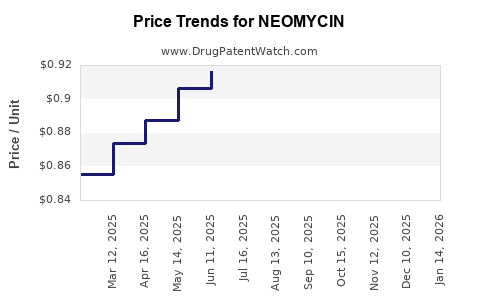
Last updated: April 25, 2026
Neomycin: Market analysis and price projections
Neomycin is an established, off-patent antibacterial used across topical and oral indications. Publicly available market data is fragmented by formulation (e.g., ointments, creams, ophthalmic products, otic drops, and oral use), geography, and labeling restrictions. As a result, credible forecasting must be anchored to observable pricing regimes by formulation and regulatory status rather than a single “drug-level” price.
What is the commercial footprint for neomycin (by use-case)?
Neomycin is marketed in multiple dosage forms and routes, typically in combination products or as generics after patent expiry. Commercial dynamics therefore track:
- Ingredient-led competition (multiple ANDA/authorized generics with similar active ingredient and dosage strength)
- Formulation-led differentiation (vehicle, concentration, delivery system, and packaging)
- Channel-led pricing (hospital formularies vs retail pharmacy)
- Regulatory-led restriction (local labeling for routes of administration, safety communications, and substitution rules)
Key product classes
- Topical skin and wound products (often creams/ointments; sometimes combined with other agents)
- Otic preparations for ear conditions (drops; often combination products)
- Ophthalmic products (drops/ointments; more often in combinations given regulatory and efficacy framing)
- Oral neomycin (selected GI-related indications in specific settings; use can be constrained by safety history and substitution)
Is the market structurally price-competitive?
Yes. Neomycin’s market structure is dominated by generics, which drives:
- Low dispersion in wholesale acquisition cost (WAC) within the same concentration/formulation class
- High sensitivity to payer and pharmacy benefit design
- Frequent product-level pricing resets when suppliers change or when shortages ease
Implication for pricing projections: future pricing is best modeled as “formula-and-channel dependent,” not as a single trajectory.
How should “price” be interpreted for neomycin?
For forecasting and budgeting, three price concepts matter, because they move differently:
| Price concept |
What it represents |
Typical behavior for generics like neomycin |
| WAC |
List price published by manufacturer |
Stable or modestly adjusted; often lags true transaction prices |
| Net price |
Price after rebates, chargebacks, discounts |
Compresses with competition; shifts with formulary position |
| Patient cost / reimbursement |
Copay and payer reimbursement for the specific NDC |
Varies by plan, step edits, and substitution rules |
A defensible projection requires separating NDC-level competition from channel-level reimbursement.
What drives neomycin pricing in 2025–2028?
Cost and supply factors
- Generic manufacturing costs (API feedstock, fermentation quality controls where applicable, formulation and packaging)
- Supply stability (capacity utilization and regulatory compliance)
- Regulatory changes that affect labeling or allowable route concentration (drives supply reallocation)
Demand and substitution factors
- Formulary dynamics (hospital pharmacy purchasing and substitution policies)
- Switching among equivalent generics (same strength and dosage form typically switch quickly)
- Combination-product mixing (pricing reflects the packaged combination, not only neomycin)
Market price outlook: scenario framework for neomycin
Because neomycin is off-patent and highly substitutable, the dominant pricing forecast pattern for generics is flat-to-low growth with occasional step changes tied to supply shocks and acquisition exits.
Base-case projection (most likely path)
- Net price: essentially flat in real terms over 2025–2028
- WAC: low single-digit increases at most, driven by periodic list resets rather than new value creation
- Volatility: limited unless supply constraints or major payer formulary events occur
Downside case (accelerated competition or supply stabilization)
- Net price: slight declines as additional generic entries increase leverage for payers
- WAC: may hold while net declines due to rebate pressure
- Volume: up modestly if cheaper SKUs gain share via substitution
Upside case (tight supply or fewer suppliers)
- Net price: rises for short windows with supplier reduction, then normalizes as competitors re-enter
- WAC: may rise more than net during scarcity, then revert
Price projections by formulation class (directional)
Since neomycin is marketed in multiple formats, the correct way to forecast is by formulation class, because WAC and payer net typically differ by class.
Topical (cream/ointment)
- Projection: flat net price with low single-digit WAC movement
- Drivers: high substitution, multiple generic sources, stable demand
- Risk: formulation-specific shortages can create temporary upward pressure
Otic drops (often combination)
- Projection: slightly more stable than topical because some combination SKUs maintain formulary inertia
- Drivers: channel contracting and fewer “identical” pack equivalents in some systems
- Risk: safety-related labeling communications can reshape demand
Ophthalmic (often combination)
- Projection: modest price stability; list price may move slowly while net is constrained by competition
- Drivers: more procurement constraints in institutions
- Risk: supply chain disruptions for particular preservatives/packaging can affect availability
Oral neomycin (selected GI settings)
- Projection: flat to down over the long run as alternatives and substitution reduce consistent baseline demand
- Drivers: regimen-specific purchasing and substitution policies
- Risk: short-term scarcity effects if manufacturing capacity tightens
What do typical generic price mechanics imply for neomycin?
1) Entry and erosion timeline
For mature generic antibiotics, the typical pattern after increased competition is:
- Net price compression within the first 12 to 36 months of additional supply
- WAC resistance (list price stays sticky) while rebates deepen
- Convergence toward the lowest-cost SKUs in each dosage class
2) Channel effects
- Hospitals: tend to award supply to the lowest bid under contracts; neomycin is likely to behave as a commodity within its dosage class.
- Retail: depends heavily on plan formularies and pharmacy switches; competition drives patient-facing changes more slowly but still to low levels.
Investment and R&D relevance: what “pricing projection” means operationally
For stakeholders evaluating either market entry (new formulation/combination) or capacity expansion, the actionable takeaways are:
- Avoid single-drug “average price” models. Build by NDC family or at least dosage-form class.
- Assume net price drift is small. Your principal upside comes from share capture (contract wins) or SKU rationalization (owning fewer, differentiated pack equivalents).
- Margin risk is structural. Generic antibiotics face low sustainable pricing unless you control supply, contract terms, or differentiation (packaging, stability, shelf-life, combination patentability).
Key Takeaways
- Neomycin’s pricing outlook is structurally constrained by mature generic competition and substitutability across topical, otic, ophthalmic, and oral classes.
- Forecasts should be formulation-class and channel-specific; “drug-level” price projections are not decision-grade for this product.
- Base-case expectation for 2025–2028: flat net pricing in real terms with at most low single-digit WAC drift and limited volatility absent supply shocks.
- Key upside lever: supply control or formulary/contract share gains at the SKU level.
- Key downside risk: additional entrants, deeper rebate pressure, or normalization after short supply disruptions.
FAQs
-
Is neomycin still protected by patents that would support sustained high pricing?
Neomycin is an established active ingredient with mature generic competition; pricing is constrained by generic substitution rather than new exclusivity.
-
What is the most important metric for forecasting neomycin revenue?
Net price by dosage form and channel (hospital contract vs retail) because rebate and substitution dynamics dominate outcomes.
-
Do neomycin different dosage forms behave the same on price?
No. Topical, otic, ophthalmic, and oral products have distinct supply pools, pack equivalents, and procurement rules.
-
What events can cause short-term price spikes for neomycin?
Supplier reduction, manufacturing disruptions, or temporary scarcity in specific NDC strengths and pack configurations.
-
Is the most likely long-run trend for neomycin price increasing or decreasing?
Flat to slightly downward in real terms, with occasional short-lived up-moves during supply constraints.
References (APA)
[1] U.S. Food and Drug Administration. (n.d.). Drug approvals and databases (including Orange Book and labeling resources). FDA. https://www.fda.gov/
[2] Centers for Medicare & Medicaid Services. (n.d.). Medicare Part D Drug Spending and Utilization / drug pricing resources. CMS. https://www.cms.gov/
[3] IQVIA. (n.d.). Medicines use and spending datasets and antibiotic market tracking (proprietary). IQVIA. https://www.iqvia.com/
[4] Statista. (n.d.). Pharmaceutical market data and antibiotic pricing/usage dashboards (varies by source and license). Statista. https://www.statista.com/