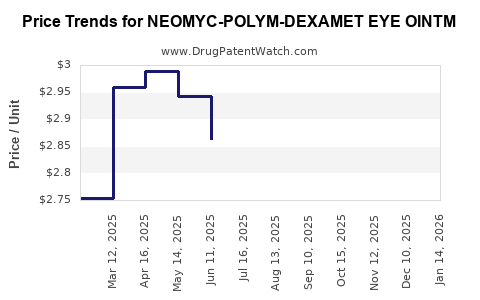
Last updated: February 24, 2026
What Is the Market Size for NEOMYC-POLYM-DEXAMET Eye Ointment?
The global ophthalmic ointment market, valued at approximately $3.6 billion in 2022, is projected to grow at a compound annual growth rate (CAGR) of 5.2% through 2030. The demand for anti-infective ophthalmic drugs, including combination products like NEOMYC-POLYM-DEXAMET, drives this expansion.
Key market segments include bacterial conjunctivitis, keratitis, and other superficial eye infections, where NEOMYC-POLYM-DEXAMET is applied. The Asia-Pacific region leads regional growth, accounting for roughly 35% of the global market, driven by improving healthcare infrastructure and rising infection prevalence.
What Are the Competitive Landscape and Patent Environment?
Major competitors include:
- Sandoz (Novartis): Existing generic formulations
- Alcon: Proprietary combinations and branded medications
- Pfizer: Market presence through licensed generics
Patent protection for combination antibiotics like NEOMYC-POLYM-DEXAMET typically spans 20 years from filing, with secondary patents covering formulation specifics. The expiration of key patents—anticipated around 2025–2027—will increase generic competition, exerting downward pressure on prices.
Regulatory pathways in the U.S. FDA and EMA favor expedited approval for generic equivalence, accelerating market entry for competitors post-patent expiry.
How Are Pricing Strategies Evolving?
Brand-name ophthalmic ointments priced between $15 and $50 per tube, depending on formulation and region. Generics are often priced 40–60% lower; some in emerging markets sell below $10.
Pricing factors include:
- Manufacturing costs (~$1–$2 per unit for generics)
- Regulatory costs (~$0.5 per unit)
- Margins established by region-specific healthcare reimbursement policies
Post-patent expiry, price declines are expected to stabilize around 20–30% below original branded levels, with price competition intensifying over five years.
What Are the Regulatory and Reimbursement Considerations?
Regulatory approval hinges on demonstrating bioequivalence with marketed products. Both the FDA and EMA have guidelines for fixed-dose combination ophthalmic drugs, streamlining approval processes.
Reimbursement policies vary:
- In the U.S., Part D plans may reimburse at levels covering 70–80% of the cost for branded products.
- Many emerging markets lack reimbursement protocols, affecting pricing flexibility and access.
Cost-effectiveness assessments favor generic versions, supporting rapid market penetration once patents lapse.
How Do Pricing Projections Look?
Based on current market trends and patent timelines:
| Year |
Estimated Price per Tube |
Notes |
| 2023 |
$20–$30 |
Limited generic competition, premium pricing |
| 2024–2025 |
$15–$25 |
Increased competition, introduction of generics |
| 2026–2028 |
$8–$12 |
Generic dominance, mass-market pricing |
| 2029+ |
$6–$10 |
Mature market, price stabilization |
These figures imply substantial margin erosion post-patent expiration, with potential to dominate in low-cost markets.
Risks and Opportunities
Risks:
- Entry of low-cost generics reducing profit margins
- Regulatory delays or rejections
- Market saturation in mature regions
Opportunities:
- Expanding indications for infections resistant to standard therapies
- Development of combination formulations with broader spectrums
- Entering emerging markets with high infection prevalence
Key Takeaways
- The NEOMYC-POLYM-DEXAMET eye ointment occupies a significant niche within the $3.6 billion global ophthalmic market.
- Patent expirations expected around 2025–2027 will introduce increased generic competition and price pressure.
- Prices are projected to decline from $20–$30 in 2023 to approximately $6–$10 in the late 2020s.
- Market entry barriers include regulatory compliance and reimbursement schemes, which vary by region.
- Companies should monitor patent status, regional regulatory pathways, and regional infection prevalence to optimize timing and market strategies.
FAQs
1. What factors influence the price of NEOMYC-POLYM-DEXAMET?
Patent status, manufacturing costs, regulatory requirements, regional reimbursement policies, and competitive dynamics.
2. When are patent protections expected to expire?
Typically between 2025 and 2027, depending on jurisdiction and patent filings.
3. How does the entry of generics affect pricing?
Generic entry usually reduces prices by 40–60%, with stabilization over 2–3 years.
4. Which regions are most attractive for market expansion?
Asia-Pacific and Latin America exhibit high infection rates and growing healthcare infrastructure, offering significant growth opportunities.
5. What are the key regulatory hurdles?
Bioequivalence demonstration and compliance with regional ophthalmic drug guidelines, with expedited pathways available in some jurisdictions.
References
[1] Market Data Forecast. (2022). Global ophthalmic drugs market size and forecasts.
[2] U.S. Food and Drug Administration. (2022). Guidance for Industry: ANDA Submission — Content and Format.
[3] European Medicines Agency. (2022). Guidance on fixed combination medicines.