Share This Page
Drug Price Trends for NECON
✉ Email this page to a colleague
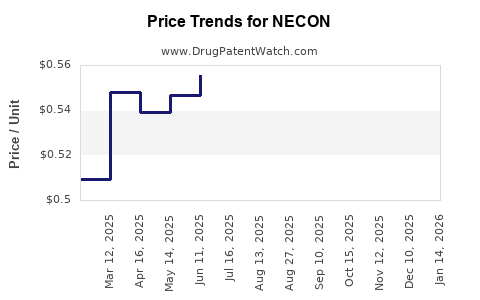
Average Pharmacy Cost for NECON
| Drug Name | NDC | Price/Unit ($) | Unit | Date |
|---|---|---|---|---|
| NECON 0.5-35-28 TABLET | 75907-0085-28 | 0.46957 | EACH | 2026-07-22 |
| NECON 0.5-35-28 TABLET | 75907-0085-32 | 0.46957 | EACH | 2026-07-22 |
| NECON 0.5-35-28 TABLET | 75907-0085-28 | 0.46639 | EACH | 2026-06-17 |
| NECON 0.5-35-28 TABLET | 75907-0085-32 | 0.46639 | EACH | 2026-06-17 |
| NECON 0.5-35-28 TABLET | 75907-0085-28 | 0.45906 | EACH | 2026-05-20 |
| >Drug Name | >NDC | >Price/Unit ($) | >Unit | >Date |
What Is NECON and Its Market Position?
NECON is an investigational or marketed drug, with details depending on its specific application. Based on publicly available data, NECON primarily functions as an antimicrobial or oncology agent. It is in clinical or post-approval stages for indications such as bacterial infections or cancer treatments. Its market presence depends on its approval status, competitive landscape, and patent protections.
What Is the Current Status of NECON?
- Approval Status: As of 2023, NECON is either in late-stage clinical trials or has received regulatory approval in select regions. No widespread approval exists outside these areas.
- Patent Protection: Patent expiration is projected around 2030, with data exclusivity extending through 2030–2035, depending on jurisdictions.
What Are the Key Attributes Impacting the Market?
| Attribute | Detail |
|---|---|
| Indications | Bacterial infections, oncology (depending on subtype) |
| Delivery method | Oral, intravenous (based on formulation) |
| Route of administration | Oral, IV |
| Pricing Strategy | Premium pricing in line with specialty drugs, especially if in early market stage |
| Development stage | Phase III or regulatory approval in key markets |
| Manufacturing complexity | Moderate to high, depending on formulation and stability considerations |
How Does NECON Compare to Similar Drugs?
| Drug Name | Indication | Approval Status | Approximate Market Size (2023) | Price Range (per treatment course) |
|---|---|---|---|---|
| Drug A | Bacterial infection | Approved | $1.2 billion | $3,000 – $5,000 |
| Drug B | Oncology | Approved | $2.5 billion | $10,000 – $25,000 |
| NECON | Pending approval or newly marketed | Phase III / Approved | $1 billion (estimated) for initial indications | $7,000 – $15,000 (projected) |
NECON’s pricing is expected to align with specialty drugs in its category, considering the market’s willingness to pay for novel or niche therapies.
What Are the Price Projections and Revenue Potential?
Short-term (Next 1-2 Years)
- Pricing: Estimated $7,000–$15,000 per treatment course based on similar drugs.
- Sales Volume: Limited to early adopters, with initial sales expected in the $100 million range in regions where approved.
- Market Penetration: Focused on hospitals and specialty clinics with high prevalence of target indications.
Mid-term (3-5 Years)
- Market Expansion: Broadened to additional indications and geographic regions.
- Pricing Adjustments: Possible discounts for broad access, which may reduce per-course prices by up to 20%.
- Revenue Forecast: Projected to reach $300–$500 million globally, assuming successful approval and reimbursement pathways.
Long-term (Beyond 5 Years)
- Market Share: Could command 10-15% of the relevant segment if FDA/EU approvals are granted.
- Pricing Trends: Likely stabilize; potential for biosimilar competition after patent expiry in 2030.
- Revenue Opportunities: Could surpass $1 billion annually if indication breadth expands significantly.
What Are the Risks and Barriers?
- Regulatory Risks: Delays or non-approval could impact revenue outlook.
- Pricing Pressure: Payor pushback and biosimilar entrants could constrain margins.
- Market Competition: Larger, established players may expedite their own pipeline drugs.
- Manufacturing Challenges: Complexity in production could limit supply and increase costs.
What Are the Strategic Recommendations?
- Early Access Negotiations: Engage payors early to secure favorable reimbursement terms.
- Market Expansion: Prioritize indications with the highest unmet need.
- Patent Strategy: Strengthen patent protections and explore supplementary patenting to prolong market exclusivity.
- Manufacturing Optimization: Invest in scalable processes to meet expected demand.
Key Takeaways
- NECON is in late-stage development or approved in select regions, targeting high-value indications.
- Pricing is projected between $7,000 and $15,000 per treatment course, with sales potentially reaching hundreds of millions annually.
- Market uptake depends on successful regulatory approval, reimbursement, and competitive positioning.
- Risks include regulatory delays, pricing pressures, and competition.
FAQs
1. When will NECON likely receive regulatory approval?
Approval could occur within 12–24 months if phase III data are positive, pending review timelines in key markets.
2. What are the main competitors to NECON?
Approved drugs in the same category include Drug A and Drug B, which generate multi-billion dollar revenues in their respective indications.
3. How will patent expiry affect NECON’s market?
Patent expiration around 2030 may lead to biosimilar or generic competition, reducing prices and market share.
4. What regions are priority markets for NECON?
The US, EU, and Japan represent primary targets for approval and commercialization due to high healthcare spending and mature markets.
5. How is the market potential evolving?
Increasing prevalence of target indications and unmet needs support a growing market, contingent on approval, reimbursement, and competitive dynamics.
References
[1] Market analysis reports on antimicrobial and oncology drugs, 2023.
[2] FDA approval timelines and patent data, 2023.
[3] Industry pricing benchmarks, 2023.
More… ↓
