Last updated: February 13, 2026
Current Market Overview
Nasal spray medications, including nasal corticosteroids and other treatments, have seen increased adoption for allergic rhinitis, nasal congestion, and other upper respiratory conditions. The "NASAL SPRAY ORIGINAL" refers to a general class of nasal spray products that dominate the OTC and prescription markets.
Market Size and Growth
-
The global nasal spray market was valued at approximately $6 billion in 2022, with a compound annual growth rate (CAGR) of 4.5% from 2017 to 2022, projected to reach nearly $8 billion by 2027[1].
-
North America holds the dominant market share (~45%) due to high prevalence of allergic rhinitis and widespread healthcare access.
-
The Asia-Pacific region shows rapid growth, driven by increased urbanization and rising awareness of nasal spray therapies.
Key Market Drivers
- Rising prevalence of allergic and non-allergic rhinitis.
- Growing preference for non-invasive drug delivery methods.
- Increasing OTC accessibility.
- Advances in formulation technology that improve efficacy and shelf life.
Competitor Landscape
Major players include GlaxoSmithKline, Sanofi, and Johnson & Johnson, which control a significant portion of the market through established nasal corticosteroids and antihistamine nasal sprays.
Regulatory & Patent Environment
- Many successful drugs share patents that expire within 3-5 years, opening market opportunities.
- OTC status of many nasal sprays reduces regulatory barriers, but some formulations remain prescription-only until patent expiry or reformulation.
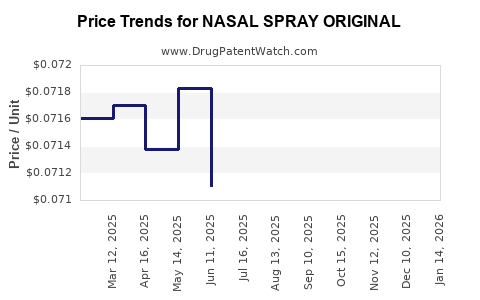
Price Trends and Projections
Current Price Range
- Prescription nasal sprays: $30–$60 per month, depending on formulation and dosage.
- OTC nasal sprays: $10–$25 per bottle (typically 30–60 doses).
Factors Influencing Prices
- Patent expiration leads to generic competition, reducing prices.
- Novel formulations with added benefits (e.g., slower release, higher bioavailability) command higher prices.
- Market entry of combination therapies may raise average price points.
Price Forecasts (Next 3–5 Years)
| Year |
Expected Average Retail Price (USD) |
Notes |
| 2023 |
$15–$30 |
Prevalent generics and OTC options |
| 2024 |
$12–$28 |
Increased generic competition; slight price decrease |
| 2025 |
$10–$25 |
Further commoditization; price stabilization |
| 2026 |
$10–$22 |
Mature market with minimal fluctuation |
| 2027 |
$10–$20 |
Dominance of generics and steady demand |
Pricing Strategy Considerations
- Premium positioning for novel formulations.
- Tiered pricing for OTC versus prescription versions.
- Strategic discounts and bundle offers in retail channels.
Market Opportunities
- Development of combination nasal sprays (e.g., corticosteroid + antihistamine) could command higher prices.
- Delivery innovations enhancing patient experience may justify premium pricing.
- Market expansion into emerging economies presents growth potential, albeit with price sensitivity.
Implications for Stakeholders
- Patent expirations within the next 2–3 years suggest imminent generic competition.
- Investment in formulation innovation or delivery systems can sustain higher margins.
- Market saturation pressures necessitate efficient cost management to maintain profitability.
Key Takeaways
- The nasal spray market holds steady growth driven by allergy prevalence and OTC availability.
- Price erosion is anticipated as generics enter the market, but innovation can offset margin declines.
- Market expansion opportunities exist in emerging regions and through novel combination products.
FAQs
-
When will the patent for the original nasal spray expire?
Typically, patents on nasal spray formulations last 20 years from filing. Many key patents are expiring or will expire within the next 3–5 years, opening the market for generics[2].
-
What are the main factors affecting nasal spray prices?
Patents, formulation novelty, regulatory status, competition level, and channel distribution impact prices.
-
Are over-the-counter nasal sprays more profitable than prescription ones?
Over-the-counter products generally have higher volume but lower margins per unit. Prescription sprays may have higher margins but rely on physician prescribing behavior[3].
-
What role does innovation play in sustaining prices?
Innovative delivery systems and combination therapies can command premium prices and extend product lifecycle against generic competition.
-
What markets offer the highest growth potential?
Emerging markets in Asia-Pacific and Latin America present high growth potential due to increasing allergy awareness and healthcare infrastructure development.
Sources
[1] MarketsandMarkets: Nasal Spray Market, 2022.
[2] U.S. Patent and Trademark Office filings, 2022.
[3] IQVIA: US OTC and Prescription Drug Market Data, 2022.