Share This Page
Drug Price Trends for NARATRIPTAN
✉ Email this page to a colleague
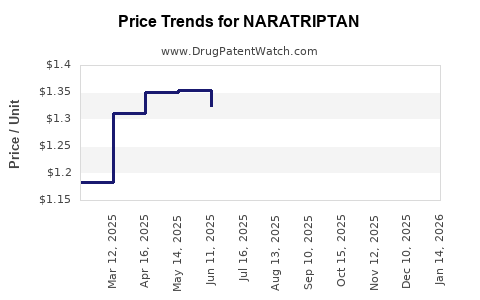
Average Pharmacy Cost for NARATRIPTAN
| Drug Name | NDC | Price/Unit ($) | Unit | Date |
|---|---|---|---|---|
| NARATRIPTAN HCL 1 MG TABLET | 00054-0278-03 | 1.75776 | EACH | 2026-06-17 |
| NARATRIPTAN HCL 2.5 MG TABLET | 00054-0279-03 | 1.11470 | EACH | 2026-06-17 |
| NARATRIPTAN HCL 1 MG TABLET | 23155-0054-19 | 1.75776 | EACH | 2026-06-17 |
| NARATRIPTAN HCL 2.5 MG TABLET | 23155-0055-19 | 1.11470 | EACH | 2026-06-17 |
| NARATRIPTAN HCL 2.5 MG TABLET | 69452-0341-60 | 1.11470 | EACH | 2026-06-17 |
| NARATRIPTAN HCL 2.5 MG TABLET | 69452-0341-72 | 1.11470 | EACH | 2026-06-17 |
| NARATRIPTAN HCL 1 MG TABLET | 23155-0054-19 | 1.52742 | EACH | 2026-05-20 |
| >Drug Name | >NDC | >Price/Unit ($) | >Unit | >Date |
Best Wholesale Price for NARATRIPTAN
| Drug Name | Vendor | NDC | Count | Price ($) | Price/Unit ($) | Unit | Dates | Price Type |
|---|---|---|---|---|---|---|---|---|
| NARATRIPTAN HCL 2.5MG TAB,UD | Golden State Medical Supply, Inc. | 00054-0279-03 | 9 | 97.50 | 10.83333 | EACH | 2023-06-15 - 2028-06-14 | FSS |
| NARATRIPTAN HCL 2.5MG TAB,UD | Golden State Medical Supply, Inc. | 00054-0279-03 | 9 | 97.57 | 10.84111 | EACH | 2023-06-23 - 2028-06-14 | FSS |
| NARATRIPTAN HCL 1MG TAB,UD | Golden State Medical Supply, Inc. | 00054-0278-03 | 9 | 97.50 | 10.83333 | EACH | 2023-06-15 - 2028-06-14 | FSS |
| NARATRIPTAN HCL 1MG TAB,UD | Golden State Medical Supply, Inc. | 00054-0278-03 | 9 | 97.57 | 10.84111 | EACH | 2023-06-23 - 2028-06-14 | FSS |
| AMERGE 2.5MG TABLETS | GlaxoSmithKline | 00173-0562-00 | 9 | 374.24 | 41.58222 | EACH | 2022-08-01 - 2027-07-31 | Big4 |
| AMERGE 2.5MG TABLETS | GlaxoSmithKline | 00173-0562-00 | 9 | 379.98 | 42.22000 | EACH | 2022-08-01 - 2027-07-31 | FSS |
| AMERGE 2.5MG TABLETS | GlaxoSmithKline | 00173-0562-00 | 9 | 371.60 | 41.28889 | EACH | 2023-01-01 - 2027-07-31 | Big4 |
| >Drug Name | >Vendor | >NDC | >Count | >Price ($) | >Price/Unit ($) | >Unit | >Dates | >Price Type |
Naratriptan Market Analysis and Price Projections: A Comprehensive Overview
The global pharmaceutical market is constantly evolving, with new drugs and treatments emerging to address various health conditions. One such medication that has gained significant attention in recent years is Naratriptan, primarily used for the treatment of migraines. This article delves into the market analysis and price projections for Naratriptan, providing valuable insights for industry professionals, healthcare providers, and investors.
Understanding Naratriptan
Naratriptan, also known by its brand name Amerge, is a medication belonging to the triptan class of drugs. It is specifically designed to treat acute migraine attacks in adults. Naratriptan works by narrowing blood vessels in the brain and blocking pain signals, providing relief from migraine symptoms.
Mechanism of Action
Naratriptan acts as a selective serotonin receptor agonist, primarily targeting the 5-HT1B and 5-HT1D receptors. This mechanism helps to:
- Constrict dilated blood vessels in the brain
- Inhibit the release of pro-inflammatory neuropeptides
- Reduce pain signal transmission in the trigeminal system
Dosage and Administration
Naratriptan is typically available in tablet form, with dosages of 1 mg and 2.5 mg. The recommended starting dose is 2.5 mg, taken orally with or without food. Patients are advised not to exceed 5 mg in a 24-hour period.
Global Market Overview
The global Naratriptan Hydrochloride market has been experiencing steady growth in recent years, driven by factors such as increasing prevalence of migraines, growing awareness about treatment options, and advancements in drug delivery systems.
According to a recent market report, the global Naratriptan Hydrochloride market size was valued at approximately USD 1.2 billion in 2023 and is projected to reach around USD 2.3 billion by 2032[10].
Market Segmentation
The Naratriptan market can be segmented based on various factors:
-
Type:
- Less than 98% purity
- 98% to 99% purity
- More than 99% purity
-
Application:
- Biopharmaceutical
- Laboratory
- Others
-
Geographical Regions:
- North America
- Europe
- Asia-Pacific
- South America
- Middle East and Africa
Current Market Trends
Several trends are shaping the Naratriptan market landscape:
1. Generic Competition
With the patent expiration of brand-name Naratriptan (Amerge), generic versions have entered the market, leading to increased competition and potentially lower prices for consumers.
2. Focus on Combination Therapies
Pharmaceutical companies are exploring combination therapies that include Naratriptan along with other migraine medications to enhance efficacy and reduce side effects.
3. Advancements in Drug Delivery Systems
Research is ongoing to develop novel drug delivery systems for Naratriptan, such as nasal sprays or transdermal patches, to improve bioavailability and patient compliance.
4. Increasing Prevalence of Migraines
The rising incidence of migraines globally is driving the demand for effective treatments like Naratriptan.
Price Analysis
Understanding the pricing dynamics of Naratriptan is crucial for both healthcare providers and patients. Let's examine the current pricing landscape:
Retail Prices
As of 2025, the average retail price for Naratriptan varies depending on the dosage and quantity:
- For a supply of 9 tablets (2.5 mg), the cost is approximately $63[2].
- The price for 1 mg tablets (9-count) is slightly higher at around $66.51[2].
It's important to note that these prices can fluctuate based on factors such as pharmacy location, insurance coverage, and available discounts.
Generic vs. Brand-Name Pricing
With the introduction of generic versions, there has been a significant impact on pricing:
- Generic Naratriptan is generally priced 30-80% lower than the brand-name version.
- Some pharmacies offer generic Naratriptan for as low as $18.13 with discount coupons[8].
Factors Influencing Pricing
Several factors contribute to the pricing of Naratriptan:
- Manufacturing costs: Including raw materials, production processes, and quality control measures.
- Research and development expenses: Ongoing studies for new formulations or applications.
- Marketing and distribution costs: Promoting the drug to healthcare providers and managing supply chains.
- Regulatory compliance: Meeting stringent FDA and other regulatory requirements.
- Competition: Presence of other triptans and migraine medications in the market.
Market Projections
The future of the Naratriptan market looks promising, with several factors contributing to its growth potential:
Projected Market Size
Experts predict significant growth in the Naratriptan market over the coming years:
The global Migraine Therapeutics Market is expected to reach USD 6.58 billion in 2025 and grow at a CAGR of 6.84% to reach USD 9.16 billion by 2030[3].
While this projection encompasses the entire migraine therapeutics market, Naratriptan is expected to maintain a substantial share within this growing sector.
Regional Growth Prospects
Different regions are expected to contribute variably to the market growth:
- North America: Likely to maintain its dominant position due to high prevalence of migraines and advanced healthcare infrastructure.
- Europe: Expected to show steady growth, driven by increasing awareness and healthcare expenditure.
- Asia-Pacific: Projected to be the fastest-growing region, attributed to improving healthcare access and rising disposable incomes.
Factors Driving Future Growth
Several factors are expected to fuel the growth of the Naratriptan market:
- Increasing migraine prevalence: The rising incidence of migraines globally will drive demand for effective treatments.
- Technological advancements: Innovations in drug delivery systems and formulations could enhance the efficacy and appeal of Naratriptan.
- Growing healthcare expenditure: As countries invest more in healthcare, access to migraine treatments is likely to improve.
- Rising awareness: Increased public awareness about migraines and available treatments will drive market growth.
Competitive Landscape
The Naratriptan market is characterized by intense competition among key players:
Major Market Players
- GlaxoSmithKline (original developer of Amerge)
- Teva Pharmaceutical Industries
- Mylan (now part of Viatris)
- Sun Pharmaceutical Industries
- Glenmark Pharmaceuticals
Strategies for Market Dominance
Companies are employing various strategies to maintain or increase their market share:
- Product differentiation: Developing new formulations or combination therapies.
- Geographic expansion: Entering new markets, particularly in emerging economies.
- Strategic partnerships: Collaborating with research institutions or other pharmaceutical companies.
- Price competitiveness: Offering competitive pricing, especially for generic versions.
Challenges and Opportunities
The Naratriptan market faces both challenges and opportunities that will shape its future:
Challenges
- Patent expirations: Leading to increased generic competition and potential price erosion.
- Regulatory hurdles: Stringent approval processes for new formulations or indications.
- Side effects: Managing and mitigating potential side effects associated with Naratriptan use.
Opportunities
- Emerging markets: Untapped potential in developing countries with growing healthcare sectors.
- Novel drug delivery systems: Developing innovative methods for administering Naratriptan.
- Combination therapies: Exploring synergistic effects with other migraine medications.
- Personalized medicine: Tailoring treatments based on individual patient profiles.
Future Price Projections
Predicting future prices for Naratriptan involves considering various factors:
Short-term Projections (1-3 years)
- Prices are likely to remain relatively stable or show a slight decrease due to generic competition.
- Potential for price fluctuations based on raw material costs and manufacturing expenses.
Long-term Projections (5-10 years)
- Prices may stabilize at a lower point as the market matures and competition intensifies.
- Introduction of new formulations or delivery systems could create premium-priced segments.
Factors Influencing Future Pricing
- Generic penetration: Increased availability of generic versions could drive overall prices down.
- Healthcare policies: Changes in reimbursement policies or drug pricing regulations.
- Technological advancements: New manufacturing processes could potentially reduce production costs.
- Market demand: Fluctuations in migraine prevalence and treatment seeking behavior.
Impact of CGRP Antagonists
The introduction of Calcitonin Gene-Related Peptide (CGRP) antagonists has significantly impacted the migraine treatment landscape, including the market for triptans like Naratriptan:
Market Disruption
CGRP antagonists, including monoclonal antibodies and gepants, have shown promising results in both acute and preventive migraine treatment:
The migraine market across the 7MM is poised to grow at a compound annual growth rate (CAGR) of 6.0% from $9.2bn in 2023 to $16.4bn in 2033, primarily driven by increased prescription of CGRP antagonists[5].
This growth in CGRP antagonists could potentially impact the market share of triptans, including Naratriptan.
Comparative Efficacy and Safety
Studies have shown that while CGRP antagonists may have fewer side effects, triptans still demonstrate higher efficacy in some cases:
As per the study titled "Comparison of New Pharmacologic Agents With Triptans for Treatment of Migraine" published in JAMA Network in October 2020, ditans and gepants were associated with less efficacy compared with triptans, whereas gepants were associated with fewer adverse events compared with triptans[3].
This suggests that triptans like Naratriptan may continue to play a crucial role in migraine treatment, particularly for patients who respond well to this class of drugs.
Regulatory Environment
The regulatory landscape plays a crucial role in shaping the Naratriptan market:
FDA Regulations
In the United States, the Food and Drug Administration (FDA) oversees the approval and regulation of migraine medications, including Naratriptan:
- ANDA Approvals: The FDA has approved several Abbreviated New Drug Applications (ANDAs) for generic versions of Naratriptan, increasing market competition.
- Safety Monitoring: Ongoing pharmacovigilance to monitor and assess the safety profile of Naratriptan in real-world use.
International Regulations
Different countries have varying regulatory frameworks for migraine medications:
- European Medicines Agency (EMA): Oversees approval and monitoring of Naratriptan in the European Union.
- Japan's Pharmaceuticals and Medical Devices Agency (PMDA): Regulates the use and distribution of Naratriptan in Japan.
Impact on Pricing and Availability
Regulatory decisions can significantly impact the pricing and availability of Naratriptan:
- Price Controls: Some countries implement price controls on prescription medications, affecting the market dynamics for Naratriptan.
- Reimbursement Policies: Healthcare systems' decisions on reimbursement can influence the accessibility and affordability of Naratriptan for patients.
Patient Access and Affordability
Ensuring patient access to Naratriptan while maintaining affordability is a key consideration in the market:
Insurance Coverage
The extent of insurance coverage for Naratriptan varies:
- Private Insurance: Many private insurance plans cover Naratriptan, often with copayments or coinsurance.
- Medicare and Medicaid: Coverage under these programs can vary by state and specific plan.
Patient Assistance Programs
Pharmaceutical companies and non-profit organizations often offer patient assistance programs to improve access to Naratriptan:
- Manufacturer Coupons: Some companies provide discount coupons to reduce out-of-pocket costs for patients.
- Non-Profit Assistance: Organizations like the Patient Access Network Foundation may offer financial assistance for eligible patients.
Generic Availability
The introduction of generic versions has significantly improved affordability:
Get naratriptan for as low as $18.00, which is 88% off the average retail price of $156.15 for the most common version, by using a GoodRx coupon[8].
This dramatic price reduction highlights the impact of generic competition on patient affordability.
Research and Development Pipeline
Ongoing research and development efforts continue to shape the future of Naratriptan and the broader migraine treatment landscape:
New Formulations
Researchers are exploring novel formulations of Naratriptan to enhance its efficacy and reduce side effects:
- Extended-Release Formulations: To provide longer-lasting relief from migraine symptoms.
- Nasal Sprays: For faster onset of action and potentially improved bioavailability.
Combination Therapies
Studies are underway to evaluate the efficacy of combining Naratriptan with other medications:
- Naratriptan + NSAIDs: Investigating potential synergistic effects for enhanced pain relief.
- Naratriptan + Antiemetics: To address both pain and nausea associated with migraines.
Personalized Medicine Approaches
Researchers are exploring ways to tailor migraine treatments, including Naratriptan, to individual patient profiles:
- Genetic Markers: Identifying genetic factors that may predict response to Naratriptan.
- Biomarker Studies: Investigating biological markers that could guide treatment selection and dosing.
Key Takeaways
- The global Naratriptan market is projected to grow significantly, reaching USD 2.3 billion by 2032.
- Generic competition has led to increased affordability, with prices as low as $18 for some formulations.
- CGRP antagonists are disrupting the migraine treatment landscape but triptans like Naratriptan maintain their relevance due to proven efficacy.
- Regulatory environments play a crucial role in shaping market dynamics and patient access.
- Ongoing research focuses on new formulations, combination therapies, and personalized medicine approaches for Naratriptan.
- Patient assistance programs and generic availability are improving access and affordability.
- The future of Naratriptan will likely involve balancing efficacy, safety, and cost-effectiveness in an increasingly competitive market.
FAQs
-
Q: How does Naratriptan differ from other triptans? A: Naratriptan has a longer half-life compared to some other triptans, potentially providing longer-lasting relief. It also has a lower risk of side effects and drug interactions compared to some other triptans.
-
Q: Can Naratriptan be used for migraine prevention? A: No, Naratriptan is specifically approved for the acute treatment of migraine attacks. It is not indicated for preventive use.
-
Q: How might the introduction of CGRP antagonists affect the price of Naratriptan? A: While CGRP antagonists may put pressure on the triptan market, the established efficacy and lower cost of generic Naratriptan may help maintain its market position. However, increased competition could potentially lead to further price reductions.
-
Q: Are there any ongoing clinical trials involving Naratriptan? A: While specific ongoing trials for Naratriptan are limited, research continues in the broader field of migraine treatment, including studies on combination therapies and novel delivery methods that may involve Naratriptan.
-
Q: How does the cost-effectiveness of Naratriptan compare to newer migraine treatments? A: Studies have shown that triptans, including Naratriptan, remain cost-effective compared to newer treatments like CGRP antagonists, particularly when considering generic pricing. However, individual patient response and specific insurance coverage can affect overall cost-effectiveness.
Sources cited:
- [2]
- [3]
- [5]
- [8]
- [10]
More… ↓
