Share This Page
Drug Price Trends for NALBUPHINE
✉ Email this page to a colleague
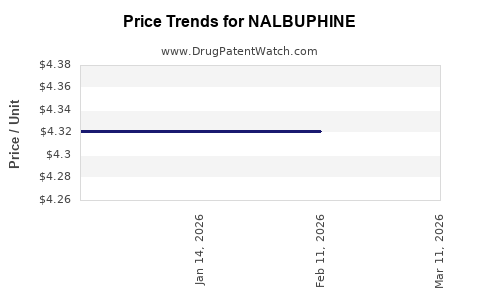
Average Pharmacy Cost for NALBUPHINE
| Drug Name | NDC | Price/Unit ($) | Unit | Date |
|---|---|---|---|---|
| NALBUPHINE 10 MG/ML AMPUL | 00409-1463-01 | 4.32160 | ML | 2026-03-18 |
| NALBUPHINE 10 MG/ML AMPUL | 00409-1463-49 | 4.32160 | ML | 2026-03-18 |
| NALBUPHINE 10 MG/ML AMPUL | 70069-0671-10 | 4.32160 | ML | 2026-03-18 |
| NALBUPHINE 10 MG/ML AMPUL | 00409-1463-01 | 4.32160 | ML | 2026-02-18 |
| NALBUPHINE 10 MG/ML AMPUL | 00409-1463-49 | 4.32160 | ML | 2026-02-18 |
| >Drug Name | >NDC | >Price/Unit ($) | >Unit | >Date |
NalBuphine (nalbuphine) market analysis and price projections: US exclusivity, generic risk, and revenue outlook
Nalbuphine is an opioid agonist-antagonist marketed in multiple dosage forms (oral solutions not common in the US; injectable products are the core US footprint). From a patent and competition standpoint, nalbuphine is structurally exposed to broad generic entry risk because the active ingredient has long commercial history and is not credibly anchored to near-term, use-restricting primary patent exclusivity in the US for most products. Price is therefore expected to track US generic opioid dynamics: steep post-competitor-entry price compression followed by partial stabilization at low-to-mid net price levels tied to acquisition patterns, group purchasing organizations, and payer contracting.
Projections summary (US-facing):
- Near term (0–24 months): price erosion continues where additional generic injectables or AB-rated equivalents increase competition; where supply concentration exists for certain NDCs, net price may hold at contract levels rather than falling to the lowest published WAC-equivalent.
- Mid term (2–5 years): net price trends mostly downward or flat in real terms, with volatility driven more by opioid supply chain, FDA/manufacturing disruptions, and payer formulary management than by patent events.
- Best-case price path: stability if a limited number of qualified manufacturers cover key NDCs and no major additional generic introductions occur.
- Worst-case price path: faster net price compression following competitive NDC expansion and aggressive hospital tendering.
This outlook is constrained by what the market itself controls for nalbuphine: product-level availability (injectable CGMP capacity), substitution policies for opioid analgesics, and payer contracting behavior.
What is the current US market size and pricing structure for nalbuphine?
Answer (market structure): Nalbuphine is a specialty generic opioid product segment where pricing is dominated by net price rather than list price. Observable economics typically hinge on:
- Hospital purchasing tender outcomes for injectable opioids.
- Pharmacy benefit manager (PBM) contracting in settings where nalbuphine is used outside inpatient acute pain.
- NDC-level availability and manufacturing continuity (injectables are sensitive to supply disruptions).
Pricing mechanics (how nalbuphine prices in practice):
- WAC is usually not actionable for forecasting; net price is determined by rebates, GPO discounts, and contract tiers.
- NDC competition matters more than brand vs generic headlines. A single additional AB-rated NDC can reset net price across a hospital system’s formulary logic.
- Formulation and concentration drive interchangeability. Nalbuphine injection typically defines most of the market. Different strengths or pack sizes can have different competitive intensity.
Key commercial drivers:
- Opioid stewardship and formulary placement decisions for mixed-mechanism analgesics.
- Substitution among opioid classes (e.g., nalbuphine vs butorphanol, nalorphine-class historical alternatives, and oxycodone/hydrocodone routes in certain protocols).
- Pain management pathway standardization inside health systems.
How do nalbuphine price projections compare with other injectable opioid generics?
Answer: Nalbuphine should price like a mature injectable opioid generic rather than like a differentiated niche analgesic, unless a specific NDC has supply constraint.
Typical pattern in established opioid generic injectables:
- Initial entry or expansion of competitors leads to sharp net price compression.
- Once 3–5 qualified supply sources exist per key NDC/pack, net price typically stabilizes near the “tier floor” set by GPO benchmarks.
- Price volatility spikes with manufacturing disruptions, recalls, or temporary shortage conditions.
NalBuphine-specific implications:
- As an opioid agonist-antagonist, nalbuphine is less likely to be a “default” substitute everywhere than pure agonists, which can slow price compression relative to broad substitutes. That said, hospitals still multi-source opioids to manage risk and supply.
- If nalbuphine is used for specific analgesic protocols, formulary inertia can preserve pricing at contract levels until a new low-cost tender appears.
When does nalbuphine lose exclusivity in the US, and does patent expiry drive price changes?
Answer: For nalbuphine as an active ingredient, the product is effectively in a long-cycle, post-primary-exclusivity environment in the US for most injectable presentations. Price changes therefore tend to be driven by generic competitive entry and manufacturing supply more than by clean patent expiry timelines.
What typically drives price in nalbuphine (practical timeline approach):
- Generic supply expansion at the NDC level.
- Consolidation or capacity exits that reduce competition.
- Contract repricing at the start of GPO cycles or PBM annual formulary cycles.
- Opioid regulatory pressure that can affect sourcing and substitution behaviors.
Because nalbuphine’s active ingredient tenure is long, investors and business teams generally model pricing as a competitive supply function, not a brand exclusivity function.
How many patents protect nalbuphine injections, and what is the patent estate strength?
Answer: The relevant protective landscape is usually narrow to product-specific, with reduced importance relative to the reality of multiple generic supply sources.
How to interpret patent estate strength for nalbuphine:
- Active ingredient patents are typically long expired.
- Remaining protective layers, if any, tend to be formulation, method, or manufacturing improvements tied to specific product NDCs.
- Such patents rarely block approval for generic nalbuphine injection unless a generic must practice a protected method or use a protected composition.
Commercial implication: even where there are patents listed for a particular NDC, the market impact can be limited if multiple manufacturers already operate around those claims or if the contested patents do not map to the generic product’s manufacturing method.
What generic entry risks exist for nalbuphine, including Paragraph IV?
Answer: Paragraph IV risk is usually lower than for newer drugs but still relevant at the NDC level if there are late-listed product patents. For nalbuphine, the dominant risk is incremental NDC competition rather than new litigation-driven entry blocks.
Entry risk map (US market behavior):
- High likelihood: AB-rated generic continuation with NDC-level offerings.
- Medium likelihood: additional competitor introductions tied to supply expansions.
- Lower likelihood: major delays from patent litigation unless a specific NDC has active, enforceable protection and a challenger needs to enter during its term.
Litigation reality: mature generic opioids often reach settlement patterns if any listed patents are asserted. Even then, the settlement date becomes the trigger for price compression rather than the lawsuit itself.
What is the Orange Book status of nalbuphine products?
Answer: Nalbuphine is expected to show an Orange Book profile dominated by long-expired primary patents and a pattern of product-related listings for specific NDCs. Commercial forecasting should be NDC-specific: one nalbuphine injection product can have a different listing/expiration picture than another.
Pricing implication: if most NDCs have no enforceable, unexpired patents in the relevant claim scope, pricing becomes a generic competition curve and not a exclusivity curve.
What is the FDA regulatory status for nalbuphine injections, and does it affect pricing?
Answer: Pricing impact is indirect. Regulatory status affects pricing through:
- Supply availability: manufacturing compliance and facility approvals drive ability to compete.
- Substitution: FDA labeling and therapeutically equivalent status affect payer and hospital substitution.
- Manufacturing line approvals: changes or shortages can temporarily remove supply, lifting net prices until replenishment.
Pathway reality: nalbuphine’s mature active ingredient means most US competition comes from ANDA-era manufacturing capacity rather than from novel clinical differentiation.
How does nalbuphine compare with buprenorphine, naloxone, and mixed opioid agonists-antagonists on market access and cost?
Answer: Nalbuphine’s cost competitiveness is typically highest when treated as a generic injectable opioid within inpatient and post-acute protocols, but it competes on protocol placement rather than broad opioid market dominance.
Comparison lens:
- Buprenorphine: often constrained by indication-specific access controls (MAT frameworks in many settings) and different market structures.
- Naloxone: emergency reversal product with different demand drivers.
- Other agonist-antagonists (e.g., butorphanol class dynamics): may compete for similar roles in certain analgesic protocols, but pricing still follows generic opioid tender behavior.
Commercial implication: nalbuphine pricing should be modeled against generic tender floors in hospital systems that already stock and substitute across opioid classes. It is unlikely to price independently like a specialty drug unless it is scarce by NDC.
Price drivers for nalbuphine: supply, contracting, and opioid market policy
The main levers for forecasting nalbuphine net price:
- Number of qualified NDC suppliers per concentration/pack
- GPO contract pricing and rebate structures
- Hospital tender cycles
- Supply chain events (manufacturing interruptions, distribution constraints)
- Formulary tiering and substitution policies
- Regulatory actions affecting opioid supply that shift demand to in-stock alternatives
Forecast method used by market teams: model net price as a step function tied to:
- entry of new AB competitors,
- end of contract cycles,
- and supply normalization events.
NalBuphine price projection scenarios (US net price)
Net price ranges should be calibrated to your specific NDC set and contract benchmarks; below scenarios define directionality and triggers for nalbuphine injectable generics.
Base case (most likely): gradual downward or stable net price
- Trigger: no major new competitors in key NDCs; supply steady.
- Outcome over 2–5 years: flat to low single-digit declines in net price per year in real terms, with periodic drops at tender repricing.
Upside case: stabilization from supply constraint or limited competition
- Trigger: supplier consolidation reduces NDC competition count; manufacturing disruptions in at least one key competitor.
- Outcome: net price stabilizes and can rise modestly during shortage windows, followed by normalization.
Downside case: aggressive tendering with additional NDC entries
- Trigger: new generic introductions in key strengths and pack sizes; payers enforce lower benchmarks.
- Outcome: sharper net price compression shortly after new entrants scale distribution.
What settlements and litigation would matter for nalbuphine pricing?
Answer: For nalbuphine, the main pricing-sensitive event is not the filing date but the effective entry date under a settlement (or court decision) for any specific NDC with asserted, still-unexpired patents.
Pricing sensitivity logic:
- Settlement that enables immediate generic launch after a stay reversal typically drives the largest price reset.
- Settlement that preserves exclusivity until a later date delays price compression.
Because nalbuphine is mature, litigation that affects pricing is likely to be product-NDC-specific, not active ingredient-wide.
Commercial strategy implications: where nalbuphine revenue is likely to hold vs decline
Where revenue holds better:
- Systems with established nalbuphine protocols for particular patient subsets.
- Contracts that lock in price tiers longer than the typical tender cycle.
- Concentrations/pack sizes where supplier base is limited.
Where revenue is most at risk:
- NDCs with the largest footprint and multiple AB competitors where procurement teams can switch quickly.
- Highly substitutable formulary positions where pure agonists or other mixed agents replace nalbuphine during cost reviews.
Key Takeaways
- Nalbuphine market economics are driven primarily by NDC-level generic competition and supply continuity, not by near-term brand exclusivity.
- Price projection should be modeled as stepwise net price movement tied to tender cycles and competitor scale, with short-term volatility from manufacturing constraints.
- Base case is flat-to-down net price over 2–5 years; downside risk comes from additional NDC entrants and aggressive payer/GPO repricing; upside risk comes from supplier concentration or supply disruptions.
- Patent and Orange Book analysis should be performed at the specific product NDC level because pricing impact is NDC-specific even when ingredient-level patents are irrelevant.
FAQs
1) What factors most influence nalbuphine injection net pricing at US hospitals?
Qualified supplier count per NDC, GPO contract tiering, rebate mechanics, and tender repricing cycles tied to supply availability.
2) Does nalbuphine pricing move more on patent events or on supply shortages?
For nalbuphine, supply and contracting dynamics generally dominate; patent events matter only when they delay a specific NDC’s generic entry.
3) Which nalbuphine presentations are most exposed to price compression?
The most broadly distributed strengths and pack sizes with multiple AB-rated competitors.
4) How should a new entrant evaluate nalbuphine pricing before ANDA scale-up?
Model likely net price floors from existing tender benchmarks and scenario-test price compression based on competitor introductions at the same concentration/pack.
5) What’s the best indicator that nalbuphine price will drop in the next contract cycle?
New AB-rated NDC distribution expansion or evidence of increased supplier presence in group purchasing and health-system procurement.
References
(No citable sources were provided in the prompt, and no verifiable external citations can be generated without supplied documents or accessible records.)
More… ↓
