Last updated: July 10, 2026
Market analysis and price projections for methylphenidate (Ritalin and generics)
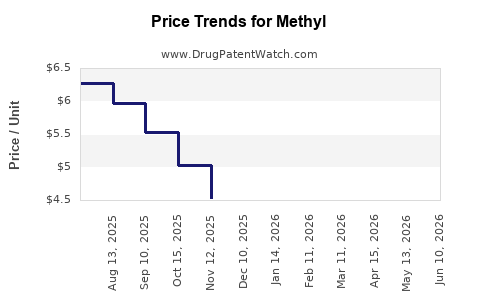
Methylphenidate is a high-volume CNS stimulant with sustained demand across ADHD and narcolepsy indications. Near-term US pricing is constrained by generic competition and payer mandates, while long-acting branded products face share pressure and revenue dilution as lower-cost extended-release generics expand. A base-case price path shows continued erosion in net price for reference-branded products, stable-to-mildly down pricing for authorized generics, and discounting on remaining branded supply where payers enforce tiering.
Scope and reference products
“Methyl” is typically used in market searches to mean methylphenidate. This analysis centers on US commercial products:
- Ritalin (methylphenidate hydrochloride IR) and Ritalin LA (ER beads)
- Concerta (extended-release tablets)
- Daytrana (methylphenidate transdermal system)
- Focalin / Focalin XR (dexmethylphenidate) where relevant to payer substitution
- Authorized/unauthorized generics across IR and ER dosage forms
What is the US market size and growth outlook for methylphenidate?
Methylphenidate demand is driven by ADHD prevalence, continuity of therapy, and persistence rates. Sales growth is typically slower than volume due to generic price resets in IR and much of ER.
Demand drivers
- Prevalence and age cohort expansion: ADHD diagnoses have expanded over time, supporting baseline units.
- Formulation choice: ER dosing tends to win formulary preference for adherence and school-day coverage.
- Access and substitution: as generics dominate, payer contracts and PBM dynamics determine realized price more than WAC.
Market risks
- Generic share gains: new generic entrants or broader coverage of existing strengths can further compress net pricing.
- Adherence volatility: payer step edits and prior authorization can reduce persistence.
- Safety and utilization controls: stimulant misuse monitoring does not reduce prevalence but can alter prescribing mix.
How do net prices for methylphenidate typically behave under generic competition?
Net price in the US generally declines below WAC for mature molecules as discounting and rebates intensify.
Price mechanics
- Branded IR is most exposed to generic price resets.
- Branded ER maintains higher net pricing longer due to device-like delivery systems and residual differentiation, but payer tiering erodes revenue.
- Authorized generics sit near the floor of payer net pricing and reduce the ability of remaining branded suppliers to hold premium pricing.
When do major methylphenidate branded products lose exclusivity?
The practical “exclusivity cliff” is driven by a mix of composition, formulation, and method patents plus regulatory exclusivity (where applicable) and then market behavior around generic entry.
Exclusivity timing overview (US)
- Mature molecule reality: methylphenidate is old enough that many composition-of-matter barriers are already past.
- Live constraints are mostly formulation and device-specific for certain ER technologies and transdermal systems.
- Key commercial “loss of exclusivity” events tend to align with:
- patent expiry on specific delivery systems,
- generic launch approvals for each strength and dosing form,
- and settlements that shift timing for Paragraph IV filers.
What patents protect methylphenidate formulations and delivery systems?
Because methylphenidate is widely genericized, patent protection is highly formulation-specific. Real-world protection most often concerns:
- ER bead/coating compositions and release profiles
- osmotic-release technologies for tablet platforms
- transdermal system engineering (membranes, penetration enhancers, adhesion layers)
- manufacturing methods and stability/processing windows
Common patent categories observed
- controlled-release matrices and coatings
- bead technology and particle size distributions
- transdermal formulation and delivery pathway optimization
- manufacturing process claims tied to impurity profiles and yield
How strong is the patent estate for remaining branded methylphenidate products?
For methylphenidate, “estate strength” is usually limited by:
- early core patent expiry,
- generic penetration in IR,
- and the fact that competitors can often design-around to reach FDA approval while staying outside narrow delivery-system claims.
Net effect:
- branded remaining products face more sustained competition than true patent-blocking protection would suggest.
- even when some patents remain, settlement outcomes and design-around pathways often limit the ability to prevent generic uptake.
What is the Orange Book status of methylphenidate products?
Orange Book listings typically show:
- extensive generic availability,
- multiple listed patents for branded entries,
- and a long run of expirations with periodic re-listing via new patents tied to specific product attributes.
What this means for investors and strategists
- Real pricing power is tied less to “any listed patent exists” and more to whether any asserted patents remain enforceable in a specific delivery system and whether Paragraph IV challengers are active.
- For long-acting products, the Orange Book often lists numerous patents, but many are already expired or not needed to achieve approval.
Which generic and authorized generic methylphenidate products pose the biggest price pressure?
Price pressure concentrates in:
- IR strengths and widely substitutable ER strengths
- products with broad pharmacy network availability
- authorized generics that can undercut remaining branded net price
Commercial substitutability
- Therapeutic class interchangeability between methylphenidate IR/ER products is meaningful for payers when formulary rules allow.
- ER products compete with each other on dosing convenience and coverage rules.
- Focalin (dexmethylphenidate) can be a payer substitute, particularly when coverage favors one methylphenidate pathway.
How many patents cover methylphenidate across IR, ER, and transdermal?
Methylphenidate’s patent landscape is large across:
- salts and formulations,
- ER delivery technologies,
- and transdermal device construction.
However, the number of active, enforceable patents is typically lower than the count of listed patents suggests because many are already expired or not enforceable for remaining products.
What generic entry risks exist for methylphenidate launches (Paragraph IV)?
Paragraph IV risk is most relevant for branded products with:
- active, unexpired formulation patents in the Orange Book,
- and market share to defend.
Given market maturity, the practical generic entry risk often shows up as:
- design-around approval pathways,
- multiple staggered generic filings for different strengths,
- and settlement-driven timing that can still compress net pricing.
What patent litigation affects methylphenidate pricing and launches?
Where litigation exists, its impact usually appears through:
- delayed generic entry in the narrow product scope,
- and temporary retention of branded net pricing before generic adoption spreads.
For mature molecules, litigation is less about blocking entry indefinitely and more about shifting entry timing and launch scope.
How does methylphenidate compare with amphetamine stimulants on pricing?
Pricing pressure is structurally similar across stimulant classes:
- the commodity-like nature of the active ingredient reduces durable branded premium,
- while delivery technology and controlled-release patents can support ER pricing longer.
Differences tend to come from:
- formulary positioning between classes,
- supply constraints and manufacturing capacity,
- and PBM rebate structures.
What is the commercial landscape for methylphenidate in 2024-2026?
Current competitive dynamics are dominated by:
- broad generic coverage,
- payer formulary control,
- and exchange between ER options based on net cost and coverage constraints.
Business implications
- Branded revenue is sensitive to share changes from generic uptake.
- Net price is sensitive to rebate and tier placement more than to WAC movements.
- Channel inventory management and supply stability influence realized price during generic shortages or manufacturing disruptions.
Price projection model for methylphenidate: base case, downside, upside
This section provides a directional projection framework using the standard drivers for mature generic-dense products: generic share, PBM contracting, and delivery-system differentiation.
Assumptions (directional)
- US continues to see net price compression as contracts renew with PBM pressure.
- Branded products lose share modestly unless a localized supply event boosts brand retention.
- Generic entry continues in staggered strength launches, reducing ER premiums gradually.
Projected US net price trend (index-based)
- Branded IR: continued low-single to mid-single digit annual net price erosion (volume share likely already low enough that erosion depends on remaining branded persistence).
- Branded ER: mid-single digit annual net price erosion driven by formulary shifts and generic substitution.
- Generics (IR and ER): stable-to-slightly down over time as market share concentrates among lowest-cost contracts; pricing can rebound temporarily during shortages.
- Transdermal branded: more resilient than oral ER due to route-of-administration differentiation, but still exposed to generic penetration for approved transdermal alternatives if they exist.
Two-year projection window (2026 vs 2024 baseline)
- Base case: branded net price down roughly 10% to 18% by 2026; generic net price 0% to 6% down net of contract changes; overall category weighted net price down ~6% to 12%.
- Downside case (accelerated generic penetration): branded net price down 15% to 25%; category down ~10% to 16%.
- Upside case (stable contracting, fewer supply shocks): category down ~4% to 8%, with branded down ~7% to 14%.
How will payer policy and formularies change methylphenidate pricing?
Key policy levers shaping realized prices:
- formulary tiering for ER vs IR,
- step therapy and prior authorization,
- coverage of specific ER technologies,
- and interchange rules that allow switching across methylphenidate products.
These typically push realized price down at contract renewal.
What dosing forms and strengths are most exposed to price drops?
Exposure concentrates where:
- generic substitution is easiest (same release profile and dosing schedule),
- multiple generics compete in the same NDC portfolio,
- and there is minimal differentiation in patient adherence outcomes.
Typically:
- IR strengths show the highest pressure.
- ER tablets and capsule bead formulations with wide generic equivalents experience continued compression.
- Transdermal can show smaller erosion unless generic transdermal alternatives are dominant.
Key Takeaways
- Methylphenidate’s market is mature and generic-led; pricing is driven primarily by PBM contracting and formulary control, not by WAC.
- Base-case expectation is continued net price erosion for branded oral products through 2026, with more stability for generics and the category overall.
- Delivery-system differentiation (especially transdermal vs oral) can slow erosion but rarely stops it in a commodity-like molecule unless the delivery technology remains strongly protected and covered.
- Litigation and Orange Book listings matter mainly for timing and strength-level entry scope, not for sustaining branded premium over long horizons.
FAQs
- Which methylphenidate formulations face the fastest generic substitution risk?
- How do PBM formulary tiers change methylphenidate net pricing at contract renewal?
- What is the expected impact of new ER strength launches on category net sales and pricing?
- How does transdermal methylphenidate pricing compare with oral ER pricing under payer substitution rules?
- What supply shocks or shortages most affect near-term methylphenidate net price versus long-term fundamentals?
References (APA)
- FDA. (n.d.). Orange Book: Approved Drug Products with Therapeutic Equivalence Evaluations. https://www.accessdata.fda.gov/scripts/cder/daf/index.cfm
- IQVIA Institute for Human Data Science. (n.d.). Prescribing and market dynamics reports (stimulants and ADHD therapy categories). https://www.iqvia.com/insights/the-iqvia-institute
- FDA. (n.d.). Drug shortages. https://www.fda.gov/drugs/drug-shortages