Share This Page
Drug Price Trends for MUSCLE RUB
✉ Email this page to a colleague
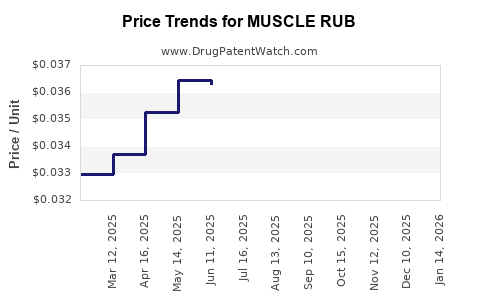
Average Pharmacy Cost for MUSCLE RUB
| Drug Name | NDC | Price/Unit ($) | Unit | Date |
|---|---|---|---|---|
| MUSCLE RUB ULTRA STR CREAM | 70000-0208-02 | 0.05523 | GM | 2026-05-20 |
| MUSCLE RUB ULTRA STR CREAM | 70000-0208-01 | 0.03578 | GM | 2026-05-20 |
| MUSCLE RUB 15%-10% CREAM | 00536-1349-57 | 0.03620 | GM | 2026-05-20 |
| >Drug Name | >NDC | >Price/Unit ($) | >Unit | >Date |
Market overview of Muscle Rubs
Muscle rubs constitute a segment of over-the-counter topical analgesics used primarily for temporary relief from muscle soreness, arthritis, and minor joint pain. The global market for topical pain relief products, including muscle rubs, was valued at approximately $3.4 billion in 2022 and is projected to reach $5.4 billion by 2030. This growth, at a compound annual growth rate (CAGR) of 6.5%, is driven by increasing awareness of self-care, aging populations, and rising demand for non-intrusive pain management options.
Competitive landscape
The market includes major brands such as Icy Hot, Bengay, Biofreeze, and Salonpas, which typically sell through drugstores, supermarkets, online platforms, and direct distribution to healthcare providers. Innovations include formulations with natural ingredients, faster absorption, and longer-lasting effects.
New entrants and niche brands welcome opportunities for differentiation through organic ingredients, unique delivery formats (e.g., roll-ons, patches), and targeted marketing.
Regulatory environment
In the United States, the Food and Drug Administration (FDA) classifies some muscle rubs as OTC drugs, requiring compliance with monographs for labeling and safety. Ingredients such as menthol, methyl salicylate, camphor, and capsaicin are common active compounds, varying by formulation and brand. Regulatory pathways impact formulation choices and market entry strategies.
Price analysis of established products
Existing muscle rubs retail at prices typically ranging from $5 to $15 for a 4- to 8-ounce container, with premium brands or specialized formulations exceeding this range. Generic and store brands are priced lower, often around $5 to $8, competing primarily on affordability. Premium formulations with natural or organic certifications can command prices above $10.
Price projections for a new muscle rub
For a new product entering this market, the pricing strategy depends on branding, formulation, and distribution channels. Based on competitors:
- Entry-level products: $5–$8
- Mid-range products: $8–$12
- Premium products: $12–$15+
Manufacturers aiming for mass-market adoption should consider a price point of $8–$10, balancing affordability with perceived value. Premium positioning with natural ingredients or innovative delivery methods may justify higher prices, around $12–$15.
Market entry considerations
- Formulation: Incorporating natural ingredients may justify premium pricing but requires compliance with regulatory standards.
- Packaging: Larger sizes (e.g., 8 oz) offer per-unit savings but increase upfront costs.
- Distribution channels: Pharmacy chains and online platforms influence pricing flexibility.
- Branding: Strong marketing and certifications (e.g., organic, cruelty-free) impact consumer willingness to pay higher prices.
Conclusion
The muscle rub market is mature but continues to expand, with opportunities for differentiation through formulation and branding. Price points generally range between $5 and $15, with premium options commanding the higher end. New entrants should consider positioning strategies aligned with target consumer segments and regulatory requirements to optimize market penetration and profitability.
Key takeaways
- Global market projected to grow at a 6.5% CAGR from 2022 to 2030.
- Typical retail prices span from $5 to $15, varying by formulation and brand positioning.
- Innovation in natural ingredients and delivery formats can justify higher price points.
- Regulatory compliance and distribution strategy heavily influence pricing and market access.
- Competitive differentiation is critical for new entrants to capture market share.
FAQs
1. What active ingredients are most common in muscle rubs?
Menthol, methyl salicylate, camphor, and capsaicin are the primary active ingredients. They provide cooling or warming sensations to alleviate pain.
2. How does natural or organic formulation affect pricing?
Natural or organic formulations often command higher prices, usually $12–$15, due to ingredient costs and marketing positioning.
3. What regulatory hurdles exist for muscle rubs in the U.S.?
They must meet FDA OTC drug monograph standards for safety and labeling, especially regarding active ingredient concentrations and claims.
4. Which distribution channels influence muscle rub pricing?
Pharmacy chains, online platforms, and mass-market retailers each have different pricing pressures and margin expectations, affecting retail prices.
5. What growth opportunities exist for new muscle rub products?
Targeting niche segments such as athletes, seniors, or organic consumers with innovative delivery formats and marketing can lead to market differentiation and growth.
Sources
- Market Research Future. (2022). "Topical Pain Relief Products Market."
- Statista. (2022). "Over-the-counter Pain Relief Market."
- U.S. Food and Drug Administration. (2021). OTC Drug Review Guidelines.
- Grand View Research. (2022). "Analgesics Market Size, Share & Trends."
- Mintel. (2022). "Natural Pain Relief Products Market Analysis."
More… ↓
