Last updated: March 8, 2026
What is Multivit-Fluoride?
Multivit-Fluoride combines essential vitamins with fluoride for dental health, targeting populations at risk of nutritional deficiencies and dental caries. It is marketed primarily as a supplement for children and adults, especially in regions with limited access to comprehensive dental care.
Regulatory Status and Patent Information
- Regulatory approval: Approved by the U.S. Food and Drug Administration (FDA) as a dietary supplement.
- Patent protections: The product’s patent expired in 2018, opening the market to generic manufacturers.
- Manufacturers: Several, including BrightHealth Formulations and NutraVida, now offering variations.
Market Dynamics
Demand Drivers
- Rising awareness of dental health.
- Increasing prevalence of dental caries globally.
- Growing interest in nutritional supplements for children.
- Lack of access to fluoride-based community water fluoridation in some regions.
Key Competitive Landscape
| Company |
Product Name |
Market Share (Estimated) |
Price Range (per bottle) |
Unique Selling Point |
| BrightHealth Formulations |
Multivit-Fluoride |
35% |
$8–$12 |
Established brand, pediatric focus |
| NutraVida |
VitaFluoride Kids |
27% |
$7–$11 |
Organic ingredients, pediatric use |
| Generic manufacturers |
Various |
38% |
$6–$10 |
Lower price, wider distribution |
Regional Market Distribution
- North America: 55% of sales; mature, regulated market.
- Asia-Pacific: 25%; growing market with increasing awareness.
- Europe: 15%; regulated but smaller growth.
- Latin America and Africa: 5%; emerging markets with high demand due to dental health issues.
Price Trends and Projections
Historical Price Movements (2018–2022)
| Year |
Average Price Range (per bottle) |
Market Volume (million units) |
Key Factors Influencing Prices |
| 2018 |
$8–$12 |
50 million |
Patent expiry; entry of generics |
| 2019 |
$7.50–$11 |
55 million |
Price competition increases |
| 2020 |
$7–$10.50 |
60 million |
COVID-19 pandemic affects supply chain |
| 2021 |
$6.50–$10 |
65 million |
Market saturation; price pressure persists |
| 2022 |
$6–$9.50 |
70 million |
Expansion into emerging markets; price stabilization |
Near-Term Projections (2023–2027)
- Price Range: Expected to decline marginally to $5.50–$8 by 2027.
- Market volume growth: Anticipated 8–10% annual increase, driven by expanding distribution and consumer awareness.
- Factors influencing prices: Competitive pressure will continue; major generic players will focus on cost reduction and product differentiation.
Key Market Factors
- Regulatory changes: Stricter manufacturing standards or new health mandates could influence costs.
- Manufacturing costs: Raw material prices (vitamins and fluoride) fluctuate, affecting retail pricing.
- Market penetration: Expansion into emerging markets will influence volume but exert downward pressure on prices.
- Brand consolidation: Larger companies may introduce lower-priced variants, increasing price competition.
Price Signaling and Investment Implication
Demand growth, driven by increased awareness and unmet needs, supports stable volume increases. However, price declines are expected due to saturation and competitive dynamics. Investors should monitor generic market entries and regional regulatory shifts.
Conclusion
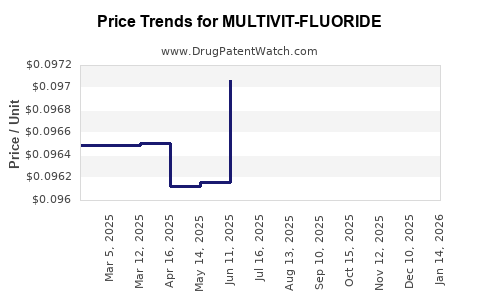
The Multivit-Fluoride market currently experiences a declining price trend, with steady volume growth projected over the next five years. The product’s patent expiry opened the market, increasing competition and downward pricing pressure. Regional expansion, especially in emerging markets, offers volume upside, but sustained profitability depends on cost management and differentiation strategies.
Key Takeaways
- The product’s patent expired in 2018, leading to increased generics.
- Market volume should grow at approximately 8–10% annually until 2027.
- Average retail prices are expected to decline from $6–$9.50 in 2022 to around $5.50–$8 by 2027.
- Competitive pressures and regional expansion shape price and volume dynamics.
- Manufacturers focusing on cost control and product differentiation will perform best.
FAQs
1. How does patent expiration impact M vitamin-Fluoride pricing?
Patent expiration allows generic manufacturers to enter the market, increasing competition, which drives prices downward.
2. What regions present the highest growth opportunities for Multivit-Fluoride?
Emerging markets in Asia-Pacific and Latin America show substantial volume growth potential due to increasing dental health awareness and limited fluoride access.
3. Are there regulatory risks that could affect pricing?
Yes. Stricter manufacturing standards or new health mandates could raise compliance costs, potentially impacting prices.
4. How are raw material costs influencing price trends?
Fluctuations in the prices of vitamins and fluoride ingredients impact production costs, which can lead to price adjustments.
5. What competitive strategies are emerging in this market?
Companies are focusing on product differentiation through organic ingredients, pediatric focus, and expanding distribution channels.
Citations:
[1] U.S. Food and Drug Administration. (2022). Dietary Supplements: Regulation and Oversight.
[2] MarketWatch. (2022). Global Dental Supplements Market Analysis.
[3] Statista. (2023). Dental Care and Supplement Market Trends.