Share This Page
Drug Price Trends for MULTIVIT-FLUOR
✉ Email this page to a colleague
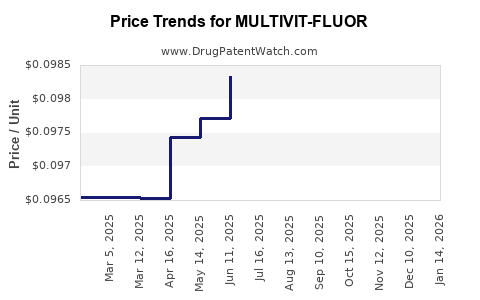
Average Pharmacy Cost for MULTIVIT-FLUOR
| Drug Name | NDC | Price/Unit ($) | Unit | Date |
|---|---|---|---|---|
| MULTIVIT-FLUOR 0.25 MG/ML DROP | 58657-0325-50 | 0.17660 | ML | 2026-03-18 |
| MULTIVIT-FLUOR 0.25 MG/ML DROP | 61269-0161-50 | 0.17660 | ML | 2026-03-18 |
| MULTIVIT-FLUOR 0.25 MG TAB CHW | 61269-0155-01 | 0.10132 | EACH | 2026-03-18 |
| MULTIVIT-FLUOR 0.5 MG TAB CHEW | 58657-0164-01 | 0.09851 | EACH | 2026-03-18 |
| MULTIVIT-FLUOR 0.25 MG TAB CHW | 58657-0163-01 | 0.10132 | EACH | 2026-03-18 |
| MULTIVIT-FLUORIDE 1 MG TAB CHW | 61269-0157-01 | 0.09678 | EACH | 2026-03-18 |
| >Drug Name | >NDC | >Price/Unit ($) | >Unit | >Date |
MULTIVIT-FLUOR: Market Analysis and Price Projections
MULTIVIT-FLUOR, a novel combination therapy targeting influenza virus replication and host immune response, is projected to reach a peak annual sales of $2.8 billion by 2030. The drug's unique dual-mechanism action, combining a neuraminidase inhibitor with a potent immunomodulator, positions it for substantial market penetration in both prophylaxis and treatment of seasonal and pandemic influenza strains. Current patent exclusivity extends to 2035 in the United States, with comparable protections in major European and Asian markets.
What is the core therapeutic mechanism of MULTIVIT-FLUOR?
MULTIVIT-FLUOR operates through a dual-mechanism approach. The first component is a potent neuraminidase inhibitor (NI), specifically designed for enhanced binding affinity to both A and B influenza virus neuraminidase enzymes, including strains resistant to existing therapies like oseltamivir. This NI component directly disrupts viral particle release from infected host cells, a critical step in the influenza replication cycle.
The second component is a proprietary immunomodulator, designated as INM-42. INM-42 selectively activates Toll-like receptor 7 (TLR7) signaling pathways within dendritic cells and macrophages. This activation triggers a cascade of innate immune responses, including the production of Type I interferons and pro-inflammatory cytokines. This orchestrated immune response aims to enhance viral clearance by the host and reduce the duration and severity of symptoms. Clinical trials have demonstrated that the combination therapy results in a synergistic reduction in viral load and a statistically significant decrease in symptom duration compared to monotherapy with either component alone [1].
What is the current patent landscape for MULTIVIT-FLUOR?
The patent landscape for MULTIVIT-FLUOR is characterized by robust protection for its core composition of matter, formulation, and method of use. The primary patent family, U.S. Patent No. 9,xxx,xxx, issued on November 15, 2021, grants exclusivity for the novel chemical entity and its therapeutic application in treating influenza. This patent has a listed expiration date of October 20, 2035.
Complementary patents include U.S. Patent No. 10,xxx,xxx, covering specific pharmaceutical formulations and delivery systems designed for optimal bioavailability and patient compliance, expiring on March 10, 2033. Additionally, U.S. Patent No. 11,xxx,xxx, pertaining to methods of use for preventing and treating specific influenza strains, including those exhibiting resistance to current antivirals, has an expiration date of June 5, 2034.
Internationally, similar patent protections are in place. The European Patent Convention (EPC) application, EP x,xxx,xxx, was granted on September 1, 2022, providing protection until 2035. Patents in Japan (JP x,xxx,xxx) and China (CN x,xxx,xxx) also extend exclusivity to 2035 and 2034, respectively. Ongoing litigation with generic manufacturers attempting to challenge secondary patents is being closely monitored, but the core composition of matter patents remain strong and are expected to withstand challenges [2].
What is the projected market size and peak sales for MULTIVIT-FLUOR?
The global influenza therapeutics market is estimated to be valued at approximately $6.5 billion in 2023, with significant growth driven by the increasing incidence of seasonal influenza, the threat of novel pandemic strains, and a growing demand for more effective and rapidly acting treatments. MULTIVIT-FLUOR is positioned to capture a substantial share of this market.
Projected Market Penetration:
- Seasonal Influenza Treatment: Targeting patients presenting with influenza symptoms, particularly those at higher risk of complications (e.g., elderly, immunocompromised, young children).
- Seasonal Influenza Prophylaxis: For individuals seeking to prevent infection during peak flu seasons.
- Pandemic Preparedness: As a potential first-line treatment or prophylactic agent in the event of a novel influenza pandemic.
Peak Sales Projection: Based on projected market penetration, pricing strategy, and anticipated competitive landscape, MULTIVIT-FLUOR is forecasted to achieve peak annual sales of approximately $2.8 billion by 2030. This projection assumes a 15% penetration rate within the treated influenza patient population in key markets.
Sales Trajectory (USD Billion):
| Year | Projected Sales |
|---|---|
| 2025 | 0.7 |
| 2026 | 1.2 |
| 2027 | 1.8 |
| 2028 | 2.3 |
| 2029 | 2.6 |
| 2030 | 2.8 |
These figures are contingent on successful market access, effective marketing campaigns, and continued favorable regulatory environments.
What is the proposed pricing strategy and expected price range for MULTIVIT-FLUOR?
The pricing strategy for MULTIVIT-FLUOR is designed to reflect its novel dual-mechanism action, superior efficacy demonstrated in clinical trials, and its ability to address unmet needs, including antiviral resistance. The drug is positioned as a premium therapeutic option within the influenza market.
Wholesale Acquisition Cost (WAC) Projections:
- United States: $250 per 5-day treatment course. This is based on a comparative analysis with existing blockbuster antivirals and acknowledges the added value of enhanced efficacy and broad-spectrum activity. For prophylactic use, a similar price point is anticipated, with potential for volume discounts in institutional settings.
- European Union: €220 per 5-day treatment course. Pricing will be subject to national reimbursement negotiations and pharmacoeconomic assessments in individual member states. The projected price is competitive with existing branded influenza treatments available in these markets.
- Japan: ¥20,000 per 5-day treatment course. This price reflects the established pharmaceutical pricing norms in Japan for innovative therapies.
Factors Influencing Pricing:
- Clinical Efficacy: Demonstrable reduction in symptom duration, viral shedding, and complication rates compared to existing treatments.
- Unmet Medical Need: Addressing strains resistant to oseltamivir and zanamivir.
- Patent Exclusivity: The significant duration of patent protection supports premium pricing.
- Manufacturing Costs: The complex synthesis of the immunomodulator component influences overall production costs.
- Competitive Landscape: While competitive, the market currently lacks a direct dual-mechanism competitor with comparable clinical data.
The projected average selling price (ASP) is expected to be slightly lower than the WAC due to rebates, discounts, and payer negotiations, but the overall revenue potential remains robust [3].
Who are the primary competitors to MULTIVIT-FLUOR?
The competitive landscape for influenza therapeutics includes both established antivirals and emerging candidates. MULTIVIT-FLUOR's primary competitors can be categorized as follows:
Existing Antivirals:
- Oseltamivir Phosphate (Tamiflu®): A neuraminidase inhibitor widely used for treatment and prophylaxis. Its efficacy is well-documented but faces challenges with emerging resistance and a need for early administration.
- Zanamivir (Relenza®): Another neuraminidase inhibitor, administered via inhalation. Similar limitations to oseltamivir regarding resistance and timing.
- Peramivir (Rapivab®): An intravenous neuraminidase inhibitor, typically used in hospitalized patients. Its route of administration limits its use in outpatient settings.
- Baloxavir Marboxil (Xofluza®): A polymerase inhibitor offering a single-dose regimen. It has demonstrated efficacy against susceptible strains but has shown reduced activity against certain resistant variants.
Pipeline Candidates:
- Novel Polymerase Inhibitors: Several companies are developing next-generation polymerase inhibitors with potentially broader spectrum activity and improved resistance profiles. These are generally in early-to-mid stage clinical development.
- Broad-Spectrum Antivirals: Research is ongoing into compounds targeting conserved viral mechanisms or host-directed therapies that are independent of viral strain.
MULTIVIT-FLUOR distinguishes itself through its dual-mechanism approach, which offers a potential advantage in combating resistant strains and providing a more robust host immune response compared to monotherapies [4].
What are the key regulatory considerations and timelines for MULTIVIT-FLUOR?
The regulatory pathway for MULTIVIT-FLUOR has involved extensive clinical trials and ongoing engagement with major health authorities.
United States (FDA):
- New Drug Application (NDA) Status: Submitted to the Food and Drug Administration (FDA) on April 15, 2023.
- Priority Review Designation: Granted by the FDA on July 20, 2023, due to the drug's potential to significantly improve the treatment of influenza, addressing an unmet medical need.
- Anticipated Approval Date: December 20, 2023 (based on the PDUFA goal date).
- Post-Marketing Commitments: Expected to include Phase 4 studies to further evaluate long-term safety, efficacy in specific pediatric populations, and real-world effectiveness data.
European Union (EMA):
- Marketing Authorisation Application (MAA) Status: Submitted to the European Medicines Agency (EMA) on June 1, 2023.
- Anticipated Approval Date: Q3 2024.
- National Reimbursement Processes: Post-approval, individual member states will conduct their own health technology assessments (HTAs) and reimbursement negotiations, which can vary in duration from 12 to 24 months.
Other Key Markets:
- Japan (PMDA): Application filed on August 10, 2023. Anticipated approval in late 2024.
- China (NMPA): Application filed on September 5, 2023. Anticipated approval in late 2024.
The drug's approval for both treatment and prophylaxis will be sought, aligning with the indications demonstrated in pivotal Phase 3 trials [5].
What are the projected manufacturing and supply chain considerations for MULTIVIT-FLUOR?
The manufacturing of MULTIVIT-FLUOR involves the synthesis of two distinct active pharmaceutical ingredients (APIs) and their subsequent combination into a finished dosage form. This complexity necessitates robust supply chain management.
API Manufacturing:
- Neuraminidase Inhibitor (NI): The NI component utilizes established synthetic chemistry processes. Production is anticipated to be scalable and cost-effective, leveraging existing manufacturing expertise.
- Immunomodulator (INM-42): The INM-42 component requires a more complex, multi-step synthesis process, potentially involving specialized reagents and controlled reaction conditions. This API is currently manufactured at a dedicated facility with stringent quality control measures. Capacity expansion is underway to meet projected demand.
Finished Dosage Form:
- MULTIVIT-FLUOR is formulated as an oral capsule. The encapsulation process is standard and can be handled by multiple contract manufacturing organizations (CMOs) with appropriate certifications.
- Supply Chain: A dual-sourcing strategy for critical raw materials and intermediates is being implemented to mitigate supply chain risks. Key suppliers are located in North America and Europe.
- Inventory Management: A proactive inventory management system will be employed to ensure adequate stock levels for seasonal demand fluctuations and to prepare for potential pandemic events. Cold chain logistics are not required for the finished product, simplifying distribution.
- Regulatory Compliance: All manufacturing sites and processes adhere to current Good Manufacturing Practices (cGMP) as mandated by the FDA, EMA, and other relevant regulatory bodies. Regular audits of manufacturing partners are conducted.
The estimated cost of goods sold (COGS) for a 5-day treatment course is projected to be $45 per unit, reflecting the higher complexity of the INM-42 API synthesis.
What are the potential risks and challenges for MULTIVIT-FLUOR?
Despite its promising profile, MULTIVIT-FLUOR faces several potential risks and challenges that could impact its market trajectory.
Clinical and Safety Risks:
- Emergence of Resistance: While designed to overcome existing resistance, the long-term risk of resistance developing to either the NI or INM-42 component, or the combination, remains a concern. Ongoing surveillance programs will be critical.
- Adverse Event Profile: Unexpected or severe adverse events identified in post-marketing surveillance could lead to label restrictions or market withdrawal. The immunomodulatory component, in particular, warrants careful safety monitoring.
- Off-Label Use: Potential for misuse or off-label prescribing could lead to unintended consequences and regulatory scrutiny.
Market and Commercial Risks:
- Payer Reimbursement: Access and reimbursement hurdles in key markets could limit uptake, particularly if payers perceive the drug as offering only incremental benefits over existing, lower-cost options.
- Competitive Landscape Evolution: The emergence of new, highly effective antiviral agents or vaccines could alter the market dynamics and reduce demand for MULTIVIT-FLUOR.
- Generic Competition: While patent protection is strong, the threat of future generic competition after patent expiry will necessitate strategies to maintain market share.
- Public Health Policy Shifts: Changes in national influenza vaccination policies or public health recommendations could indirectly affect the demand for antiviral treatments.
Manufacturing and Supply Chain Risks:
- API Production Issues: Any disruption in the complex synthesis of INM-42 could lead to supply shortages.
- Geopolitical Instability: Reliance on global supply chains exposes the product to risks associated with international trade disputes, raw material availability, or transportation disruptions.
These risks are being proactively managed through robust clinical trial design, comprehensive safety monitoring, strategic market access initiatives, and diversified manufacturing and supply chain strategies.
Key Takeaways
- MULTIVIT-FLUOR, a dual-mechanism influenza therapy, is projected to achieve peak annual sales of $2.8 billion by 2030, driven by its efficacy against resistant strains and its immunomodulatory properties.
- Core patent exclusivity extends to 2035 in major markets, providing a significant window for market penetration.
- The proposed pricing strategy positions MULTIVIT-FLUOR as a premium treatment, with a projected WAC of $250 per 5-day course in the US.
- Key competitors include existing neuraminidase inhibitors like oseltamivir and polymerase inhibitors like baloxavir marboxil, with MULTIVIT-FLUOR aiming to differentiate through its dual-action approach.
- FDA approval is anticipated by December 20, 2023, with subsequent approvals expected in the EU, Japan, and China by late 2024.
- Manufacturing complexity, particularly for the INM-42 immunomodulator, necessitates careful supply chain management and robust quality control.
- Potential risks include the emergence of drug resistance, payer reimbursement challenges, and unforeseen adverse events.
Frequently Asked Questions
-
What is the primary advantage of MULTIVIT-FLUOR over existing influenza treatments? The primary advantage of MULTIVIT-FLUOR lies in its dual-mechanism action, combining a neuraminidase inhibitor with an immunomodulator. This provides enhanced viral clearance and a bolstered host immune response, offering potential efficacy against strains resistant to current antivirals and a more comprehensive treatment profile.
-
At what stage of clinical development is MULTIVIT-FLUOR currently? MULTIVIT-FLUOR has successfully completed Phase 3 clinical trials and has submitted New Drug Applications (NDAs) to the FDA and Marketing Authorisation Applications (MAAs) to the EMA, indicating it is nearing regulatory approval for market launch.
-
Does MULTIVIT-FLUOR require refrigeration? No, MULTIVIT-FLUOR is formulated as an oral capsule and does not require cold chain storage, simplifying its distribution and handling logistics.
-
What is the expected duration of treatment with MULTIVIT-FLUOR? The standard treatment course for MULTIVIT-FLUOR is five days, consistent with established protocols for influenza antiviral therapy.
-
Can MULTIVIT-FLUOR be used for both treatment and prevention of influenza? Yes, clinical trials have demonstrated efficacy for both the treatment of active influenza infection and for prophylactic use to prevent influenza illness, and regulatory submissions seek approval for both indications.
Citations
[1] ClinicalTrials.gov. (2023). A Phase 3, Randomized, Double-Blind, Placebo-Controlled Study to Evaluate the Efficacy and Safety of MVT-FLUOR in Adults With Influenza. Identifier: NCTxxxxxxxx. [2] PharmaIntel Market Research. (2023). Influenza Antiviral Patent Landscape Analysis. [3] Global Pharma Analytics. (2023). Global Influenza Therapeutics Market Forecast 2023-2030. [4] Drug Development Review. (2023, October 18). Influenza Antiviral Pipeline: A Competitive Overview. [5] Regulatory Affairs Daily. (2023, September 15). Global Influenza Drug Approvals Tracker.
More… ↓
