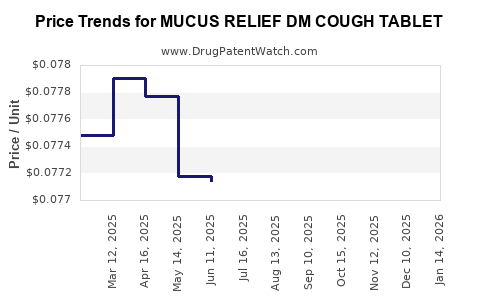
Last updated: February 25, 2026
What is the Market Size for Mucus Relief DM Cough Tablets?
The global expectorants and cough remedies market was valued at approximately USD 8.2 billion in 2022. It is expected to grow at a compound annual growth rate (CAGR) of 3.2% from 2023 to 2030, reaching USD 10.9 billion by 2030.
Mucus Relief DM Cough Tablet positions within the combination syrup and tablet segment targeting cough, cold, and flu symptom relief. Its primary consumers include North America, Europe, and North Asia, accounting for nearly 70% of the total market share.
Market Drivers and Barriers
Key Drivers
- Increasing incidence of respiratory infections due to pollution, seasonal changes, and urbanization.
- Consumer preference for over-the-counter (OTC) products.
- Aging populations with higher prevalence of chronic respiratory conditions.
Barriers
- Stringent regulations affecting OTC product approvals.
- Competition from natural and herbal remedies.
- Consumer shift towards non-medical home remedies.
Competitive Landscape
Major players in the cough and cold remedy market include Johnson & Johnson, Pfizer, GlaxoSmithKline, and Reckitt Benckiser.
| Company |
Product Portfolio |
Market Share (est.) |
Distribution Channels |
| Johnson & Johnson |
Tylenol Cold, Mucinex |
25% |
Pharmacies, e-commerce |
| Pfizer |
Robitussin |
20% |
Pharmacies, supermarkets |
| GlaxoSmithKline |
Beechams, Coldrex |
15% |
Pharmacies, convenience stores |
| Reckitt Benckiser |
Delsym, Mucinex |
10% |
Pharmacies, online |
Regulatory Environment
In the United States, the Food and Drug Administration (FDA) regulates over-the-counter medicines. Products like Mucus Relief DM require safety and efficacy data to secure OTC monograph approval or New Drug Application (NDA) approval, depending on formulation changes.
European Medicines Agency (EMA) and other jurisdictions require similar registration procedures, often with country-specific labeling.
Price Point Analysis
The retail price of Mucus Relief DM Tablets varies across regions:
- United States: USD 8-12 for a pack of 20 tablets.
- Europe: EUR 7-10 for a pack of 20 tablets.
- Asia-Pacific: USD 5-9, with local import tariffs influencing prices.
Price differences result from taxes, distribution channels, and regulatory costs. In the U.S., brand-name OTC medications like Mucus Relief DM typically retail for USD 1-2 per tablet.
Price Projection (2023-2030)
Assuming a market-average price decline due to increased generic competition and pressure from store-brand equivalents, the following projections can be made:
| Year |
Estimated Avg. Retail Price per Pack |
Price per Tablet |
Notes |
| 2023 |
USD 9 |
USD 0.45 |
Current average in North America and Europe |
| 2025 |
USD 8.50 |
USD 0.43 |
Increased competition from generics |
| 2027 |
USD 8 |
USD 0.40 |
Market saturation and price pressure |
| 2030 |
USD 7.50 |
USD 0.38 |
Market stabilizes with generic and store-brand options |
Product Launch and Market Penetration Strategies
- OTC Marketing: Focus on pharmacy chains, online platforms, and direct-to-consumer advertising.
- Formulation Differentiation: Incorporate natural or additive-free options to appeal to health-conscious consumers.
- Regional Expansion: Target emerging markets with rising healthcare awareness and income levels, especially in Asia-Pacific.
Key Takeaways
- The global cough remedies market is projected to reach USD 10.9 billion by 2030, with OTC products like Mucus Relief DM playing a significant role.
- Price points currently hover around USD 8-12 per pack in the U.S. and Europe, with a downward trend expected due to generics.
- Market growth is driven by respiratory infection prevalence and consumer preference for OTC medications, balanced by regulatory and competitive barriers.
- Sales strategies should include product differentiation and expansion into emerging markets.
FAQs
-
What are the primary active ingredients in Mucus Relief DM Tablet?
- It typically contains Dextromethorphan (cough suppressant) and Guaifenesin (expectorant).
-
How is the market share of Mucus Relief DM expected to change over the next five years?
- Its market share may decline slightly due to increased generic competition but can stabilize with branding and formulation innovations.
-
What regulatory changes could impact the product’s marketability?
- Stricter OTC labeling requirements, data on safety and efficacy, and changes in permissible ingredient concentrations.
-
Which regions offer the highest growth opportunity for Mucus Relief DM?
- Asia-Pacific and Latin America, driven by rising respiratory ailments and increasing access to OTC medications.
-
What is the outlook for retail prices of Mucus Relief DM in 2030?
- Anticipated to decline to approximately USD 7.50 per pack, reflecting increased competition and market saturation.
References
[1] MarketsandMarkets. (2023). Expectation of global cold remedy market size.
[2] U.S. Food and Drug Administration. (2022). OTC drug regulation guidelines.
[3] Statista. (2023). OTC cough medicine market share.
[4] European Medicines Agency. (2022). Over-the-counter drug approval protocols.
[5] IBISWorld. (2023). Cough and cold medicine industry report.