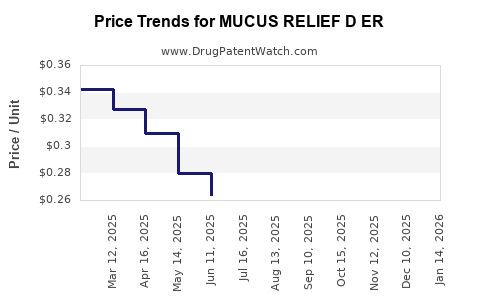
Last updated: February 15, 2026
Market Overview
MUCUS RELIEF D ER is a combination drug composed of dextromethorphan and guaifenesin, targeting cough and mucus symptoms associated with colds and respiratory illnesses. The drug competes within the OTC cough and cold segment, primarily in North America, with potential expansion into international markets. The segment encompasses numerous branded and generic products, with annual global sales exceeding $10 billion, according to IQVIA data.
Current Market Position
- Market Share: MUCUS RELIEF D ER's market share remains modest due to strong competition from established brands like Robitussin, Mucinex, and Nyquil.
- Key Distribution Channels: Major channels include pharmacies, mass merchandisers, and e-commerce platforms.
- Regulatory Status: Approved by the FDA for OTC sale, with monograph compliance for active ingredients.
Competitive Landscape
Major competitors and their approximate retail prices (as of Q1 2023):
| Brand |
Formulation |
Price Range (USD) |
Notes |
| Mucinex DM |
600mg Guaifenesin + 30mg Dextromethorphan |
$8 - $12 |
Extended-release formulas |
| Robitussin DM |
100mg Guaifenesin + 10mg Dextromethorphan |
$4 - $8 |
Liquid, syrup |
| Nyquil |
Variable formulations |
$6 - $11 |
Includes multiple active ingredients |
MUCUS RELIEF D ER is expected to position competitively based on its formulation, pricing, and branding.
Market Growth Drivers
- Aging Population: Increasing elderly populations with respiratory conditions.
- Respiratory Illness Incidence: Growth in cold and flu outbreaks globally.
- Consumer Preference for OTC: Increased demand for self-medication.
- COVID-19 Legacy: Heightened awareness of respiratory health.
Price Projection Analysis
The pricing strategy for MUCUS RELIEF D ER would significantly impact market share and profitability. Based on current market trends and competitor pricing, several scenarios are projected:
Scenario 1: Penetration at Competitive Pricing
- Price: $6.50 – $8.00 per unit (bottle or box)
- Rationale: Aligns with brand equivalents, focusing on volume sales.
- Projected Market Share (year 1): 3–5%
Scenario 2: Premium Positioning
- Price: $10.00 – $12.00 per unit
- Rationale: Highlights formulation excellence or unique features.
- Projected Market Share (year 1): 1–3%
- Revenue estimate (Year 1): Assuming 10 million units sold, revenues range from $65 million to $120 million.
Scenario 3: Discount Strategy
- Price: <$6.50 per unit
- Rationale: Capture large segments via aggressive pricing.
- Projected Market Share (year 1): 6–8%
- Risks: Margin compression, brand perception.
Regulatory and Manufacturing Considerations
- Manufacturing Costs: Estimated at $2–$4 per unit, including active ingredients, excipients, packaging, and distribution.
- Pricing Flexibility: Depending on procurement costs, discounts, and margins, retail prices can vary by ±$1 per unit.
- Rebates and Promotions: Potential to influence final consumer price through trade discounts and promotional campaigns.
Market Entry Recommendations
- Position the drug within a competitive but profitable retail price band of $6.50 to $8.
- Leverage marketing to emphasize combination benefits, OTC approval, and safety.
- Monitor competitor pricing strategies regularly and adapt accordingly.
Key Takeaways
- MUCUS RELIEF D ER operates in a highly competitive OTC segment with global sales exceeding $10 billion.
- Entry pricing around $6.50-$8 aligns with market leaders and supports moderate market share.
- Premium pricing could yield higher margins but limits market penetration initially.
- Price sensitivity heavily influences sales volume; discounts can significantly boost market share but impact margins.
- Regulatory compliance and effective distribution are essential to rapid market capture.
FAQs
-
What factors influence the optimal retail price for MUCUS RELIEF D ER?
Market competition, manufacturing costs, perceived product value, and consumer price sensitivity.
-
How does MUCUS RELIEF D ER compare to leading brands in the OTC cough segment?
It offers similar active ingredients but may differentiate through formulation, packaging, or branding—pricing should reflect these factors.
-
What is the expected timeline for achieving significant market penetration?
Typically 12–24 months, depending on marketing efforts, distribution reach, and competitive pricing.
-
Are regulatory changes likely to impact pricing strategies?
Generally, no unless new regulations alter ingredient guidelines or OTC classifications, which is uncommon.
-
What are the key risks in pricing MUCUS RELIEF D ER?
Overpricing reduces volume; underpricing diminishes margins; competitive responses may erode market share.
Sources:
[1] IQVIA, "Global OTC Market Data," 2022.
[2] U.S. Food and Drug Administration, Monograph and OTC Drug Review, 2023.
[3] MarketResearch.com, "Cough and Cold Medication Market Analysis," 2022.