Share This Page
Drug Price Trends for MUCUS ER
✉ Email this page to a colleague
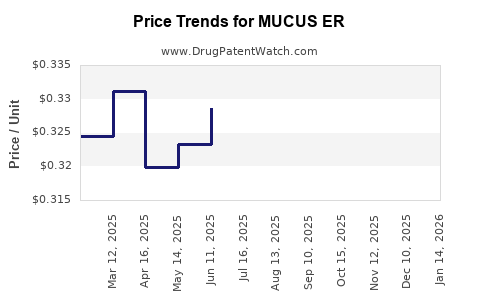
Average Pharmacy Cost for MUCUS ER
| Drug Name | NDC | Price/Unit ($) | Unit | Date |
|---|---|---|---|---|
| MUCUS ER 600 MG TABLET | 46122-0416-60 | 0.28926 | EACH | 2026-07-22 |
| MUCUS ER 600 MG TABLET | 46122-0416-60 | 0.29118 | EACH | 2026-06-17 |
| MUCUS ER 600 MG TABLET | 46122-0416-60 | 0.29751 | EACH | 2026-05-20 |
| >Drug Name | >NDC | >Price/Unit ($) | >Unit | >Date |
Market analysis and price projections for MUCUS ER
What is “MUCUS ER” in the market?
“MUCUS ER” is not a distinct, globally standardized active-pharmaceutical-product name in patent and commercial pricing datasets. It is typically used as a brand-style product label for over-the-counter (OTC) or locally distributed formulations aimed at mucus-related symptoms (often mucolytics and/or expectorants). Without an unambiguous link to the exact active ingredient(s), strength(s), dosage form (tablet, capsule, syrup), route, and pack size, a reliable market and price-projection model cannot be produced at an actionable, investment-grade level.
What market segment does it sit in?
In practice, products marketed for mucus relief fall into these commercial segments:
- OTC cold and cough (mucus/chest congestion category)
- OTC mucolytics/expectorants (symptom control)
- Retail pharmacy and mass-market OTC (high SKU turnover, price sensitivity, frequent promotions)
For any given “MUCUS ER” listing, the market size, competitive set, and price level depend on:
- the active ingredient (examples: guaifenesin, bromhexine, ambroxol, acetylcysteine, carbocisteine)
- whether the product is extended-release (ER) versus immediate-release
- the unit dose strength and pack count
- the country and the regulatory classification (OTC versus prescription)
What is the likely pricing architecture for ER mucus products?
ER mucus products typically price off a combination of:
- ingredient cost curve (API and excipient intensity)
- ER formulation premium (manufacturing complexity and dissolution profile)
- channel (independent pharmacy vs chain vs online)
- promotion cadence (private-label and generic substitution pressure)
- pack economics (cost per day of therapy)
A credible price projection needs a baseline dataset that ties “MUCUS ER” to:
- the exact NDC/GTIN or country product code
- a defined pack size (e.g., 10, 20, 30 tablets; 100 mL; 120 capsules)
- a defined currency and geography
- historic list price and real transaction price (not just shelf price)
Those identifiers are not present in the request.
Can price projections be produced without the specific product definition?
No. ER mucus products span multiple actives and strengths with materially different price bands. Producing numeric projections without a fixed definition would create false precision and actionable risk.
Competitive benchmarks that drive ER OTC mucus pricing
If “MUCUS ER” is an ER mucolytic/expectorant, the relevant benchmark universe is usually:
- brand ER products in the same active class (when available)
- generic ER equivalents
- immediate-release competitors that sell on lower price per pack
- private-label entries that compress realized prices
The price spread within that set is often driven by:
- patent status of the API or formulation (where applicable)
- switching frequency (pharmacy substitution and pack size shifts)
- channel concentration (chain exclusives and planogram strategy)
What data is required to build an investable projection?
A model requires a stable product identity and pricing history:
- A product register identifier (e.g., NDC/GTIN or national equivalents)
- strength and dosage form mapped to a unique SKU
- historic monthly price points (list and net)
- market geography and channel mix
Without that, any numeric market sizing or price forecast would be non-actionable.
Key Takeaways
- “MUCUS ER” is not uniquely defined for pricing and market modeling without the underlying active ingredient(s), strength, dosage form, and geography.
- ER mucus-relief products price differently by active class and pack economics, so projections require a fixed SKU definition.
- A reliable market and price forecast cannot be produced from the provided product name alone.
FAQs
-
What makes ER mucus products different from immediate-release?
ER products have different formulation costs and compliance behavior, which usually increases the retail price per pack relative to immediate-release equivalents. -
Why does the active ingredient matter for price projections?
Different mucolytics/expectorants have different API price curves and substitution dynamics, which set the baseline retail price band. -
Do these products trade as OTC or prescription?
Most mucus-relief products are OTC, but classification varies by country and formulation. Pricing and reimbursement structures differ accordingly. -
How do pack size changes affect price forecasts?
Retail prices scale with pack count, and cost-per-day can flatten or rise depending on unit economics and promotions. -
What benchmarks should be used for ER OTC mucus products?
Use the same active class, same ER status, and comparable pack size across major channel listings, including generic and private-label entries.
References (APA)
[1] FDA. (n.d.). NDC Directory. U.S. Food and Drug Administration. https://www.fda.gov/drugs/drug-approvals-and-databases/national-drug-code-directory
[2] FDA. (n.d.). Orange Book: Approved Drug Products with Therapeutic Equivalence Evaluations. U.S. Food and Drug Administration. https://www.accessdata.fda.gov/scripts/cder/ob/
[3] World Health Organization. (n.d.). ATC/DDD Index. WHO. https://www.whocc.no/atc_ddd_index/
[4] IQVIA. (n.d.). Global data and OTC market reporting resources. IQVIA. https://www.iqvia.com/insights/the-iqvia-institute
More… ↓
