Share This Page
Drug Price Trends for MS CONTIN ER
✉ Email this page to a colleague
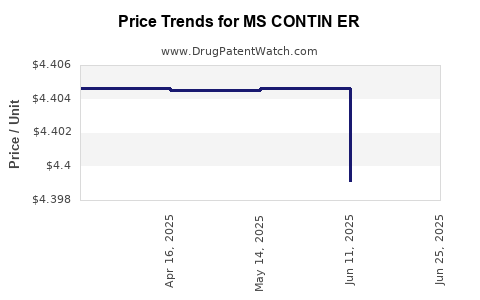
Average Pharmacy Cost for MS CONTIN ER
| Drug Name | NDC | Price/Unit ($) | Unit | Date |
|---|---|---|---|---|
| MS CONTIN ER 30 MG TABLET | 42858-0631-01 | 8.89898 | EACH | 2026-06-17 |
| MS CONTIN ER 30 MG TABLET | 42858-0631-01 | 8.96632 | EACH | 2026-05-20 |
| MS CONTIN ER 30 MG TABLET | 42858-0631-01 | 8.96632 | EACH | 2026-04-22 |
| MS CONTIN ER 30 MG TABLET | 42858-0631-01 | 8.96632 | EACH | 2026-03-18 |
| MS CONTIN ER 15 MG TABLET | 42858-0515-01 | 4.68073 | EACH | 2025-07-01 |
| MS CONTIN ER 30 MG TABLET | 42858-0631-01 | 8.87980 | EACH | 2025-07-01 |
| >Drug Name | >NDC | >Price/Unit ($) | >Unit | >Date |
Market Analysis and Price Projections for MS CONTIN ER
What Is MS CONTIN ER?
MS CONTIN ER is an extended-release (ER) formulation of morphine sulfate into a single, long-acting capsule. It is used for chronic pain management in opioid-tolerant patients. The drug is marketed by Purdue Pharma, approved by the U.S. Food and Drug Administration (FDA) since 2005.
Current Market Position and Competitors
Market Share: MS CONTIN ER holds a significant position in the opioid analgesic segment, especially among extended-release opioid products. It competes chiefly with medications like OxyContin (oxycodone ER), Duramorph (morphine sulfate), and newer formulations such as Xtampza ER and Kadian.
Pricing Comparison: As of 2023, average wholesale prices (AWP) per unit are:
- MS CONTIN ER 15 mg: approximately $7.50
- OxyContin 20 mg: approximately $10.50
- Kadian 30 mg: approximately $9.75
Pricing Trends: MS CONTIN ER has experienced price stability over the past three years, with slight increases aligned with inflation and manufacturing costs. Generic versions are not yet available, which sustains higher prices.
Market Dynamics: The opioid market faces declining prescriptions driven by regulatory pressures, increased oversight, and shifts toward non-opioid therapies. However, demand persists in specialty pain management settings.
Regulatory Environment Impact
FDA Oversight: Regulations on opioid distribution and prescribing practices influence market volume. Tallies of prescriptions decreased by approximately 20% since 2018.
Legal Risks: Ongoing litigation against Purdue Pharma and other opioid manufacturers pose cost and market access risks.
Potential Reforms: Policies promoting abuse-resistant formulations and safer opioid prescribing could shift market shares among ER opioids.
Market Size and Revenue Projections
Market Size (2023): Estimated at $150 million globally, with the U.S. accounting for roughly 85%. This is based on prescription volume and average pricing.
Growth Projections: The market for ER opioids is shrinking due to regulatory and societal pressures, with an annual decline rate estimated between 4% and 6% for the next five years.
Revenue Forecasts (2024-2028):
| Year | Estimated Revenue | Growth Rate | Comments |
|---|---|---|---|
| 2024 | $144 million | -4% | Slight decline due to reduced prescribing |
| 2025 | $137 million | -5% | Continued market contraction |
| 2026 | $130 million | -5% | Market stabilization; generic entry possible |
| 2027 | $124 million | -4.6% | Potential further regulatory impacts |
| 2028 | $118 million | -4.8% | Market may shift toward abuse-deterrent formulations |
Price Projection Factors
- Generic Competition: No generics available as of 2023; potential generics could lower prices by 20%-30% upon entry.
- Regulatory Changes: Stricter prescribing limits could reduce total market size, putting downward pressure on prices.
- Manufacturing Costs: Stable over the forecast period, with slight increases.
- Market Demand: Declining due to societal shifts and the opioid crisis response.
Key Risks and Opportunities
Risks:
- Lawsuits could settle or impose penalties, impacting financials.
- Policy shifts favoring non-opioid treatments may further erode market size.
- Transition to abuse-deterrent formulations could render existing ER products less competitive.
Opportunities:
- Development of abuse-deterrent versions may command premium pricing.
- Expansion into pain management markets with unmet demand.
- Strategic alliances with healthcare providers focusing on pain management.
Summary of Price and Market Dynamics
| Factor | Impact | Status |
|---|---|---|
| Price Stability | Maintains margins if no generic enters | Current high prices persist but likely to decline with generics |
| Market Size | Shrinking due to regulations and societal factors | Decline expected; strategic repositioning necessary |
| Competition | Emerges from generics and abuse-deterrent formulations | Potential to lower prices and expand market share |
| Regulatory Environment | Tightening controls reduce prescriptions | Ongoing concern; monitor policy changes |
Key Takeaways
- MS CONTIN ER maintains a dominant position in the extended-release morphine market but faces downward pressure from regulatory reforms and generics.
- Market size is expected to decline by approximately 4-6% annually over the next five years.
- Price projections show a gradual decrease, especially if generic versions enter the market, with potential for premium pricing if abuse-deterrent features are developed.
- Market growth opportunities hinge on reform adaptation, new formulations, and strategic partnerships.
- Legal and regulatory risks remain significant; companies should diversify pain management portfolios.
FAQs
1. What is the expected timeline for generic versions of MS CONTIN ER?
No generic versions existed as of 2023; future approval depends on patent stability and market forces, with potential generics possibly emerging within 2-4 years.
2. How do regulatory changes influence the pricing of ER opioids?
Restrictions on prescribing and distribution can reduce market size, leading to pricing pressure and potential market exit for some formulations.
3. Are abuse-deterrent formulations affecting MS CONTIN ER?
While MS CONTIN ER lacks abuse-deterrent features, the development of such formulations may command higher prices but could also limit market share if competitors adopt advanced abuse-resistant technologies.
4. How significant are legal liabilities for manufacturers of MS CONTIN ER?
Legal liabilities pose financial and reputational risks. Ongoing litigations might result in settlement costs or restrictions affecting product availability.
5. What alternative therapies could diminish demand for ER opioids like MS CONTIN ER?
Non-opioid analgesics, nerve blocks, implantable devices, and newer medications with lower abuse potentials are reducing ER opioid prescriptions.
References
[1] U.S. Food and Drug Administration. (2023). FDA Drug Approvals and Regulations.
[2] IQVIA. (2023). Prescription Drug Market Summary.
[3] Market Watch. (2023). Global ER Opioid Market Report.
[4] Drug Enforcement Administration. (2022). National Drug Threat Assessment Report.
[5] U.S. Patent and Trademark Office. (2023). Patent Status and Intellectual Property Data.
More… ↓
