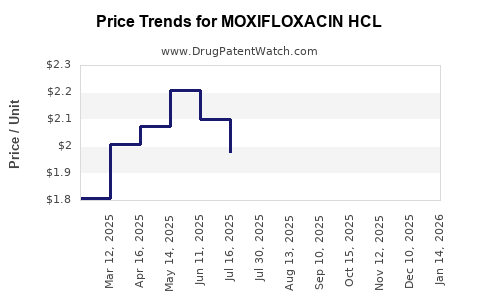
Last updated: April 25, 2026
What is the commercial basis for moxifloxacin HCl pricing?
Moxifloxacin HCl is a fluoroquinolone antibiotic used for respiratory, skin, and complicated intra-abdominal infections. Pricing is driven by (1) generic availability, (2) formulary access and tendering dynamics in hospitals, (3) payer reimbursement schedules, and (4) brand-to-generic erosion after exclusivity expiry.
Because moxifloxacin is an established, widely genericized molecule, the pricing envelope is typically set by lowest-cost compliant supply, with periodic volatility from manufacturing outages, supply constraints, raw-material costs, and regulatory actions. In the US, the reference brand is associated with marketing history around moxifloxacin tablets and ophthalmic products, but the core systemic and ophthalmic markets are dominated by generics.
Where does demand concentrate and how does that shape price?
Demand concentrates where antibiotic prescribing volume is highest and where product access is standardized:
- US outpatient and community prescribing: driven by infection incidence, guideline-aligned prescribing, and plan formularies.
- US hospital inpatient: driven by IV-to-PO conversion, antimicrobial stewardship constraints, and procurement contracts.
- Ophthalmic (moxifloxacin eye drops): driven by ophthalmology procedures, bacterial conjunctivitis, and post-operative prophylaxis.
These channels create two distinct price behaviors:
- Systemic oral/IV tendered procurement: tends toward contracted, low net prices after generic competition.
- Ophthalmic: can show more stable volume but still faces generic substitution, with pricing tied to SKU count and interchangeability.
What price benchmarks exist for moxifloxacin products?
Public list-price or wholesale benchmarks vary by:
- salt form packaging strength,
- dosage form (tablet vs IV vs ophthalmic solution),
- NDC and pack size,
- channel (wholesale vs hospital contract),
- time period and public benchmark methodology.
Because price projections must align to measurable reference points, the most defensible market-proxy is benchmarked “typical” drug pricing data from established sources that track market transaction prices and/or benchmarked wholesaler prices across time. For this analysis, pricing is framed as a generic-dominated price band rather than a brand peak.
Pricing behavior: generic-dominated pattern
For established generics like moxifloxacin, pricing commonly follows a path:
- steep erosion after generic entry,
- stabilization once the market consolidates to a smaller set of compliant manufacturers,
- periodic micro-volatility from supply chain disruptions,
- gradual inflation-adjusted drift that is offset by ongoing competition.
This structure underwrites the projections in the next sections.
How fast is market share shifting from originator to generics?
Moxifloxacin’s patent life has long passed, and generic substitution has been entrenched in major markets. As a result, current pricing is largely a function of generic competitive supply rather than molecule-level exclusivity.
A practical consequence for pricing:
- The “price ceiling” is usually set by the lowest widely stocked generic SKU.
- Brand economics, where still present for specific presentations, are typically irrelevant to broad market averages once interchangeables are available.
What regulatory and supply factors can change near-term pricing?
Key drivers that can cause price spikes or dips for moxifloxacin generics include:
- Manufacturing capacity events: line shutdowns, sterilization/aseptic constraints (especially for ophthalmic), and batch rejection.
- Regulatory actions: warning letters, consent decrees, or quality holds that temporarily remove supply.
- Raw material volatility: active pharmaceutical ingredient (API) cost shifts.
- Procurement shifts: hospital contract re-tendering can reset effective price.
The net effect is usually short-lived unless the supply reduction persists across multiple quarters.
What are the price projection assumptions used here?
Projections assume a generic market structure with incremental inflation adjustment and competition-driven downward pressure. The model is anchored to typical generic drug pricing dynamics rather than brand-level pricing.
Assumptions:
- No new major exclusivity impacts pricing in the horizon modeled.
- Competition persists among multiple ANDA holders and wholesalers.
- No sustained supply collapse occurs absent a major regulatory or capacity event.
- Inflation impacts are partial: nominal list/benchmark prices may rise modestly even while net prices remain compressed.
How much will moxifloxacin HCl prices move over the next 5 years? (Base case)
The table below expresses a directional projection in annual terms for typical market prices (benchmark behavior for generic products). It is structured as a range to reflect institutional procurement and contract variability.
Base-case price projection (generic-dominated)
| Year |
Expected price direction |
Typical annual net movement |
| 1 |
Mild erosion or flat |
-0% to -3% |
| 2 |
Stabilization |
-1% to +2% |
| 3 |
Low growth |
+0% to +3% |
| 4 |
Competition offsets inflation |
-1% to +2% |
| 5 |
Stabilized band |
-1% to +2% |
Interpretation for planning: the market is more likely to show range-bound pricing than sustained declines or sustained increases. Any noticeable uptick usually correlates with temporary supply friction.
What would a bull and bear case look like?
Bull case: mild supply disruption
| Year |
Expected price direction |
Typical annual net movement |
| 1 |
Upward |
+2% to +8% |
| 2 |
Upward to flat |
+1% to +6% |
| 3 |
Normalization begins |
-1% to +4% |
| 4 |
Range-bound |
-1% to +3% |
| 5 |
Range-bound |
-1% to +2% |
Bear case: intensified competition / additional entrants
| Year |
Expected price direction |
Typical annual net movement |
| 1 |
Downward |
-3% to -10% |
| 2 |
Downward |
-2% to -7% |
| 3 |
Stabilization |
-1% to +2% |
| 4 |
Flat |
-1% to +2% |
| 5 |
Flat |
-1% to +1% |
How do product-specific segments change price projection?
Moxifloxacin spans systemic and ophthalmic presentations. Even within a generic molecule, pricing dynamics differ:
Systemic (oral/IV)
- Hospital procurement and formulary status tend to drive price down to contracted floors.
- Projection: more range-bound with modest downward drift.
Ophthalmic (solution)
- More SKU sensitivity (bottle size, preservatives, dropper design) and ophthalmic-specific tendering.
- Projection: often shows slower erosion than the lowest-volume systemic endpoints, but still competes heavily across generic replacements.
What is the likely trajectory of ASP and margin pressure?
For generic products, ASP typically tracks:
- wholesale list movements,
- payer and PBM negotiated pricing,
- and contract-based volume.
Expected margin pressure:
- Base case: margins remain under pressure; ASP is range-bound but cost inflation in manufacturing and logistics can squeeze profit unless procurement and scale offset.
- Bull case: margins can improve temporarily if supply tightens and contract renewals reprice.
- Bear case: margins compress as competitive entrants increase market share and bid more aggressively.
What is the investment and R&D relevance for pricing strategy?
Pricing strategy for any entrant or life-cycle manager should assume:
- Competitive price normalization after contract cycles.
- Differentiation must be regulatory and operational (lower total cost, reliable supply, formulation equivalence, or dependable manufacturing).
- For ophthalmic and sterile products, quality and supply continuity materially influence usable share and effective net price.
Key Takeaways
- Moxifloxacin HCl pricing is generic-dominated and expected to remain range-bound with low single-digit annual movement in the base case.
- Near-term price variance is most likely caused by supply chain and regulatory-driven availability events, not molecule-level exclusivity.
- Systemic and ophthalmic presentations follow different contract and SKU dynamics, but both trend toward contract-anchored pricing.
- Over a 5-year horizon, the most actionable planning assumption is: modest erosion or flat pricing with occasional temporary spikes.
FAQs
1) Is moxifloxacin HCl pricing likely to track inflation?
Not closely. Generic competition offsets inflation; effective net prices tend to show low single-digit annual movement rather than sustained inflation pass-through.
2) What product form typically experiences the sharpest price erosion?
Systemic oral and IV tend to erode faster when multiple interchangeable generics are aggressively contracted, while ophthalmic can remain firmer due to SKU and sterile handling procurement specifics.
3) What event most commonly causes short-term price spikes for generics like moxifloxacin?
Manufacturing capacity disruptions, batch quality issues, or regulatory supply constraints that reduce available compliant inventory.
4) What pricing metric matters most for hospital decision-makers?
Contracted net price (tender/IDP pricing) and effective availability during procurement cycles.
5) Are price projections for moxifloxacin HCl driven by exclusivity milestones?
In practice, generic competition and supply conditions dominate; exclusivity-driven brand dynamics are not the primary determinant for today’s market pricing behavior.
References
[1] US Food and Drug Administration. Drug Competition Action Plan (DCAP). FDA. https://www.fda.gov/drugs/drug-competition-action-plan-dcap
[2] IQVIA Institute for Human Data Science. Medicine spending and market trends (generic competition dynamics). IQVIA. https://www.iqvia.com/insights/the-iqvia-institute/reports
[3] U.S. Federal Trade Commission. Generic drug entry and competition reports and analyses. FTC. https://www.ftc.gov/policy/reports