Last updated: July 16, 2026
Montelukast Market Analysis and Price Projections: Pricing Trends, Generic Erosion, and FDA/Patent Exit Timelines
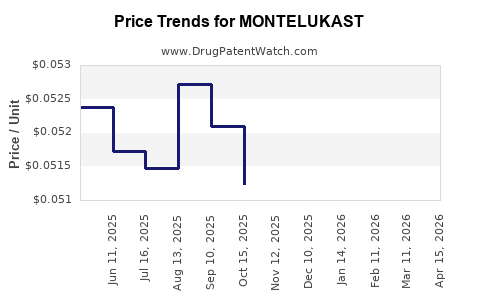
Montelukast (including montelukast sodium; brand: Singulair) has already moved through the main US price compression phase driven by generic entry. Current price levels are largely determined by (1) low-cost multisource supply, (2) payer formulary placement, and (3) package strength mix (10 mg tablet, 4 mg chewable, 5 mg chewable) rather than brand-specific contracting. With no meaningful remaining brand exclusivity in the US, price projections skew toward continued mean-reversion around low wholesale acquisition cost (WAC) bands, with periodic step-downs tied to new generic market entrants and competitive bid cycles.
How is montelukast priced today in the US and what are the key drivers of payer net price?
What products drive current montelukast price bands
Montelukast is widely marketed in generic form in the US across multiple dosage forms and strengths:
- 10 mg oral tablets (largest volume category)
- 4 mg chewable tablets (pediatric)
- 5 mg chewable tablets (pediatric)
Pricing is driven more by network pharmacy and PBM contracting mechanics than by branded pricing, since brand competition is largely displaced.
What moves net price
Key drivers of net price (the economic driver for payer contracting) include:
- Generic supply density: multiple ANDA holders and ongoing label expansions for common strengths.
- PBM formulary tiering: montelukast is typically managed on a value tier.
- Package mix: different NDC package sizes affect WAC-to-NADAC relationships.
- Acquisition cost pressure: wholesale discounts to plans compress net prices.
- Regional distribution: in-store and mail order competition affects local acquisition costs.
Pricing implication
For a low-cost multisource drug, headline price changes tend to understate payer net movement. Net price can decline even when WAC appears stable, especially during PBM rebid cycles.
What are montelukast price projections through 2028 based on generic competition dynamics?
Base-case projection (2025-2028)
For a mature generic like montelukast, the base case is:
- Low-to-mid single digit annual WAC pressure (driven by competitive bid cycles and incremental entrants)
- Smaller annual net price reductions (because net prices already sit near floor levels set by procurement competition)
Practical expectation for investors and planners:
- Most near-term variability comes from inventory and rebate timing rather than structural pricing power.
- Major step-downs typically occur when an additional high-volume generic manufacturer enters large package offerings, or when PBMs shift preferred generics.
Downside scenario
- Faster price erosion if additional low-cost suppliers gain shelf share in 10 mg tablets.
- Temporary spikes are possible with supply disruptions at one or more manufacturers, but these are usually short-lived and do not change long-run pricing.
Upside scenario
- Stabilization if preferred products hold share during rebids and if supply remains balanced.
What to watch
- Consolidation in generic manufacturing (capacity tightening can stabilize price floors).
- PBM contracting changes that move preferred status across NDCs.
When did montelukast lose exclusivity and what does that imply for future pricing?
US exclusivity and patent context
Montelukast’s branded era has ended for practical commercial purposes in the US, with generic products now standard-of-care in payer formularies. The implication for pricing is direct: without brand exclusivity leverage, the market is governed by generic price competition.
Why exclusivity status matters less now
Even if any residual formulation or method-of-use IP remained, it would not typically prevent ANDA market entry unless a specific patent was actively enforced in a way that blocked launch for a particular generic claim set. For pricing projections, the dominant factor is already-established multisource supply.
What patents protect montelukast and what generic entry risks remain?
Core reality for a mature generic
For montelukast, the generic entry risk profile is low in aggregate because:
- Multiple generics have already launched in common dosage forms.
- Formularies already carry low-cost alternatives.
- Any incremental launch delay would mainly affect specific NDCs, not the overall category price.
Residual IP types that can affect specific products
Even when the active ingredient is off-patent, generic pricing can be influenced by:
- Formulation patents tied to specific chewable compositions
- Manufacturing method patents that complicate certain process validations
- Device or packaging claims (less common for tablets/chewables)
Where the remaining risk usually sits
- Pediatric chewables (4 mg and 5 mg) can show NDC-specific differences if fewer manufacturers supply certain package sizes.
- Different label strengths can have different competitive intensity.
What formulations of montelukast exist and how do they affect market pricing by NDC?
Dosage form segmentation
Pricing and availability can differ across:
- 10 mg tablets
- Usually the most competitive and lowest cost.
- 4 mg chewables
- Often competitively priced but may have fewer suppliers for certain package sizes.
- 5 mg chewables
- Similar structure to 4 mg with potential differences in package-level competition.
NDC-level projection logic
- 10 mg: expect continued pressure and high substitution across generics.
- 4 mg and 5 mg chewables: expect slower erosion if supply is less concentrated, but category-level pricing still trends toward low-cost convergence.
What is the Orange Book status of montelukast and what does it mean for litigation and settlements?
Orange Book mechanics
The Orange Book listing structure informs whether:
- A generic could face a relevant patent blocking launch, and
- Whether any Paragraph IV challenges and settlements occurred in a given launch window.
Settlement impact on pricing
In mature categories, the practical pricing effect of settlements is usually:
- One-time impact on the timing of a particular generic entrant.
- Ongoing impact only if settlements caused durable exclusivity for a specific generic product configuration or delayed additional entrants.
For montelukast, category pricing is dominated by today’s established multisource dynamics, not by sporadic launch timing disputes.
How many manufacturers sell montelukast and what does that do to price competition?
Market structure
Montelukast is supplied by many generic firms. Broad multisource availability typically:
- Compresses WAC toward procurement cost bands
- Reduces price dispersion across NDCs
- Lowers the impact of individual supplier pricing actions
Competitive implication
As long as more than a few large suppliers remain active across the main strengths, the market tends to show:
- Slow, steady declines rather than sharp swings
- Limited ability for any single firm to reset price
How does montelukast’s price compare with other asthma and allergy controller therapies?
Relative positioning
Montelukast is a low-cost oral controller relative to inhaled corticosteroids, combination inhalers, and biologics. That relative positioning typically helps:
- Maintain formulary preference at value tiers
- Drive consistent utilization despite therapeutic alternatives
Implication
Category-level payer economics keep montelukast competitive, but the flip side is that payer preference reinforces price competition among generics rather than supporting premium pricing.
What generic entry scenarios could change montelukast prices materially?
Material change scenario 1: supply contraction
- If multiple high-volume manufacturers face supply constraints simultaneously, prices can rise temporarily.
- Long-run recovery still trends back down if capacity normalizes.
Material change scenario 2: major preferred-NDC switch
- PBMs can change preferred status based on rebate and pricing terms.
- That can shift buying patterns across NDCs and change price visibility.
Material change scenario 3: product-specific shortage
- Chewables (4 mg and 5 mg) can show NDC-level shortages more readily if supply diversity is lower in certain package sizes.
What does the montelukast revenue pool look like and how sensitive is it to price erosion?
Revenue sensitivity
In mature generics:
- Revenue declines tend to be driven more by volume share shifts and supply substitution than by small price moves.
- If price erosion continues, absolute revenue can decline even when volume remains stable.
Strategic implication
For any remaining brand exposure (if any residual), the business case is:
- Limited pricing upside
- Greater focus on contracting, channel retention, and pediatric mix
How strong is the patent estate for montelukast and what does that mean for future R&D?
Patent strength view
From a commercial perspective:
- The patent estate has already been largely monetized through brand exclusivity and early generic entry disputes.
- Current R&D opportunity is more likely in:
- New delivery systems (longer-term)
- Combinations or novel dosing regimens
- Pediatric-focused innovations with differentiated clinical outcomes
Near-term R&D implication
The pricing ceiling for new entrants is constrained by generic baseline economics. Differentiation must translate into measurable payer value to avoid immediate pricing compression.
Key Takeaways
- Montelukast pricing in the US is governed by multisource generic competition and payer contracting rather than brand-level exclusivity.
- Near-term price projections skew to continued low WAC pressure and small net price declines through 2028, with volatility primarily from preferred-NDC switching and occasional supply constraints.
- Any remaining IP risk is likely product-NDC specific (especially pediatric chewables), not category-wide.
- Durable pricing upside is unlikely without a differentiated product that changes formulary or reimbursement dynamics.
FAQs
1) Will montelukast tablet prices drop further as new generics enter?
Category WAC can decline modestly as supply expands and preferred contracting shifts, but the mature multisource structure limits upside for large step changes.
2) Do montelukast chewable prices behave differently than 10 mg tablets?
Yes at the NDC level; pediatric chewables can show less uniform supply diversity across package sizes, which can slow erosion or create short-lived spikes.
3) What is the biggest factor in montelukast net price movement for PBMs?
Rebate and rebid dynamics tied to preferred formulary status and procurement terms typically drive net price more than headline list price.
4) Could a Paragraph IV settlement still impact montelukast pricing today?
Any impact would likely be limited to the specific litigated product configuration and timing, since the category is already broadly generic.
5) What market event would most likely cause a sustained montelukast price change?
A sustained supply contraction among major manufacturers or a durable shift in preferred contracting toward a different lower-cost NDC cluster.
References
- U.S. Food and Drug Administration. Orange Book: Approved Drug Products with Therapeutic Equivalence Evaluations. FDA. https://www.accessdata.fda.gov/scripts/cder/daf/
- FDA. Drugs@FDA. https://www.accessdata.fda.gov/scripts/cder/daf/
- U.S. FDA. Purple Book: Drug Products with Pediatric Information. https://purplebooksearch.fda.gov/