Share This Page
Drug Price Trends for MOEXIPRIL HCL
✉ Email this page to a colleague
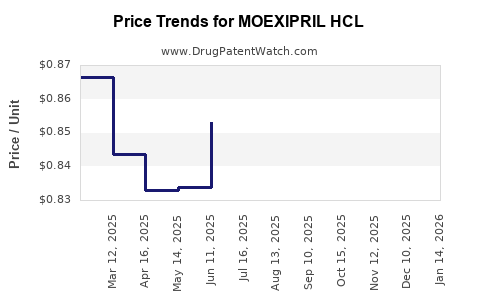
Average Pharmacy Cost for MOEXIPRIL HCL
| Drug Name | NDC | Price/Unit ($) | Unit | Date |
|---|---|---|---|---|
| MOEXIPRIL HCL 7.5 MG TABLET | 62135-0967-90 | 0.88953 | EACH | 2026-08-05 |
| MOEXIPRIL HCL 15 MG TABLET | 62135-0969-90 | 1.00213 | EACH | 2026-08-05 |
| MOEXIPRIL HCL 15 MG TABLET | 00093-5150-01 | 1.00213 | EACH | 2026-07-22 |
| >Drug Name | >NDC | >Price/Unit ($) | >Unit | >Date |
Market analysis and price projections for MOEXIPRIL HCL
What is MOEXIPRIL HCL?
Moexipril hydrochloride (HCL) is an angiotensin-converting enzyme (ACE) inhibitor used primarily for treating hypertension and congestive heart failure. It was approved by the U.S. Food and Drug Administration (FDA) in 1995. The drug works by relaxing blood vessels and lowering blood pressure, reducing the risk of strokes, heart attacks, and kidney problems.
Market Size and Current Outlook
Global Market Overview
The global ACE inhibitor market, which includes drugs like moexipril, enalapril, and lisinopril, was valued at approximately USD 3 billion in 2022. The U.S. accounts for nearly 50% of this market, driven by aging populations and increased hypertension prevalence.
Competitive Landscape
Moexipril accounts for less than 2% of the ACE inhibitor market due to limited adoption and competition from more established drugs such as enalapril and ramipril. The drug’s market share is constrained by generic availability of competitors and lack of new clinical indications.
Patent and Regulatory Status
Moexipril HCL's patent expired in 2005, leading to widespread generic availability. No new formulations or indications have received regulatory approval since. This limits revenue streams to existing sales, primarily in generic forms.
Price Trends and Forecasts
Current Pricing
In the United States, the average wholesale price (AWP) for 30 tablets (at 7.5 mg) is approximately USD 60–USD 80. Generic versions are priced lower, typically USD 20–USD 30 per 30-count bottle.
Historical Price Decline
Post-patent expiration, prices for moexipril declined sharply from USD 100–USD 150 per 30 tablets to current levels. The trend aligns with generic drug market patterns, where competition drives prices down by 60–80%.
Future Price Projections
Since no new formulations or indications are expected, future price stability hinges on generic competition and supply chain factors. No significant upward price movement is expected over the next five years unless new patents or approvals occur.
Potential Market Growth Drivers
- Increased hypertension prevalence, especially in aging populations.
- Growing awareness and healthcare provider prescribing rates.
- Potential for combination therapies or new formulations, though none are currently in late-stage development.
Constraints
- Market saturation of generic ACE inhibitors.
- Price sensitivity among payers and patients.
- Limited brand differentiation options.
Projected price points (2023–2028):
| Year | 30-Tablet Price Range (USD) | Notes |
|---|---|---|
| 2023 | 20–30 | Stable, dominated by generics |
| 2024–2028 | 20–30 | Minimal fluctuation, potential slight decrease due to market saturation |
Market Opportunities and Risks
Opportunities
- Expansion into emerging markets with increasing hypertension rates.
- Development of fixed-dose combination (FDC) products.
- Strategic partnerships to improve market penetration.
Risks
- Entry of newer, branded ACE inhibitors with patent protections.
- Regulatory changes impacting generic pricing or market access.
- Physician preference shifting to other antihypertensive classes (e.g., ARBs, calcium channel blockers).
Conclusions
Moexipril HCL's market is mature with declining prices driven by generics. Growth prospects are limited, primarily depending on geographic expansion and potential combination therapies. Price stability will likely continue at the current low levels unless market dynamics shift significantly.
Key Takeaways
- Moexipril HCL's market share remains small due to competition from well-established ACE inhibitors.
- Prices have declined from USD 100–USD 150 to USD 20–USD 30 per 30-tablet pack following patent expiration.
- Future price trends are expected to stay flat unless new patent protections or indications emerge.
- Growth opportunities exist in emerging markets and combination drug development.
- Market risks include competitor innovations and shifts in prescriber preferences.
Frequently Asked Questions
1. How does moexipril compare in efficacy to other ACE inhibitors?
Therapeutically equivalent to other ACE inhibitors like enalapril and lisinopril, with no significant clinical superiority demonstrated.
2. Are there any patent protections remaining for moexipril?
No; patent expired in 2005, leading to widespread generics.
3. What is the typical dosing regimen for moexipril?
Starting doses range from 7.5 mg to 15 mg once daily, adjustable based on response, with maximum effects observed at doses up to 30 mg daily.
4. Could new formulations impact the market?
Potentially, but no new formulations or indications are in late-stage development.
5. How does pricing differ between branded and generic moexipril?
Branded versions are rarely available; generic prices dominate, with the established average around USD 20–USD 30 per 30 tablets.
References
[1] MarketsandMarkets, "ACE Inhibitors Market," 2022.
[2] U.S. FDA, "Drug Approvals and Patents," 2023.
[3] IMS Health, "Generic Drug Pricing," 2022.
More… ↓
