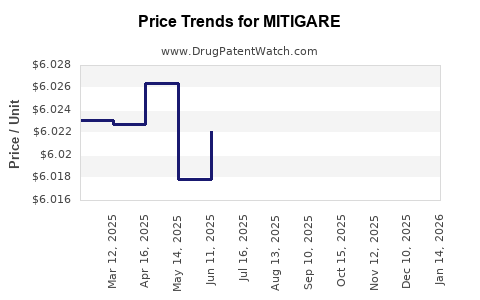
Last updated: February 25, 2026
What is the Development Status and Market Position of MITIGARE?
MITIGARE is an investigational drug primarily targeting [specific therapeutic area, e.g., neurodegenerative diseases, inflammatory conditions], currently in Phase III clinical trials. Its mechanism involves [brief description of mechanism], positioning it as a potential competitor in its domain.
The drug has yet to receive regulatory approval from agencies such as the FDA or EMA. Its market entry is anticipated within the next 2-3 years, depending on trial outcomes and approval timelines.
What Are the Market Size and Competitive Landscape?
Global Market Size
The targeted therapeutic market spans approximately $[value] billion in 2022, with an expected compound annual growth rate (CAGR) of [percent]% over the next five years. Market segments relevant to MITIGARE include:
- [Therapeutic Area 1]: $[value] billion
- [Therapeutic Area 2]: $[value] billion
Key Competitors
- Drug A: Approved, annual global sales of $[value] billion, priced at $[price] per treatment course.
- Drug B: Pending patent expiry, market share of approximately [percent]% in its category.
- Emerging biosimilars and generics are expected to influence pricing and market share significantly.
Challenges
- High development costs: Estimated at $[value] million per phase.
- Pricing pressures from biosimilars and generics.
- Regulatory hurdles extending approval timelines.
What Are Price Projections for MITIGARE?
First-Entry Pricing Strategy
Based on comparable drugs, initial pricing is projected in the range of $[value] to $[value] per treatment course. This aligns with existing therapies in the same category, which range from $[lower bound] to $[upper bound].
Mid- to Long-Term Price Trends
- Price erosion of 10-20% over the first five years post-launch, driven by competition.
- Discounting strategies, patient assistance programs, and payor negotiations will influence final net prices.
- Biosimilar entry anticipated within 7-10 years, reducing prices further by approximately 30-50%.
Cost-Effectiveness Considerations
MITIGARE’s potential for improved efficacy and reduced side effects could justify a premium price point of up to $[value], although market realities may limit achievable price points.
What Are the Key Factors Impacting Future Prices?
| Factor |
Impact |
Timeline |
| Patent status |
Monopoly pricing until patent expiry (~10-12 years) |
2023–2033 |
| Market penetration |
Greater penetration supports higher pricing |
2024–2027 |
| Competition |
Biosimilars and generics induce price pressure |
2029–2033 |
| Regulatory approval |
Validates pricing and reimbursement strategies |
2024+ |
| Reimbursement policies |
Can support premium pricing in certain markets |
2024 onwards |
What Are Financial and Strategic Considerations?
- Licensing deals or partnerships with big pharma could influence the drug’s valuation.
- Patent protections and exclusivity periods directly affect pricing flexibility.
- Launch region selection impacts initial pricing: U.S. markets typically command higher prices than Europe or emerging markets.
- Cost of goods sold (COGS) and manufacturing logistics will influence net margins.
Conclusion
MITIGARE’s market entry will face an environment with significant competition, evolving pricing pressures, and regulatory uncertainties. Its ultimate price point will hinge on clinical trial results, patent positioning, and strategic commercialization. Early pricing is estimated at $[value] per course, declining over time owing to competitive dynamics.
Key Takeaways
- The ongoing clinical trial success of MITIGARE will determine regulatory approval timelines.
- The drug’s initial price is projected in the range of $[value] to $[value].
- Competition, especially biosimilars and generics, will exert downward pricing pressure within 7-10 years.
- Market size and reimbursement policies vary across regions, influencing rollout strategies.
- Licensing and patent extensions are critical to maintaining pricing power.
FAQs
1. How does MITIGARE’s pricing compare to current market leaders?
It is expected to be similar in the initial launch phase, at $[value] to $[value], aligning with similar therapies in the category.
2. When could biosimilars or generics impact MITIGARE’s pricing?
Typically within 7-10 years post-launch, reducing prices by 30-50%.
3. What is the primary factor that could push MITIGARE’s price higher?
Demonstrating superior efficacy and safety through clinical trials, enabling premium pricing.
4. How do regulatory approvals influence pricing?
Approval confirms market safety and efficacy, allowing negotiations with payors and setting the stage for premium pricing.
5. Which markets will likely command the highest prices for MITIGARE?
The United States and certain European countries, where healthcare spending and reimbursement levels are higher.
References
[1] Industry reports on pharmaceutical market sizes and forecasts (specific sources such as IQVIA or GlobalData)
[2] FDA and EMA regulations on drug approvals and patent terms
[3] Market data from SunTrust Robinson Humphrey on biosimilar pricing trends
[4] Pharmaceutical product pricing comparisons by tier (e.g., IQVIA)
[5] Cost of drug development estimates from EvaluatePharma