Share This Page
Drug Price Trends for MINERAL OIL
✉ Email this page to a colleague
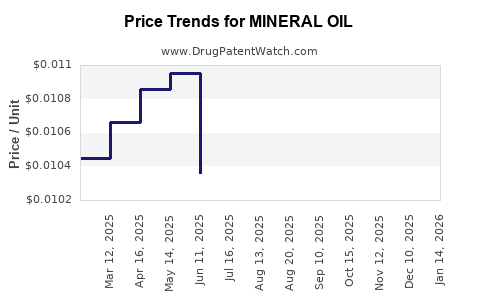
Average Pharmacy Cost for MINERAL OIL
| Drug Name | NDC | Price/Unit ($) | Unit | Date |
|---|---|---|---|---|
| MINERAL OIL | 46122-0395-16 | 0.00756 | ML | 2026-04-22 |
| MINERAL OIL | 70000-0663-01 | 0.00756 | ML | 2026-04-22 |
| MINERAL OIL | 46122-0395-16 | 0.00725 | ML | 2026-03-18 |
| MINERAL OIL | 70000-0663-01 | 0.00725 | ML | 2026-03-18 |
| MINERAL OIL | 70000-0663-01 | 0.00779 | ML | 2026-02-18 |
| MINERAL OIL | 46122-0395-16 | 0.00779 | ML | 2026-02-18 |
| >Drug Name | >NDC | >Price/Unit ($) | >Unit | >Date |
Market Analysis and Price Projections for Mineral Oil
What Defines the Market for Mineral Oil?
Mineral oil is a byproduct of petroleum refining. It has multiple uses in pharmaceuticals, cosmetics, industrial lubricants, and food processing. The global market is driven by demand across multiple sectors, notably cosmetics and pharmaceuticals, where it is used as a moisturizer, laxative, and protectant.
Key market segments include:
- Pharmaceuticals: laxatives, topical preparations.
- Cosmetics: moisturizers, skin protectants.
- Industrial: lubricants, insulation, and machinery.
- Food industry: packaging, anti-foaming agents.
What Is the Size of the Global Mineral Oil Market?
As of 2022, the global mineral oil market valued approximately $7.8 billion. It recorded a compound annual growth rate (CAGR) of 4.2% from 2017 to 2022, with expected continued expansion.
Regional demand is concentrated as follows:
- Asia-Pacific: 40%
- North America: 25%
- Europe: 20%
- Rest of World: 15%
This distribution reflects industrial activity, cosmetic consumer bases, and pharmaceutical consumption levels.
What Are the Drivers and Constraints?
Drivers:
- Increase in cosmetic application, especially skincare products.
- Growth in pharmaceutical use as a laxative and topical agent.
- Rising industrial adoption for lubrication and insulations.
- Expansion in emerging markets with growing middle-class purchasing power.
Constraints:
- Regulatory scrutiny, especially concerning impurities like polycyclic aromatic hydrocarbons (PAHs).
- Environmental concerns about petroleum-based products.
- Availability of alternative synthetic or plant-based oils.
How Has Pricing Evolved Recently?
Average prices for mineral oil varied significantly by grade and application:
- Pharmaceutical-grade mineral oil: circa $2.50–$3.50 per kilogram (kg).
- Cosmetic-grade mineral oil: approximately $2.00–$3.00 per kg.
- Industrial-grade mineral oil: around $1.20–$2.00 per kg.
Pricing data from 2022 indicates stabilization after volatility caused by crude oil price fluctuations. The price sensitivity is notably tied to crude oil dynamics, supply chain factors, and regulatory updates.
What Are the Price Projection Trends?
Projection analysis based on current market dynamics suggests:
| Year | Projected Price Range per kg | Notes |
|---|---|---|
| 2023 | $2.80 – $3.70 | Slight upward pressure due to crude oil prices and regulatory tightening. |
| 2024 | $3.00 – $4.00 | Growth driven by increased demand in Asia-Pacific and cosmetics. |
| 2025 | $3.20 – $4.50 | Anticipated supply constraints in some regions and inflation. |
| 2026 | $3.50 – $5.00 | Potential price stabilization if supply chains improve. |
The CAGR for prices from 2023 to 2026 is projected around 3% to 5%, reflecting moderate upward movement.
How Will Supply and Demand Influence Market Dynamics?
Supply is constrained mainly by crude oil market volatility, with geopolitical influences impacting extraction and refining capacities. Demand remains robust in sectors like cosmetics and pharmaceuticals, which are less sensitive to economic cyclicality but susceptible to regulatory constraints.
Emerging markets will likely sustain demand growth, but supply chain disruptions and regulatory compliance costs can increase prices.
What Are the Main Risks to Price Stability?
- Crude oil price volatility.
- Regulatory bans or restrictions regarding impurities or environmental concerns.
- Technological developments favoring synthetic or plant-based substitutes.
- Disruptions due to geopolitical conflicts or pandemics impacting supply chains.
Key Takeaways
- The global mineral oil market was valued at approximately $7.8 billion in 2022, with ongoing growth expected.
- Price per kilogram varies by grade, with pharmaceutical-grade reaching around $3.00 or more.
- Market growth driven by cosmetic and pharmaceutical sectors, especially in Asia-Pacific.
- Prices are projected to increase modestly at a CAGR of 3–5% over the next three years.
- Supply constraints due to crude oil volatility, regulatory changes, and environmental factors are primary risks.
FAQs
1. How does crude oil price fluctuation impact mineral oil prices?
Crude oil influences the cost of raw materials; rising oil prices typically increase mineral oil costs due to higher refining costs, while falling prices can reduce costs.
2. Are there significant regional differences in mineral oil prices?
Yes. Prices tend to be higher in regions with stricter regulations or limited refining capacity, such as Europe, compared to Asia-Pacific or North America.
3. What regulatory standards affect mineral oil market pricing?
Standards like the US FDA (Food and Drug Administration), European Pharmacopoeia, and ISO standards concerning purity, PAH limits, and environmental safety influence pricing.
4. What impact do substitutes have on mineral oil demand and prices?
Synthetic oils, plant oils, and other non-petroleum-based lubricants and skincare ingredients can displace mineral oil, especially if regulatory or environmental pressures increase.
5. Is there potential for price correction or stabilization?
Yes. Price stabilization is possible if crude oil prices stabilize and regulatory frameworks become more predictable, allowing for efficient supply chain planning.
Sources
[1] MarketWatch. "Mineral Oil Market Size, Share & Trends Analysis Report." 2022.
[2] Research and Markets. "Global Mineral Oil Market Forecast 2022-2026." 2022.
[3] US FDA. "Guidance for Industry: Mineral Oil in Cosmetic Products." 2018.
[4] International Organization for Standardization. ISO 11014:2009 — Chemicals — Analytical determination of PAHs in mineral oils.
More… ↓
