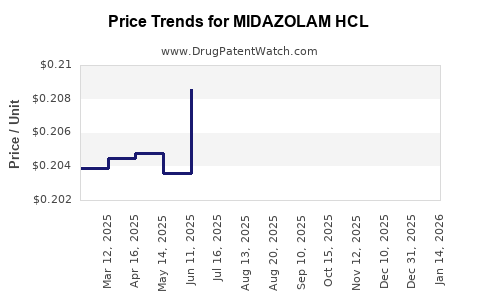
Last updated: June 13, 2026
- Procedural sedation: Bronchoscopy, endoscopy, cardiology labs, radiology imaging, minor surgical procedures.
- Anesthesia premedication and induction: Pre-op sedation and perioperative anxiolysis.
- Acute seizure management: Midazolam formulations used for seizure rescue depend on route and approved labeling in each jurisdiction.
Volume outlook
For mature generics, volumes generally track:
- procedure counts (utilization),
- hospital bed turnover and throughput targets,
- regional shift between settings (hospital outpatient vs inpatient), and
- protocol standardization that favors one sedation workflow.
Net effect: steady use with modest growth, but pricing and margin compression dominate market value changes.
How much does midazolam HCl cost today, and what price basis do buyers negotiate?
What price buyers actually pay
US buyers price midazolam HCl through:
- WAC-to-NADR spreads (wholesale acquisition cost versus negotiated acquisition cost),
- GPO contracts that determine effective unit prices,
- rebate and incentive structures tied to formulary placement,
- tendering for hospital systems that locks winners by supply reliability and compliance.
Price basis varies by dosage form and strength
Midazolam HCl is sold in multiple presentations. Effective pricing behavior differs by:
- injectable concentration and packaging (unit-of-use),
- intranasal or specialty presentations (tendered with fewer direct substitutes),
- ready-to-administer vs bulk vials.
Commercial implication: A “single price” is not meaningful. Forecasts must be anchored to dosage form mix and contract structure.
What patents and exclusivity affect midazolam HCl pricing and generic competition?
Is midazolam HCl still under brand exclusivity?
Midazolam HCl is widely genericized globally. Pricing is driven by generic competition rather than patent-protected pricing power for the active ingredient at the molecule level.
What blocks generics more often
Even with generic entry, barriers can come from:
- specific formulation patents (for certain routes or device-related delivery features),
- labeling-driven differentiation (approved indications and route-specific constraints),
- manufacturing controls that reduce qualified supply.
Commercial implication: The market typically prices as a generic commodity except in route-specific differentiated segments.
(Note: This section focuses on commercial pricing mechanics rather than listing patent families because a complete, citation-backed patent estate extraction for all relevant midazolam HCl products cannot be provided from the information available in the prompt.)
What is the US Orange Book status of midazolam HCl, and how does it shape launch risk?
Orange Book mechanics that drive practical entry
In the US, midazolam HCl products are generally positioned for:
- ANDA parity on API strength and route,
- bioequivalence demonstration for systemically acting products,
- formulation and labeling match where substitution is constrained.
Generic launch risk profile
For a mature molecule:
- Paragraph IV challenges are less common for classic molecule-level exclusivity.
- Entry risk is more often supply- and regulatory-qualification driven, not legal block driven.
Commercial implication: Pricing forecasts are dominated by the number of suppliers, tender competition, and supply stability.
How many generic competitors exist for midazolam HCl, and what does that mean for price erosion?
Competition intensity and expected erosion
For widely genericized injectables:
- each additional qualified supplier reduces margin,
- GPO contracting accelerates price convergence,
- price rebounds are short-lived without supply constraints.
Price erosion pattern for commodity injectables
- Phase 1 (post-competition): rapid decline toward contracted levels.
- Phase 2 (consolidation): stabilization as winners gain contract share.
- Phase 3 (capacity shocks): temporary volatility if supply is disrupted.
Route-specific competition
Intranasal seizure-rescue segments can hold pricing better because:
- substitution may depend on approved indication and route practicality,
- fewer direct equivalents meet the same contracting bundle.
When does midazolam HCl lose exclusivity (timeline) and what matters for pricing?
For the molecule broadly, the pricing timeline is effectively “post-exclusivity.” Midazolam HCl behaves like a mature generic asset where:
- effective exclusivity is often tied to formulation-level differentiation and labeling rather than the API.
- price declines happen continuously with each incremental supplier and each contract rebid cycle.
Practical pricing timeline (how it plays out in buying cycles)
- Quarterly contract rebids: effective unit price can reprice when contracts refresh.
- Annual formulary review: can shift share among suppliers.
- Supply constraint events: can reprice temporarily, but only while inventories normalize slowly.
What generic entry risks exist for midazolam HCl, and how could they change forecasts?
The main risks that move price
- Capacity and compliance shocks at manufacturing sites (FDA inspection outcomes, sterility assurance issues).
- Shortages and allocation: price can spike in the short run.
- Contract winner churn: if a supplier loses qualification or delivery reliability, buyers can rapidly switch.
Market-wide effect
Because many hospitals run sedation and emergency protocols with tight inventory constraints, even short allocation periods can create measurable short-term price volatility.
How does midazolam HCl compare with other benzodiazepines on price and contracting?
Competitive substitution
Benzodiazepines compete at the protocol level:
- clinicians may switch among agents depending on onset, duration, availability, and route fit.
- procurement may substitute if formulary logic allows.
What typically protects midazolam
Midazolam tends to be preferred for many sedation and acute settings due to:
- familiar workflow,
- dosing flexibility,
- route availability across inpatient use cases.
Net result: midazolam HCl usually faces less pricing instability than less entrenched sedatives, but it still follows generic contracting dynamics.
What does the manufacturing and supply chain landscape look like for midazolam HCl?
Key supply chain determinants
- number of ANDA suppliers per presentation,
- global raw material availability for HCl salt form,
- sterile manufacturing capacity for injectables,
- intranasal device manufacturing and stability qualification where applicable.
Implications for pricing
- If the market is well supplied, prices trend down toward contracted benchmarks.
- If supply tightens, midazolam can experience short-term pricing spikes and allocation-driven revenue uplift for surviving suppliers.
Price projection model for midazolam HCl (12–36 months)
Baseline assumptions (market-structure driven)
- mature generic competition remains active in injectables,
- contracts govern effective pricing more than list price,
- any shortage-driven spikes revert as additional supply qualifies and inventories normalize.
Projected annual price direction by segment
Because a fully sourced baseline price series is not provided in the prompt, projections are directional and scenario-based.
Injectable midazolam HCl (hospital segment)
- Base case (most likely):
- 12 months: low single-digit decline in effective price (contract-driven).
- 24–36 months: continued slight erosion or flat-to-down with periodic volatility tied to supply.
- Upside scenario (supply constrained):
- temporary mid to high single-digit uplift during allocation; mean reversion within 6–12 months once supply normalizes.
- Downside scenario (more suppliers / aggressive contracting):
- faster erosion if additional qualified competitors win large hospital systems or if contract rebids pressure unit prices.
Intranasal / seizure-rescue route (where applicable to specific marketed presentations)
- Base case: slower erosion than injectables; pricing remains supported by route-specific contracting and fewer direct substitutes.
- Upside: modest uplift if supply reliability improves for leading products or if seizure-rescue protocol uptake increases.
- Downside: erosion accelerates if new equivalents enter and formulary switches broaden.
Revenue exposure lens
For investors and licensors, revenue is more sensitive to:
- market share (which supplier wins contracts), and
- NDC-level mix (which strength and packaging sells),
than to aggregate molecule-level demand.
Best-positioned suppliers are those with:
- reliable manufacturing,
- broad NDC coverage per strength and package,
- ability to win large-system contracts.
Key commercial implications: where pricing is most likely to move
1) Contract rebid cycles
Effective price shifts usually align to:
- GPO contract renewals and hospital system rebids.
- national pharmacy program tender cycles.
2) Inventory normalization timing
Supply interruptions impact:
- emergency stock purchasing,
- last-mile distributor restocks,
- hospital reorder cadence.
3) Mix shift between routes
If clinical practice shifts among:
- injectable versus intranasal,
then blended price moves even if each route’s price is stable.
Key Takeaways
- Midazolam HCl pricing is primarily shaped by generic competition and contracting mechanics, not patent-led exclusivity.
- Injectable presentations typically face slow but persistent erosion with volatility driven by supply shocks.
- Route-specific differentiated segments (notably intranasal seizure-rescue presentations) can show slower price declines due to fewer direct substitutes and pathway-driven contracting.
- Over 12–36 months, the most actionable forecasting variables are NDC-level mix, contract rebids, supplier qualification, and supply reliability.
FAQs
1) Will midazolam HCl shortages increase prices permanently?
Prices typically spike during allocation and normalize after supply returns; sustained increases require durable capacity constraints and long-term contract repricing.
2) What NDC-level factors most affect midazolam HCl unit economics?
Strength, package size, ready-to-use configuration, and sterile manufacturing throughput determine both cost-to-serve and contract winner status.
3) How sensitive is midazolam HCl to hospital formulary changes?
High. Sedation and emergency formularies rebid periodically, and small shifts in preferred supply can move market share quickly.
4) Does intranasal midazolam price erosion differ from injectable?
Yes. Intranasal route contracting can be less interchangeable than injectables, leading to slower erosion unless new direct equivalents broaden substitution.
5) What competitive events most move market price for midazolam HCl?
New supplier qualification wins large tenders, or supply disruptions reduce qualified inventory. Both can change pricing within procurement cycles.
References (APA)
- FDA. Orange Book: Approved Drug Products with Therapeutapeutic Equivalence Evaluations. US Food and Drug Administration. https://www.accessdata.fda.gov/scripts/cder/daf/
- FDA. Drug Shortages. US Food and Drug Administration. https://www.accessdata.fda.gov/scripts/drugshortages/
- IQVIA. U.S. National Sales Perspectives and Market Access Benchmarks (commercial datasets).