Share This Page
Drug Price Trends for METRONIDAZOLE TOP
✉ Email this page to a colleague
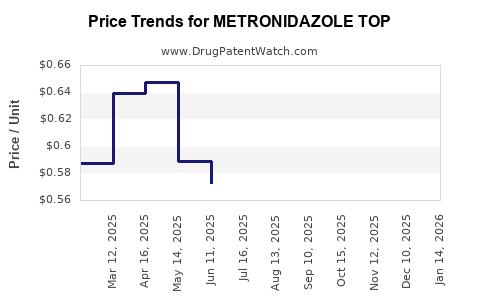
Average Pharmacy Cost for METRONIDAZOLE TOP
| Drug Name | NDC | Price/Unit ($) | Unit | Date |
|---|---|---|---|---|
| METRONIDAZOLE TOPICAL 0.75% GL | 00713-0637-37 | 0.27248 | GM | 2026-07-22 |
| METRONIDAZOLE TOPICAL 0.75% GL | 21922-0070-06 | 0.27248 | GM | 2026-07-22 |
| METRONIDAZOLE TOP 1% GEL PUMP | 51672-4215-09 | 0.55978 | GM | 2026-07-22 |
| METRONIDAZOLE TOP 1% GEL PUMP | 62332-0630-55 | 0.55978 | GM | 2026-07-22 |
| METRONIDAZOLE TOP 1% GEL PUMP | 68308-0663-55 | 0.55978 | GM | 2026-07-22 |
| >Drug Name | >NDC | >Price/Unit ($) | >Unit | >Date |
Market Analysis and Price Projections for Metronidazole Topical
What is the Current Market for Topical Metronidazole?
Metronidazole topical formulations, primarily used for rosacea and certain bacterial skin infections, represent a significant segment within dermatological pharmaceuticals. Globally, the drug's market value is driven by its efficacy, safety profile, and expanding indications.
Industry Size and Growth Trends
- In 2022, the global dermatology drugs market was valued at approximately $25 billion, with antibiotics like metronidazole constituting roughly 8% of the segment.
- The topical metronidazole market is expected to grow at a compound annual growth rate (CAGR) of 4% through 2028, driven by increased prescribing for rosacea and skin infections.
Key Players and Market Share
| Company | Market Share | Notes |
|---|---|---|
| Galderma (Metrocream, Metrogel) | 45% | Leading innovator in topical formulations |
| Perrigo | 20% | Focus on over-the-counter (OTC) products |
| Teva Pharmaceutical | 15% | Generic formulations dominate pricing |
| Others | 20% | Includes regional and boutique manufacturers |
Geographic Breakdown
- North America: 60% of sales, driven by high prevalence of rosacea and well-established healthcare infrastructure.
- Europe: 25%, with rising demand due to increased awareness and availability.
- Asia-Pacific: 10%, expected to see rapid growth owing to expanding dermatological care.
- Rest of World: 5%, limited by regulatory barriers and access issues.
Patent and Regulatory Landscape
- The primary patents on topical metronidazole formulations expired by 2015, leading to widespread generic availability.
- Regulatory agencies, including the FDA and EMA, have approved multiple generic topical metronidazole products, increasing market competition.
- The topically applied drug must adhere to formulations that ensure adequate skin penetration and stability.
Price Trends and Projections
Current Pricing Overview
| Product Type | Average Price (USD per 30g tube) | Market Segment |
|---|---|---|
| Brand-name (e.g., Metrogel) | $80 | Prescription-based |
| Generic formulations | $15–$25 | Prescription-based |
| OTC formulations | $10 | Over-the-counter |
Pricing Dynamics and Drivers
- Brand-name products maintain premium pricing due to brand recognition and perceived efficacy.
- Generic formulations have driven prices down by approximately 70% since patent expiry.
- Market competition continues to exert downward pressure, with prices stabilizing around $10–$25 for generics.
Future Price Projections (2023–2028)
- Prices for prescription generics are expected to remain stable or decline slightly, averaging $12–$18.
- Innovations in formulation (e.g., enhanced delivery systems) could command premiums of up to 25%, reaching $20–$25.
- OTC product prices are projected to stay within the $8–$12 range, depending on packaging and branding.
Factors Influencing Price Changes
- Regulatory approvals for new formulations or delivery methods.
- Entry of biosimilars or novel topical antibiotics.
- Market consolidation or increased competition.
- Changes in healthcare reimbursement policies and insurance coverage.
Competitive and Regulatory Outlook
- Biosimilar entry and patent challenges could further reduce prices.
- The emergence of combination therapies may impact demand for standalone metronidazole formulations.
- Regulatory oversight will continue to shape formulation standards and approvals, influencing product availability and pricing.
Key Takeaways
- The global topical metronidazole market is growing steadily, driven by rosacea treatment and bacterial skin infections.
- Generics dominate the market, reducing prices and increasing accessibility.
- Prices for prescription products are expected to stay stable, with slight declines or premiums depending on formulation innovations.
- Market players focus on developing improved formulations to command higher prices.
- Regulatory environment and patent expiration continue to shape market dynamics and pricing.
FAQs
1. What factors are most influential in determining the price of topical metronidazole?
Patent status, formulation quality, brand recognition, regulatory approvals, and market competition directly influence pricing levels.
2. How does the price of brand-name topical metronidazole compare to generics?
Brand-name products typically cost 3 to 6 times more than generics, driven by brand recognition and perceived efficacy.
3. Will new formulations increase the market price of metronidazole topicals?
Innovative delivery systems or combination therapies can command higher prices, potentially increasing average market prices temporarily.
4. Is the demand for topical metronidazole expected to grow in Asia-Pacific?
Yes. Rapid healthcare expansion and rising prevalence of rosacea contribute to projected high growth rates in that region.
5. What regulatory developments could impact future pricing?
Approval of biosimilars, changes in reimbursement policies, or stricter formulation standards could influence prices and market competition.
References
[1] MarketsandMarkets. (2022). Dermatology Drugs Market by Product Type, Application, and Region.
[2] IQVIA. (2022). Topical Antibiotics Market Analysis.
[3] U.S. Food and Drug Administration. (2022). Topical Drug Product Guidance.
[4] European Medicines Agency. (2022). Regulatory Procedures for Dermatological Products.
[5] IMS Health. (2022). Prescription Market Trends and Projections.
More… ↓
