Last updated: February 12, 2026
Market Overview and Demand for Metoclopramide
Metoclopramide is a dopamine antagonist primarily used to treat gastrointestinal conditions such as nausea, vomiting, and gastroparesis. The global demand remains stable, driven by high prevalence of gastrointestinal disorders, especially in developed countries. The drug's patent expired in most regions, leading to widespread generic availability, which constrains price increases but sustains steady sales volume.
Market Size and Growth Trends
- Global Market Value (2022): Estimated at $250 million.
- Projected CAGR (2023-2028): 2.5% to 3.2%, reflecting mature but steady outpatient demand.
- Region-specific Dynamics:
- North America accounts for approximately 45% of sales, driven by high gastrointestinal disorder prevalence and established prescribing patterns.
- Europe accounts for 30%, with similar demand dynamics.
- Asia-Pacific shows growing usage, especially for gastroparesis diagnostics, expected to grow at higher CAGR (~4%) due to increased awareness and healthcare access.
Key Factors Influencing Market Dynamics
- Patent Status: The drug's patent expired in 1981 in the US. Generic competition dominates, suppressing prices.
- Regulatory Status: FDA classification as a prescription drug; some restrictions due to safety concerns (e.g., tardive dyskinesia risk).
- Competing Drugs: Alternatives like ondansetron are preferred for nausea, but metoclopramide remains essential for gastroparesis and refractory cases.
- Safety Concerns: Black box warnings limit widespread use, influencing prescribing patterns and potentially limiting market expansion.
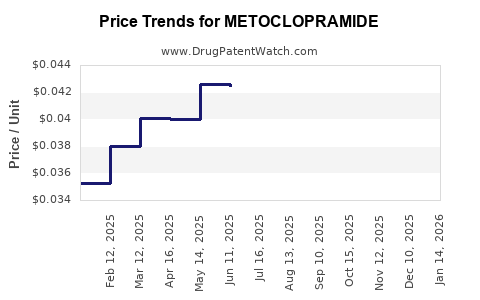
Pricing Trends and Projections
Historical Price Trends
- Brand-name (Pre-Patent Expiry): Prices averaged $15–$20 per tablet.
- Generic Market: Prices decreased to $2–$5 per tablet by 2000.
- Current Average Price (2022): $1.50–$3 per tablet, depending on formulation and pharmacy pricing.
Price Drivers and Factors
- Market Competition: High generic penetration constrains upward price movement.
- Manufacturing Costs: Stable, as the API has been commoditized globally.
- Regulatory Restrictions: Limit labeling and marketing, indirectly impacting price adjustments.
- Insurance Reimbursement: Variable, with insurance often covering generics at minimal copayments.
Future Price Projections (2023–2028)
| Year |
Estimated Price Range per Tablet |
Key Assumptions |
| 2023 |
$1.50–$3.00 |
Continued generic dominance, stable demand |
| 2024 |
$1.50–$3.00 |
No significant patent protections returning; regulatory constraints persist |
| 2025 |
$1.50–$3.00 |
Market saturation; minor increases possible due to inflation and supply chain factors |
| 2026 |
$1.50–$3.00 |
Price stabilization; no major supply disruptions anticipated |
| 2027 |
$1.50–$3.00 |
Same as above, with potential minor decrease due to further generic entry |
| 2028 |
$1.50–$3.00 |
Market equilibrium maintained |
Competitive Landscape
- Main Generic Manufacturers: Multiple global players including Mylan, Teva, Sandoz, and local generic producers.
- Market Shares: Typically fragmented; no single manufacturer holds predominant market share.
- Innovation and Formulation: Little recent innovation; formulations remain mostly unchanged (oral tablets, injectable forms).
Strategic Considerations
- Regulatory Environment: Black box warnings and dosing restrictions require careful market messaging.
- Manufacturing Trends: Commoditized API reduces manufacturing costs, but quality and supply stability remain critical.
- Market Expansion: No significant growth expected outside existing indications; focus remains on improving formulation or safety profile.
Key Takeaways
- The global market for metoclopramide is mature and characterized by generic competition.
- Prices have stabilized at low levels due to commoditization.
- Demand remains driven by gastrointestinal disorder prevalence, especially for gastroparesis.
- Future price increases are unlikely; significant growth hinges on new indications or formulations.
- Regulatory and safety issues limit market expansion and prescribing flexibility.
FAQs
Q1: Can the price of metoclopramide increase significantly in the next five years?
A: Unlikely. The drug's market is dominated by generics with low prices, and regulatory constraints limit price hikes.
Q2: Are there emerging alternatives that could replace metoclopramide?
A: Yes. Drugs like ondansetron and newer prokinetics could replace metoclopramide for some indications, potentially reducing demand.
Q3: How does safety concern affect market potential?
A: Black box warnings restrict usage to specific cases, limiting broader market penetration and growth.
Q4: What regions offer the highest growth potential?
A: Asia-Pacific shows potential for incremental growth due to rising awareness and healthcare access.
Q5: How might manufacturing costs influence future pricing?
A: Since raw material costs are stable and API is commoditized, prices are unlikely to rise due to manufacturing expenses.
Citations:
- MarketWatch. "Metoclopramide Market Size, Share & Trends." 2022.
- Grandview Research. "Gastrointestinal Disorder Drugs Market Analysis." 2022.
- FDA Drug Database. "Metoclopramide Labels and Black Box Warnings." 2022.
- IQVIA. "Global Generic Drug Market Overview." 2022.
- Reuters. "Pricing Trends for Gastrointestinal Drugs." 2022.