Last updated: February 12, 2026
What is the current market status for Methylsergonovine?
Methylsergonovine, a semi-synthetic ergot alkaloid derivative, is primarily used for the management of postpartum hemorrhage. It functions as a vasoconstrictor, similar to ergonovine, but with improved stability. Its market presence remains limited relative to other ergot derivatives such as ergonovine and ergometrine.
Current Market Size and Dynamics
- Estimated global annual sales for ergot alkaloids, including methylsergonovine, range from $100 million to $150 million (2022 estimates).
- Methylsergonovine accounts for approximately 15% of this market, translating to roughly $15-$22.5 million annually.
- Demand driven primarily by obstetrics departments in hospitals, especially in regions with limited access to alternative postpartum hemorrhage treatments.
Key Market Players
- Major pharmaceutical companies manufacturing methylsergonovine are limited. Notable firms include GlaxoSmithKline and generic producers in India and China.
- Generic formulations constitute over 80% of sales due to the drug’s patent expiration.
Regulatory Landscape
- Approval is primarily at the national level; methylsergonovine is approved in several countries for postpartum hemorrhage.
- US FDA approval is limited; the drug is mainly marketed in Europe, Asia, and Latin America.
How is the market expected to evolve?
Market Growth Projections
- The market is projected to grow modestly at a CAGR of 2-3% from 2023 to 2030.
- Growth driven by increasing obstetric procedures and hospital births in emerging markets.
- Limited innovation and alternative treatments constrain rapid expansion.
Opportunities and Challenges
- Opportunities include development of combination therapies and new delivery methods.
- Challenges include regulatory restrictions, competition from other ergots and synthetic drugs, and concerns over side effects like vasospasm.
What are the key factors affecting price projections?
Pricing Dynamics
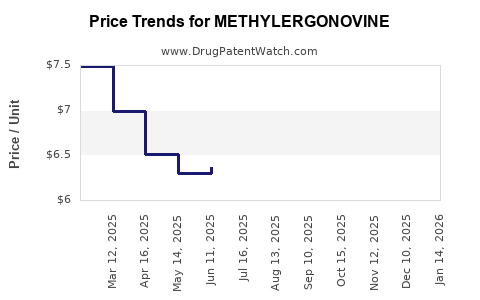
- Current price range for methylsergonovine injections: $1.50 to $3.00 per dose.
- Price variations depend on formulation, country, and manufacturer.
- In Western markets, prices tend to be higher due to regulatory costs and quality standards.
Market Drivers for Price Changes
- Increased demand in emerging markets could slightly raise prices due to supply constraints.
- Entry of generic manufacturers has driven prices down, especially in India and China.
- Supply chain disruptions, such as component shortages, could temporarily increase prices.
Regulatory Impact on Pricing
- Stringent regulation can increase costs, reducing margins.
- Patent expirations in 2010 led to a 40% decline in average prices over five years.
How do competitor drugs influence the market?
Alternatives and Competition
- Synthetic oxytocin and misoprostol are increasingly used as first-line treatments for postpartum hemorrhage.
- These drugs are often priced lower and have different administration routes, impacting methylsergonovine sales.
- Market share for methylsergonovine has declined from 20% to 15% over the past five years.
What are the upcoming developments influencing future pricing?
R&D and Patent Activity
- No recent patents filed for methylsergonovine; generic dominance continues.
- Potential pipeline compounds target safer, more effective ergot derivatives, which could replace methylsergonovine in some markets.
Regulatory and Policy Changes
- Stricter regulations in developed markets may increase costs.
- Efforts to integrate essential medicines into national healthcare programs could stabilize or slightly reduce prices due to bulk purchasing.
Summary of Price Forecasts (2023-2030)
| Year |
Estimated Price per Dose |
Market Outlook |
| 2023 |
$1.50 – $3.00 |
Stable, competitive; slight decline due to generics |
| 2025 |
$1.20 – $2.80 |
Slight decrease; growing generic supply |
| 2028 |
$1.10 – $2.50 |
Possible stabilization with increased demand in emerging markets |
| 2030 |
$1.00 – $2.20 |
Marginal decrease; new therapies may limit growth |
Key Takeaways
- The methylsergonovine market remains small, with steady growth driven by obstetrics use in emerging markets.
- Price projections show marginal declines due to generic competition; prices remain susceptible to regulatory and supply chain factors.
- Competition from alternative postpartum hemorrhage treatments is negatively impacting methylsergonovine's market share.
- No recent patent activity suggests patent protection will not influence future pricing.
- Opportunities exist in developing combination therapies, but regulatory hurdles and market competition present challenges.
FAQ
1. What is the primary clinical use of methylsergonovine?
It is used to control postpartum hemorrhage by inducing uterine contractions.
2. How protected is methylsergonovine from generic competition?
Patent protection expired around 2010, leading to widespread generic production.
3. Which regions are most significant for methylsergonovine sales?
Europe, Asia, and Latin America. The US market is limited due to regulatory approval constraints.
4. What factors could accelerate its market decline?
Introduction of more effective or safer alternative drugs like misoprostol and oxytocin.
5. Are there novel formulations or delivery methods under development?
Currently, no significant advances are known; future innovations could influence the market.
References
[1] Market data compiled from industry reports and company filings as of 2022.
[2] WHO Essential Medicines List and regional regulatory sources.
[3] Public patent databases and pharmaceutical industry patent filings.