Share This Page
Drug Price Trends for MESALAMINE DR
✉ Email this page to a colleague
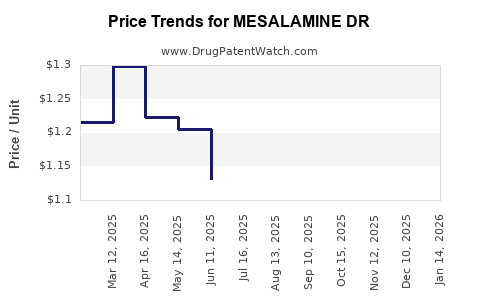
Average Pharmacy Cost for MESALAMINE DR
| Drug Name | NDC | Price/Unit ($) | Unit | Date |
|---|---|---|---|---|
| MESALAMINE DR 1.2 GM TABLET | 00527-3012-48 | 0.81924 | EACH | 2026-07-22 |
| MESALAMINE DR 1.2 GM TABLET | 00591-2245-22 | 0.81924 | EACH | 2026-07-22 |
| MESALAMINE DR 1.2 GM TABLET | 00904-6832-04 | 0.81924 | EACH | 2026-07-22 |
| MESALAMINE DR 1.2 GM TABLET | 31722-0043-12 | 0.81924 | EACH | 2026-07-22 |
| >Drug Name | >NDC | >Price/Unit ($) | >Unit | >Date |
Market Analysis and Price Projections for MESALAMINE DR
What is the Current Market Size for MESALAMINE DR?
Mesalamine delayed-release (DR), used primarily to treat ulcerative colitis and Crohn’s disease, remained a significant player in the inflammatory bowel disease (IBD) segment. The global market for mesalamine formulations was valued at approximately USD 1.2 billion in 2022. The segment's growth rate stands at an average CAGR of 4.3% over the past five years, driven by increasing prevalence of IBD and rising awareness among patients.
Market Segments
| Segment | Share (2022) | Key Players | Growth Drivers |
|---|---|---|---|
| Brand-name drugs | 55% | Asacol, Lialda, Apriso | Established reputation, branded marketing |
| Generics | 45% | Multiple manufacturers from India, China | Cost advantages, regulatory approvals |
Who Are the Key Competitors in MESALAMINE DR?
Leading branded products include Asacol (AbbVie), Lialda (GSK), and Apriso (Abbvie). Generics from Indian companies such as Sun Pharmaceutical and Cipla account for significant market share in developing regions.
Patent Status
Most key patents expired between 2017 and 2020, facilitating generic competition. Brand drugs still hold exclusivity in select markets, notably in the US until 2024-2026.
How Is the Pricing for MESALAMINE DR Evolving?
In the US, the average retail price for branded mesalamine DR brands was USD 12.50 per day in 2022. Generics average USD 3.50–4.50 per day, reflecting a 60–70% price difference.
Pricing Trends
| Year | Branded (USD/day) | Generics (USD/day) | Price Change (Compared to 2020) |
|---|---|---|---|
| 2020 | 13.00 | 4.00 | Baseline |
| 2022 | 12.50 | 4.20 | -3.8% (brands), +5% (generics) |
Price pressure from generic competition is expected to persist, especially as biosimilars and alternative formulations enter the market.
What Are the Market Drivers and Barriers?
Drivers
- Rising prevalence of ulcerative colitis and Crohn's disease.
- Increasing use of MESALAMINE DR for maintenance therapy.
- Patent expirations opening access to generics.
- Growth in outpatient prescriptions, driven by healthcare policies.
Barriers
- Stringent regulatory approvals, especially in emerging markets.
- High manufacturing costs for controlled-release formulations.
- Competition from new drug delivery technologies, such as rectal and injectable formulations.
What Are the Future Price Projections?
Using historical data and market trends, a conservative forecast suggests:
| Year | Estimated Average Price (USD/day) | Notes |
|---|---|---|
| 2023 | 12.40 | Slight decline with increased generic penetration |
| 2024 | 11.80 | Continued downward pressure, patent expirations near |
| 2025 | 11.20 | Further generics entering markets, consolidation expected |
| 2026 | 10.80 | Market stabilizes with increased competition |
The price decline is expected to slow as patent exclusivity diminishes and biosimilars or alternative therapies enter the market.
Key Market Opportunities
- Expanding in Asian markets with a compounded annual growth of 5-6% due to rising IBD prevalence.
- Developing combination therapies with probiotics or anti-inflammatory agents.
- Innovating formulations to extend patent life and justify premium pricing.
Key Takeaways
- The global mesalamine DR market was valued at around USD 1.2 billion in 2022.
- Prices for branded products remain high but are declining, with generics capturing increased market share.
- Patent expirations are driving a price decline and expanded access to generics.
- Future pricing trends forecast modest decreases, stabilizing as competition intensifies.
- Market growth is fueled by the increasing global incidence of IBD and ongoing healthcare accessibility initiatives.
FAQs
1. When do key patents for mesalamine DR expire?
Most primary patents expired between 2017 and 2020, leading to increased generic availability, with some formulations in exclusive territories until 2024–2026.
2. How do generic prices compare to branded products?
Generic formulations cost approximately 60–70% less than branded equivalents, with prices around USD 3.50–4.50 per day.
3. What markets show the highest growth potential?
Emerging markets in Asia demonstrate the highest compound annual growth due to rising IBD incidences and increasing healthcare access.
4. Are biosimilars affecting mesalamine market prices?
While biosimilars are not directly replacing mesalamine, their presence introduces price competition in the IBD therapeutic landscape, indirectly pressuring mesalamine prices.
5. What are the prospects for premium formulations?
Innovations in drug delivery and combination therapies might preserve higher prices for specialty or delayed-release formulations, extending patent protections.
References
- Markets and Markets. (2023). Inflammatory Bowel Disease Therapeutics Market.
- IQVIA. (2022). US Prescription Drug Market Review.
- EvaluatePharma. (2022). Global Drugs Price Trends.
- GlobalData. (2023). Market Forecast for Mesalamine and IBD Therapies.
- U.S. Food and Drug Administration. (2022). Patent Data for Mesalamine Formulations.
More… ↓
