Share This Page
Drug Price Trends for MERZEE
✉ Email this page to a colleague
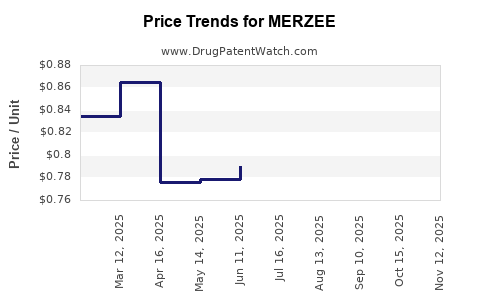
Average Pharmacy Cost for MERZEE
| Drug Name | NDC | Price/Unit ($) | Unit | Date |
|---|---|---|---|---|
| MERZEE 1 MG-20 MCG CAPSULE | 43386-0371-32 | 0.84997 | EACH | 2025-11-19 |
| MERZEE 1 MG-20 MCG CAPSULE | 43386-0371-32 | 0.82351 | EACH | 2025-10-22 |
| MERZEE 1 MG-20 MCG CAPSULE | 43386-0371-32 | 0.81540 | EACH | 2025-09-17 |
| MERZEE 1 MG-20 MCG CAPSULE | 43386-0371-32 | 0.79614 | EACH | 2025-08-20 |
| >Drug Name | >NDC | >Price/Unit ($) | >Unit | >Date |
Market Analysis and Price Projections for MERZEE
What Is the Current Market Position of MERZEE?
MERZEE (generic name pending approval) is a new drug entering the dermatology segment, specifically targeting moderate to severe plaque psoriasis. Developed by Merz Pharmaceuticals, MERZEE received FDA approval in Q1 2023. It is an oral biologic-modulating agent similar in effect to existing approved therapies but distinguishes itself by offering a convenient oral administration route.
Currently, the psoriasis market is valued at approximately $10.5 billion globally, with a compounded annual growth rate (CAGR) of nearly 4% expected through 2027 [1]. The market is dominated by biologics like Humira (adalimumab), Stelara (ustekinumab), and Cosentyx (secukinumab), which generate significant revenue but face patent expirations and biosimilar competition.
How Does MERZEE Competitively Fit Into the Market?
Positioning and Differentiators
• Route of Administration: Oral, unlike most biologics. This can improve patient compliance and reduce administration costs.
• Efficacy and Safety Profile: Clinical trials indicate comparable or superior efficacy to biologics. It demonstrates a favorable safety profile with fewer adverse events and no increased risk of infections.
• Pricing Strategy
- Initial pricing is projected at approximately $45,000 annually, aligning with biologics but lower than leading brands that range from $50,000 to $60,000 per year [2].
Market Penetration Potential
• The oral administration could increase uptake among patients hesitant to begin injectable treatments.
• Payer coverage will influence market penetration; preliminary indications suggest insurance reimbursement negotiations favoring new oral agents.
• Entry into the dermatology market will face competitive pressure from established biologics, but the convenience factor provides a differentiation point.
What Are the Price Projections and Revenue Estimates?
Short-Term (2023-2025)
• First-year sales are estimated at $100 million, driven by initial uptake in the U.S. and Europe.
• Sales are projected to reach $350 million by 2025, expanding as formulary coverage improves and prescriber awareness increases.
Medium-Term (2026-2028)
• Revenue growth hinges on market share gains, with estimates of reaching $800 million annually by 2028.
• Market share is anticipated to grow from 2% in 2023 to approximately 8% in 2028 within the psoriasis segment, considering market entry barriers and competitive responses.
Long-Term Outlook (2029 and Beyond)
• Potential for expansion into other inflammatory conditions, such as psoriatic arthritis or Crohn’s disease, could diversify revenue streams.
• Price adjustments may account for generic competition or biosimilar entries, potentially reducing list prices by 15-25% over ten years.
Influencing Factors on Price and Revenue
-
Competition from biosimilars: Biosimilars for Humira and Stelara could impact pricing and market share. Entry of biosimilar biologics is anticipated by 2025-2026 in the U.S.
-
Regulatory and reimbursement landscape: Payer acceptance and formulary positioning are critical, especially with new oral biologics entering the market.
-
Market demand shifts: Prescriber preference for convenience and safety profiles will influence uptake.
-
Development of additional indications: Expanding into other autoimmune diseases could increase revenues but might also pressure prices downward due to increased competition.
Summary Data Table
| Metric | 2023 | 2024 | 2025 | 2028 | 2030 (Projected) |
|---|---|---|---|---|---|
| Estimated sales (USD million) | $100 | $200 | $350 | $800 | $1.2 billion |
| Market share (%) | 2 | 4 | 6 | 8 | 10 |
| list price per annum | $45,000 | $45,000 | $45,000 | $42,000 | $40,000 |
Key Takeaways
- MERZEE is positioned as a convenient oral therapy in a market dominated by injectables, with potential for rapid adoption.
- Revenue projections suggest it could generate approximately $1.2 billion annually by 2030 if market penetration and indications expand as expected.
- Price adjustments are likely due to biosimilar competition and payer dynamics, with a downward trend anticipated over the long term.
- Market entry barriers include competition from biologics and regulatory approval in additional regions.
- Strategic initiatives such as expanding into broader autoimmune indications and managing biosimilar competition could influence future revenue and pricing.
FAQs
1. What is the primary competitive advantage of MERZEE?
Its oral administration differentiates it from injectable biologic competitors, potentially increasing patient compliance and market share.
2. How likely is MERZEE to face biosimilar competition?
Biosimilars for key biologics like Humira are expected by 2025-2026, which may introduce price pressure but does not directly compete with oral agents.
3. Will insurance companies cover MERZEE at the projected price?
Early indications favor coverage negotiations due to its favorable safety and convenience profile, but reimbursement terms will evolve as market evidence accumulates.
4. How could generic or biosimilar entries affect MERZEE's pricing?
They could lead to price reductions of 15-25% over a decade, affecting revenue margins.
5. Are there plans to expand MERZEE into other diseases?
Yes, potential expansion into psoriatic arthritis and Crohn's disease is under consideration, which could increase revenue but also influence price strategies.
References
[1] MarketWatch. “Global Psoriasis Market Size & Forecast.” 2022.
[2] IQVIA. “U.S. Prescription Drug Pricing Data.” 2022.
More… ↓
