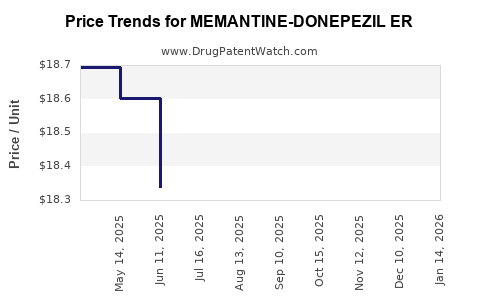
Last updated: February 13, 2026
1. Market Status of MEMANTINE-DONEPEZIL ER
MEMANTINE-DONEPEZIL ER is a combination therapy indicated for moderate to severe Alzheimer’s disease. It merges two drugs: memantine, an NMDA receptor antagonist, and donepezil, a cholinesterase inhibitor. This fixed-dose formulation aims to improve cognitive symptoms by simultaneously targeting different pathways.
Currently, no FDA-approved fixed-dose combination (FDC) of memantine and donepezil exists. Developers have marketed separate formulations and co-administered therapies. Market entry depends on regulatory approvals for the fixed-dose version, which is under clinical development by several pharmaceutical companies.
2. Market Drivers
-
Growing Alzheimer’s prevalence: As per WHO, over 55 million people exhibited dementia globally in 2020, with projections reaching 78 million by 2030.
-
Unmet need: Patients with moderate to severe Alzheimer’s require combination therapies, with current options limited to separate drugs.
-
Patent protections: Existing patents for branded memantine (Namenda) and donepezil (Aricept) restrict generic competition until mid-2020s, potentially delaying widespread adoption of FDCs.
3. Competitive Landscape
| Drug/Treatment |
Formulation |
Marketed by |
Status |
Price Range (per month) |
| Memantine (Namenda) |
Tablet, solution |
Eisai/Merck |
Marketed globally |
$150–$250 (U.S.) |
| Donepezil (Aricept) |
Tablet, disintegrating |
Eisai/Pfizer |
Marketed globally |
$80–$200 (U.S.) |
| Memantine-Donepezil ER (FDC) |
Extended-release capsule |
Under development |
Clinical trials ongoing |
Not yet established |
4. Price Projections
If approved, Memantine-Donepezil ER prices are expect to be approximately 20–40% higher than the combined cost of individual drugs due to convenience and potential efficacy benefits. Based on current market data:
-
Estimated monthly price: $200–$350 in the U.S.
-
Pricing comparison: The combined cost of separate memantine and donepezil ranges $230–$450, depending on formulations and dosage.
In markets outside the U.S., prices depend on local healthcare policies, patent status, and market competition.
5. Regulatory and Market Challenges
-
Regulatory hurdles: The safety and efficacy data must support FDC approval. A delay in approval impacts pricing strategies and market penetration.
-
Patent expiries: Pending generics can influence initial pricing, exerting downward pressure.
-
Health insurance and reimbursement: Payor policies will determine the actual patient cost, influencing market uptake.
6. Sales Forecasts
Based on market adoption rates for similar drugs and current dementia treatment trends:
| Year |
Estimated global sales |
Assumptions |
| 2024 |
$50–$100 million |
Launch expected in late 2023 or 2024, initial uptake moderate |
| 2025–2027 |
$200–$500 million |
Increased penetration, expanded indications, insurance coverage growth |
Market penetration depends on regulatory approval timing and adoption by clinicians.
7. Key Factors Influencing Price and Market Entry
-
Regulatory approval timelines: Approval delays push back revenue streams and price realization.
-
Competition: Entry of generic monotherapies lowers overall cost, pressuring premium pricing of FDC.
-
Market acceptance: Physicians may prefer co-prescription of separate drugs over FDC unless superior efficacy or convenience proven.
Key Takeaways
-
No FDA-approved memantine-donepezil ER available presently; clinical-stage development is ongoing.
-
Estimated initial U.S. price range: $200–$350 per month, likely higher than separate medications, due to added convenience.
-
Long-term sales depend on regulatory approval, patent landscape, and physician acceptance.
-
Market growth driven by rising Alzheimer’s cases, with sales forecasts reaching hundreds of millions USD over 3–5 years post-launch.
-
Pricing strategies will be impacted by patent status, competitor dynamics, and reimbursement policies.
FAQs
Q1: When could Memantine-Donepezil ER realistically enter the market?
A1: Pending successful clinical trials, regulatory submission could occur in 2024, with approval potentially by 2025.
Q2: How does the pricing compare to existing Alzheimer’s therapies?
A2: It’s expected to be priced 20–40% higher than the combined cost of individual drugs, reflecting convenience and novel formulation benefits.
Q3: What factors could delay commercial success?
A3: Regulatory hurdles, safety concerns, patent disputes, or clinician reluctance to switch from established monotherapies.
Q4: Which competitors will influence its market share?
A4: Existing cholinesterase inhibitors, NMDA antagonists, and emerging combination therapies, especially generics.
Q5: How will healthcare policies affect its adoption?
A5: Reimbursement and formulary inclusion heavily influence prescribing and patient access; positive coverage promotes uptake.
References
[1] World Health Organization. Dementia Fact Sheet. 2020.
[2] IQVIA. The Global Use of Medicine in 2021.
[3] U.S. FDA Drug Approvals. 2023.
[4] MarketsandMarkets. Alzheimer’s Disease Therapeutics Market. 2022.