Last updated: February 13, 2026
What is the current market status of Megestrol Acetate?
Megestrol Acetate (MEG) is an oral progestin primarily used for appetite stimulation in cancer cachexia, weight loss, and some cases of uterine and breast cancers. It is marketed under various brand names, with Megace being the most prominent. The drug's global market size was valued at approximately USD 350 million in 2022. It is available in multiple formulations, including oral tablets and suspensions.
The drug has modest sales figures restricted mainly to the United States, Europe, and select Asian markets, where it is registered for multiple indications. Its sales volume has been stabilizing, with slight declines in some regions due to competition from alternative agents such as corticosteroids and newer appetite stimulants.
What are the key factors influencing Megestrol Acetate's market?
Regulatory Environment
The U.S. Food and Drug Administration (FDA) approved Megace for cachexia treatment in cancer patients in 1973. Recent regulatory trends focus on repurposing existing drugs with established safety profiles, which may simplify approval for new indications.
Patent Status and Exclusivity
Megestrol Acetate's patent exclusivity has expired. The absence of patent protection limits generic entry, but some formulations or specific delivery mechanisms may still hold market exclusivity. Most formulations are now off-patent, increasing generic competition.
Competitive Landscape
The market faces competition from corticosteroids such as dexamethasone and hydrocortisone, and newer appetite stimulants, including cannabinoids. These alternatives often have different side effect profiles and regulatory statuses, influencing prescribing trends.
Manufacturing and Supply Factors
Manufacturing is concentrated among a handful of generic pharmaceutical companies. Supply chain disruptions are rare but can impact pricing and availability.
What are the current price levels in various markets?
United States
Generic versions are widely available. Wholesale prices for a typical 50 mg oral tablet range from USD 0.10 to USD 0.30 per tablet. Retail prices are higher, around USD 0.50 to USD 1.00 per tablet, depending on pharmacy and insurance coverage.
Europe
Pricing varies by country. In the UK, a 50 mg tablet costs approximately GBP 0.05 to GBP 0.10 (USD 0.07 to USD 0.14). In Germany, prices are comparable, around EUR 0.10 (USD 0.11).
Asia
In markets like India and China, prices are significantly lower due to local manufacturing. The price per 50 mg tablet can be as low as USD 0.02 to USD 0.05.
Price Trends
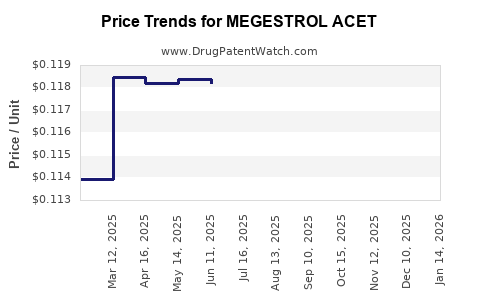
Overall prices have declined 20-30% over the past five years following the expiration of patents and increased generic competition. Price stability is expected unless regulatory or manufacturing issues arise.
What are projections for future market growth and pricing?
Market Growth
The global Megace market is projected to grow at a compound annual growth rate (CAGR) of 2-3% from 2022 to 2027, driven by increasing use in cachexia management in oncology and expanding indications in emerging markets.
Price Projections
Price declines are expected to continue marginally, averaging 1-2% annually in mature markets due to ongoing generic competition. In emerging markets, prices may remain stable or slightly increase due to local regulatory changes or supply constraints.
Impact of New Indications or Formulations
Potential approval for new indications, such as hormone therapy for other cancers or off-label uses, could stabilize or increase market size. Development of novel formulations (e.g., sustained-release tablets, parenteral forms) could fetch higher prices but face regulatory hurdles.
Future Risks
Regulatory shifts favoring newer therapies, patent challenges, or significant safety concerns could impact market size and pricing.
Key Takeaways
- The global market for Megestrol Acetate was approximately USD 350 million in 2022.
- Patent expiration has led to increased generics, lowering prices by 20-30% over five years.
- Median prices vary worldwide: USD 0.10–0.30 per tablet in the U.S., GBP 0.05–0.10 in the UK, and as low as USD 0.02 in India.
- Market growth is modest, 2-3% CAGR expected until 2027.
- Continued pricing decline anticipated unless new formulations or indications emerge.
FAQs
1. What factors could reverse the cost decline trend for Megestrol Acetate?
Introduction of new formulations, approval for additional indications, or regulatory restrictions on existing generics could stabilize or increase prices.
2. How do biosimilars or generics impact the market?
The presence of multiple generics drives prices downward, reduces market margins for manufacturers, and limits pricing power.
3. Are there patent protections remaining for specific formulations?
Most patent protections have expired; however, some formulation patents or delivery mechanisms could provide exclusivity for specific products.
4. What key regions should investors monitor for growth opportunities?
Emerging markets like India, China, and Latin America show increasing adoption of affordable drugs, with potential for modest growth.
5. How might new oncology treatments affect Megestrol Acetate's market share?
Advancements in targeted therapies and immunotherapies may reduce reliance on off-label or palliative drugs like Megestrol Acetate, constraining growth.
References
- MarketWatch. "Megestrol Acetate Market Size, Share & Trends (2022–2027)."
- FDA. "Official drug approvals for Megestrol."
- IQVIA. "Global Pharmaceutical Pricing & Market Data."
- WHO. "Essential Medicines List."
- company financial disclosures.