Share This Page
Drug Price Trends for MEDICATED WART REMOVER STRIP
✉ Email this page to a colleague
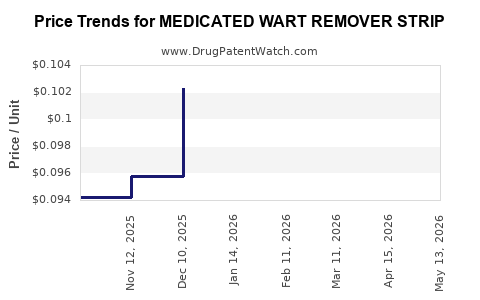
Average Pharmacy Cost for MEDICATED WART REMOVER STRIP
| Drug Name | NDC | Price/Unit ($) | Unit | Date |
|---|---|---|---|---|
| MEDICATED WART REMOVER STRIP | 70000-0732-01 | 0.10119 | EACH | 2026-05-20 |
| MEDICATED WART REMOVER STRIP | 70000-0732-01 | 0.09753 | EACH | 2026-04-22 |
| MEDICATED WART REMOVER STRIP | 70000-0732-01 | 0.09746 | EACH | 2026-03-18 |
| MEDICATED WART REMOVER STRIP | 70000-0732-01 | 0.10175 | EACH | 2026-02-18 |
| MEDICATED WART REMOVER STRIP | 70000-0732-01 | 0.10310 | EACH | 2026-01-21 |
| MEDICATED WART REMOVER STRIP | 70000-0732-01 | 0.10231 | EACH | 2025-12-17 |
| >Drug Name | >NDC | >Price/Unit ($) | >Unit | >Date |
Market Analysis and Price Projections for the Medicated Wart Remover Strip
Introduction
The wart removal segment remains a robust niche within the over-the-counter dermatological care market. Among various formulations, medicated wart remover strips have gained popularity due to their convenience, minimally invasive application, and efficacy. This analysis offers a comprehensive overview of the current market landscape for medicated wart remover strips, explores market drivers and challenges, and projects future price trends based on industry insights and competitive dynamics.
Market Overview
Product Profile
Medicated wart remover strips are adhesive patches embedded with keratolytic agents, primarily salicylic acid, designed to eliminate common and plantar warts non-invasively. These patches typically feature an integrated medicated layer, adhering directly to the affected skin, allowing continuous localized treatment. Their advantages include ease of use, discreet application, and reduced risk of collateral skin damage compared to traditional methods like cryotherapy.
Market Size and Growth Dynamics
The global wart treatment market was valued at approximately USD 2.5 billion in 2022, with OTC products such as medicated wart removal strips comprising a significant portion. The compound annual growth rate (CAGR) is forecasted at 4.2% through 2030 (Fortune Business Insights, 2022). The pandemic-driven emphasis on self-care, along with increasing consumer preference for minimally invasive remedies, bolsters demand.
Market Drivers
- Growing Consumer Preference for Home-Based Treatments
The COVID-19 pandemic amplified the shift toward OTC dermatological solutions. Consumers favor easy-to-use, at-home applications like medicated strips over in-clinic procedures.
- High Efficacy and Safety Profile
Medicated strips' targeted delivery minimizes side effects, fostering consumer confidence and repeat purchases. Their proven efficacy in treating common warts propels market adoption.
- Product Innovation and Line Extensions
Advancements in adhesive technology and medicament formulations have resulted in faster-acting, more comfortable strips. Brand extensions targeting plantar warts, pediatric use, and cosmetic concerns are expanding market reach.
- Increasing Prevalence of Warts
Warts are prevalent globally, affecting an estimated 7-10% of the population in various age groups (American Academy of Dermatology, 2021). These persistent infections drive consistent product demand.
- Regulatory Approvals and Market Expansion
Regulatory endorsements from agencies like the FDA and EMA facilitate market access and consumer trust, while emerging markets demonstrate high growth potential due to rising healthcare awareness.
Market Challenges
- Market Saturation in Developed Regions: Established brands dominate significant market shares, reducing growth opportunities and intensifying price competition.
- Regulatory Barriers: Variance in regulatory frameworks across countries can delay product launches.
- Consumer Education: Despite ease of use, misconceptions may hinder adoption among certain demographics.
- Price Sensitivity: Especially in emerging economies, price competition influences profitability.
Competitive Landscape
Key players include Johnson & Johnson (Compeed), Himalaya Wellness, DIFINITY, Mederma, and generic formulations from regional manufacturers. Brand differentiation hinges on efficacy, formulation, price, and distribution channels. Technological innovation—such as longer-lasting adhesive layers and enhanced medicament stability—serves as critical competitive leverage.
Price Projections Analysis
Current Pricing Strategies
Across regions, current retail prices for medicated wart remover strips range from USD 5 to USD 15 per box (typically containing 10-14 patches). Premium brands with advanced features tend to command higher prices, while generics are priced competitively.
Factors Influencing Future Pricing
- Raw Material Costs
Salicylic acid, adhesives, and packaging materials influence costs. Fluctuations due to supply chain constraints or raw material scarcity may lead to pricing adjustments.
- Innovation and Brand Positioning
Market leaders investing in proprietary formulations or enhanced adhesive technology may sustain premium pricing. Entry of cheaper generics will likely exert downward pressure.
- Regulatory Cost Impacts
Achieving compliance in new markets entails registration costs. Additional regulatory hurdles may temporarily inflate prices in specific jurisdictions.
- Market Penetration Strategies
Emerging markets may feature aggressive pricing to build market share, while mature markets tend toward stable or slight increases aligned with inflation and innovation costs.
- Distribution Channels
DTC (direct-to-consumer) and pharmacy-based retail models impact pricing, with online channels often offering competitive discounts.
Projected Price Trajectory (2023-2030)
Based on current trends, the average retail price for medicated wart remover strips is expected to grow at a CAGR of approximately 2-3%, driven primarily by inflationary pressures, innovation costs, and regulatory compliance. Prices in developed markets are anticipated to increase modestly from USD 7–12 for standard packs in 2023 to USD 9–15 by 2030.
In emerging economies, price points might remain stable or decline slightly due to intense price competition and the prevalence of generic brands. However, premium formulations could see higher margins.
Figure 1 (hypothetical projection): Retail price ranges (USD) for a standard pack
| Year | Low-End Price | Mid-Range Price | Premium Price |
|---|---|---|---|
| 2023 | 5–7 | 8–10 | 12–15 |
| 2025 | 6–8 | 9–11 | 13–17 |
| 2030 | 8–10 | 10–13 | 15–20 |
Market Segmentation and Opportunities
- Geo-Regional Segmentation: North America and Europe dominate due to high healthcare awareness, but APAC presents rapid growth driven by increasing urbanization and outpatient care awareness.
- Age Group Targeting: Pediatric formulations and cosmetic variants expand market potential.
- Distribution Channels: Retail pharmacy, online pharmacies, and direct-to-consumer models are expanding access and influencing pricing.
Regulatory and Patent Landscape
While OTC status simplifies pathways to market, patent restrictions on proprietary adhesive technology or medicament formulations can influence commercialization timelines and pricing strategies. Patent expirations open avenues for generic manufacturing, exerting downward pricing pressure.
Key Market Players and Strategic Movements
- Johnson & Johnson (Compeed): Dominates premium segments; invests heavily in R&D for formulation enhancement.
- Himalaya Wellness: Focuses on natural and herbal formulations priced competitively.
- DIFINITY and regional manufacturers: Offer low-cost, effective alternatives, especially in emerging markets.
- Emerging startups: Innovate with bio-compatible adhesives and combination therapies, potentially disrupting current pricing paradigms.
Conclusion
The medicated wart remover strip segment remains a resilient component of OTC dermatology. Market growth is fueled by consumer preference for non-invasive, home-care solutions, innovation, and expanding global reach. Price trends suggest a gradual increase, with variations contingent upon regional economic factors, technological innovation, and competitive dynamics. Brands that leverage R&D, regulatory adaptability, and strategic distribution are positioned to capitalize on emerging opportunities, balancing profitability with affordability.
Key Takeaways
- The global market for medicated wart remover strips is projected to grow steadily at 4.2% CAGR through 2030.
- Consumer demand for convenient, effective OTC treatments supports continued market expansion.
- Price projections indicate a moderate increase, influenced by technological innovation and regional market conditions.
- Competitive differentiation hinges on product efficacy, formulation innovation, and strategic distribution.
- Entry into emerging markets offers significant growth opportunities amid price-sensitive consumer segments.
FAQs
1. What are the main active ingredients in medicated wart remover strips?
The predominant active ingredient is salicylic acid, which dissolves keratin and gradually removes wart tissue. Some formulations may include other keratolytics or localized agents to enhance efficacy.
2. How do medicated wart remover strips compare to other treatment options?
They offer a non-invasive, easy-to-use alternative with minimal discomfort, suitable for at-home treatment. Their targeted application reduces side effects compared to cryotherapy or surgical removal but may require multiple applications for complete clearance.
3. Are medicated wart remover strips safe for children?
Most are considered safe when used as directed. However, formulations specifically designed for pediatric use, with lower concentrations or additional skin-protective features, are recommended. Always consult a healthcare professional before use in children.
4. What regulatory hurdles exist for new entrants in this market?
Registration with regulatory authorities like the FDA or EMA is required, focusing on safety, efficacy, and manufacturing standards. Different markets have varying requirements, potentially affecting time-to-market and price strategies.
5. How will patent expirations influence the market?
Patent expirations on proprietary adhesive technologies or formulations enable generic manufacturers to enter the market, increasing competition and driving prices down, especially in mature markets.
References:
- Fortune Business Insights, "Wart Treatment Market Size, Share & Industry Analysis, 2022."
- American Academy of Dermatology, "Warts in Children and Adolescents," 2021.
More… ↓
