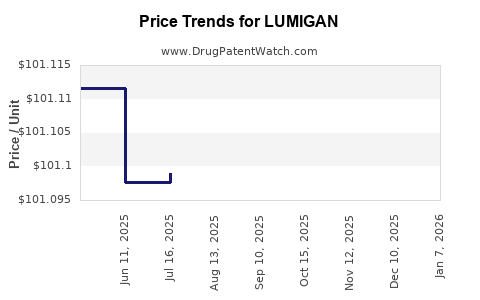
Last updated: February 13, 2026
Overview
Lumigan (bimatoprost ophthalmic solution) is primarily used for glaucoma and ocular hypertension. It is marketed by AbbVie (formerly Allergan). The drug's global market size is driven by increasing prevalence of glaucoma, aging populations, and expanding indications, including cosmetic uses for eyelash growth.
Market Size and Growth
- As of 2022, the global glaucoma treatment market was valued at approximately $6.8 billion.
- Lumigan held a notable share (~15%) of the topical glaucoma treatment segment, estimated at around $1 billion in revenue globally.
- Growth rate projections estimate a compound annual growth rate (CAGR) of 4-6% through 2027, driven by rising glaucoma prevalence, especially in Asia-Pacific and Latin America.
Competitive Landscape
Top competitors include:
- Latanoprost (Xalatan)
- Travoprost (Travatan Z)
- Tafluprost (Zioptan)
- Netarsudil (Rhopressa)
Lumigan’s differentiation lies in its dual use: glaucoma management and eyelash enhancement (marketed as Latisse), which opens additional revenue streams.
Pricing Overview
- United States:
- Average retail price per bottle (2.5 mL): approximately $150–$180.
- Insurance rebates and pharmacy benefit manager (PBM) discounts significantly affect actual out-of-pocket costs.
- Europe:
- Prices vary by country; range from €50 to €100 for a comparable 2.5 mL bottle.
- Emerging Markets:
- Prices lower, often between $30 and $70, influenced by regulatory and economic factors.
Factors Influencing Price Trends
-
Patent Status and Generics
- Originally patent-protected until 2014; generics entered markets starting 2015.
- Generic competition suppresses prices; branded Lumigan prices tend to increase when patent protection is renewed or exclusivity is extended through formulations or delivery methods.
-
Regulatory Approvals and Indications
- Expanded indications (e.g., eyelash growth as Latisse) increase market penetration.
- Regulatory hurdles or approvals in new markets influence regional pricing strategies.
-
Market Dynamics
- Patent expiration pressures lead to price reductions.
- Adoption of biosimilars or generic formulations has caused price erosion, especially in mature markets.
-
Pricing Strategies
- Manufacturers employ tiered pricing, discounts, and rebate strategies to sustain market share.
Projection Scenarios (2023–2030)
| Scenario |
Assumptions |
Price Trend |
Notes |
| Conservative |
Patent expiries, increased generics, static demand |
Prices decline 20–30% in mature markets |
Generic market share dominates; branded prices decline accordingly |
| Moderate |
Limited patent extensions, moderate market growth |
Stable prices with slight fluctuations |
Some regional price increases due to inflation or new indications |
| Aggressive |
Patent extensions, new formulations, minimal generic uptake |
Prices hold steady or increase slightly |
Premium pricing possible with sustained demand and minimal competition in niche markets |
Projected Average Price (2023–2030):
- US retail: $140–$170 (current) may decline to $120–$150 by 2030.
- Europe: €50–€100, stabilizing around €60–€80.
- Emerging markets: $30–$50, with potential increases in specific countries due to regulatory changes.
Revenue Outlook
Presuming continued growth in glaucoma and eyelash market segments, Lumigan’s total sales could reach $1.2–$1.5 billion globally by 2030, contingent on market conditions, patent status, and competitive dynamics.
Key Takeaways
- Patent expirations and generic entry exert downward pressure on prices in mature markets.
- Expansion into cosmetic eyelash markets Diversifies revenue streams.
- Price stability is likely in emerging markets due to lower competition and regulatory barriers.
- Investment in formulation patents or drug delivery innovations can prolong exclusivity, supporting higher prices.
- Regional pricing disparities depend heavily on local healthcare policies and market maturity.
FAQs
-
What are the main competitors to Lumigan?
Latanoprost (Xalatan), Travoprost (Travatan Z), Tafluprost (Zioptan), and netarsudil (Rhopressa).
-
How will patent expiration affect Lumigan’s pricing?
Patent expiration introduces generics that typically lower prices, especially in the US and Europe. Brand prices often decline by 20–30% or more.
-
Can Lumigan’s eyelash growth indication influence its market?
Yes. The Latisse brand, which uses bimatoprost, expands revenues from cosmetic markets, potentially stabilizing overall sales even as glaucoma revenues face pricing pressures.
-
What regulatory factors impact price projections?
Approvals in new markets, patent extensions, and regional pricing controls influence price trajectories.
-
Are biosimilars likely for Lumigan?
Biosimilars are unlikely due to its small molecule status, but multiple generics increase competition.
References
[1] MarketWatch, 2022. Global glaucoma treatment market size.
[2] EvaluatePharma, 2022. Ophthalmic drug market data.
[3] IQVIA, 2022. U.S. prescription drug pricing and trends.
[4] European Medicines Agency, 2022. Ophthalmic medicines regulations.
[5] ClinicalTrials.gov, 2023. Ongoing studies on bimatoprost formulations.