Share This Page
Drug Price Trends for LUBRICANT EYE OINTMENT
✉ Email this page to a colleague
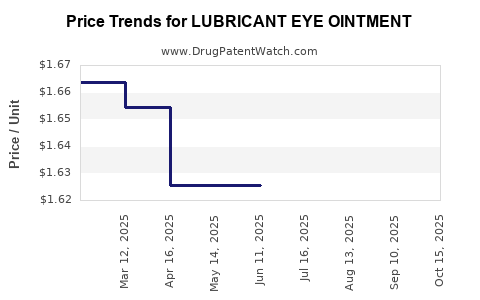
Average Pharmacy Cost for LUBRICANT EYE OINTMENT
| Drug Name | NDC | Price/Unit ($) | Unit | Date |
|---|---|---|---|---|
| LUBRICANT EYE OINTMENT | 70000-0513-01 | 1.64952 | GM | 2025-10-22 |
| LUBRICANT EYE OINTMENT | 70000-0513-01 | 1.62571 | GM | 2025-09-17 |
| LUBRICANT EYE OINTMENT | 70000-0513-01 | 1.62571 | GM | 2025-08-20 |
| >Drug Name | >NDC | >Price/Unit ($) | >Unit | >Date |
LUBRICANT EYE OINTMENT Market Analysis and Financial Projection
Market Analysis and Price Projections for Lubricant Eye Ointment
Market Overview
Lubricant eye ointments are used primarily for dry eye relief, corneal protection, and post-surgical care. The global ophthalmic lubricants market was valued at approximately $1.2 billion in 2022 and is projected to grow at a compound annual growth rate (CAGR) of about 5.2% from 2023 to 2028. The increasing prevalence of dry eye syndrome, aging populations, and rising awareness of eye health contribute to this growth.
Key Market Drivers
- Aging demographics increase incidence of dry eye syndrome.
- Rising prevalence of autoimmune and allergic eye conditions.
- Advancements in formulation technology yielding longer-lasting ointments.
- Growing use in post-operative care, especially following refractive or cataract surgeries.
Regional Market Breakdown
| Region | Market Share (2022) | CAGR (2023-2028) | Notes |
|---|---|---|---|
| North America | 40% | 4.8% | Dominated by high healthcare spending and awareness. |
| Europe | 25% | 5.0% | Increased aging population, regulatory environment. |
| Asia-Pacific | 20% | 6.2% | Fast growth driven by large populations and developing healthcare infrastructure. |
| Latin America | 8% | 5.5% | Rising awareness and rising healthcare expenditure. |
| Rest of World | 7% | 4.7% | Emerging markets showing growth, regulatory hurdles. |
Competitive Landscape
Major players include Alcon, Bausch + Lomb, Johnson & Johnson, and Santen Pharmaceutical. Innovations focus on longer-lasting formulations, preservative-free options, and combination therapies.
| Company | Market Share (Est.) | Key Products |
|---|---|---|
| Alcon | 35% | Systane, Max hydration ointment |
| Bausch + Lomb | 20% | Lacri-Lube, Soothe |
| Johnson & Johnson | 15% | Preservative-free ointments |
| Santen Pharmaceutical | 10% | Thealoz, topical formulations |
| Others | 20% | Various regional brands |
Market entry requires navigating regulatory frameworks, which vary globally; the US FDA classifies these as over-the-counter (OTC) drugs, facilitating easier market access than prescription-only drugs.
Price Projections
Pricing varies based on formulation, brand positioning, and regional market conditions. For standard OTC lubricant eye ointments:
- United States: Retail prices typically range from $8 to $15 per tube (3-4 grams).
- Europe: Similar pricing, often €7-€14, influenced by VAT and regional healthcare policies.
- Asia-Pacific: Prices are generally lower, from $4 to $10 per tube, due to market competition and lower manufacturing costs.
Projected average retail prices for new entrants over the next five years:
| Year | Price Range (USD) | Factors influencing prices |
|---|---|---|
| 2023 | $8 - $15 | Stable, with minor regional variations |
| 2024 | $8 - $14.50 | Increased competition, regional price elasticity |
| 2025 | $7.50 - $14 | Cost reductions, formulation innovations |
| 2026 | $7 - $13.50 | Market saturation, price competition |
| 2027 | $6.50 - $13 | Shift to generic and private label brands |
In private label segments, prices can dip below $6, heightening competitive pressures for branded products.
Regulatory Impact
Entry barriers are moderate. Many countries require OTC approval, with application processes typically completed within 6-12 months. Reformulation to preservative-free variants is increasingly favored, with regulatory encouragement for preservative-free products in several markets.
Future Pricing Trends
- A gradual price decrease as generics and private labels grow.
- Premium formulations, such as longer-lasting or preservative-free variants, may command 10-20% higher prices.
- Incorporation of combination therapies might add complexity, resulting in variable pricing.
Market Expansion Opportunities
- Developing markets offer growth potential with lower brand penetration.
- Product innovations that extend duration or improve comfort are key differentiators.
- Expansion into veterinary ophthalmic ointments remains niche but relevant.
Key Takeaways
- The global lubricant eye ointment market is projected to grow at over 5% CAGR through 2028.
- Price stability exists in mature markets, with downward pressure driven by generics.
- Price variation across regions is significant, influenced by local regulatory and economic factors.
- Innovation in formulation and targeted marketing will influence future pricing strategies.
- Entry barriers are moderate; regulatory pathways differ but are manageable with proper planning.
FAQs
1. What factors most influence the pricing of lubricant eye ointments?
Formulation complexity, brand positioning, regional regulatory costs, and competition levels primarily determine retail prices.
2. How does patent protection impact market prices?
Patents limit generic competition temporarily, allowing higher prices during exclusivity. Once expired, prices typically decline due to generic entry.
3. Are preservative-free formulations more expensive?
Yes, preservative-free formulations incur higher manufacturing costs, leading to price premiums of 10-20% over preservative-containing variants.
4. What is the outlook for private label lubricant eye ointments?
They represent an increasingly price-competitive segment, often priced 20-30% below branded products, pressuring established brands.
5. Which regions offer the most growth potential for new entrants?
Asia-Pacific and Latin America present high growth, driven by demographic trends and increasing ophthalmic healthcare access.
References
- MarketWatch. "Ophthalmic Lubricants Market Size." 2022.
- Grand View Research. "Ophthalmic Lubricants Market Analysis." 2023.
- US FDA. "Over-the-Counter Ophthalmic Products." 2022.
- Deloitte. "Global Eye Care Market Trends." 2023.
- IMS Health. "Pharmaceutical Price Trends." 2022.
More… ↓
