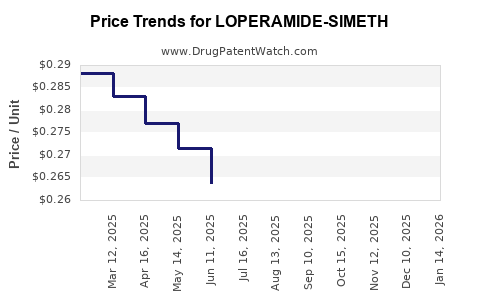
Last updated: February 20, 2026
What is Loperamide-Simeth?
Loperamide-Simeth combines loperamide, an anti-diarrheal agent, with simethicone, an antiflatulent. It is used to treat diarrhea caused by gastrointestinal disturbances, offering symptomatic relief by reducing intestinal motility and gas buildup.
Market Overview
Current Market Landscape
- Global diarrhea treatment market size: Valued at approximately $4.1 billion in 2021, projected to reach $5.8 billion by 2028 at a compound annual growth rate (CAGR) of 5.2% [1].
- Leading regions: North America accounts for around 40% of sales, followed by Europe with 30%. Emerging markets in Asia-Pacific are growing rapidly.
- Key competitors: Over-the-counter (OTC) formulations include branded products such as Imodium (loperamide) and generic equivalents.
Approved Drugs and Patent Status
- Imodium (loperamide): Patents expired in 2011 in the US, with generics available.
- Loperamide-Simeth formulations: Few in the market; mainly generic combinations or compounded formulations. No major branded drugs combining both active ingredients are approved in major markets.
Regulatory Landscape
- United States (FDA): Loperamide is OTC, simethicone also OTC. No combined formulation has FDA approval.
- European Union (EMA): Similar status—individual components are approved OTC, but combination drugs require separate approval.
- Emerging markets: Vary by country; some permit compounded formulations without formal approval.
Market Drivers and Constraints
- Drivers:
- Increasing prevalence of gastrointestinal infections and conditions.
- Growing OTC medication use.
- Rising awareness of combination therapies to enhance symptom relief.
- Constraints:
- Lack of regulatory approval for combined formulations.
- Market preference for established monotherapies.
- Concerns over safety with combination drugs without formal approval.
Price Projections
Historical Pricing Trends
- Loperamide (brand): Imodium OTC costs range from $8 to $12 per box of 20 tablets in the US. Generics sell for $4 to $8.
- Simethicone: OTC products priced between $4 and $10 for a 100-capsule bottle.
Projected Pricing for Loperamide-Simeth
- Within established markets: Likely similar to the sum of active ingredients' costs. Patent and regulatory barriers may influence pricing.
- Estimated retail price: $8 to $15 per course in the US.
- Wholesale price: approximately 30-50% lower.
- Emerging markets: Pricing could be lower, around $3 to $8 per course, subject to local regulations.
Factors Influencing Future Prices
- Patent status: No current patents protect the combination; generic competition can drive prices down.
- Regulatory approval: Securing approval could enable branding and premium pricing.
- Manufacturing costs: Estimated at $0.50 to $2 per unit for active ingredients production, excluding formulation and marketing.
Investment and Commercialization Strategy
- Pursuing regulatory approval as a combination drug could command higher pricing.
- Developing a proprietary formulation with documented safety and efficacy could create a competitive advantage.
- Target markets include OTC channels and treatment of GI disturbances in hospital settings.
Summary Table
| Aspect |
Details |
| Market Size (2021) |
$4.1 billion |
| Expected Market Growth (CAGR) |
5.2% |
| Common Pricing (US OTC) |
$4–$15 per course |
| Regulatory Status |
No formal approval as combination drug in major markets |
| Price Projection (Next 5 Years) |
$8–$15 in developed markets; lower in emerging markets |
Key Takeaways
- No approved branded Loperamide-Simeth products exist in key markets.
- Pricing aligns with the cost of active ingredients plus regulatory and branding premiums.
- Patent expiries and generic competition will pressure prices downward unless the combination gains regulatory approval.
- Growing demand for effective diarrhea treatments supports potential market entry, especially with regulatory approval.
- Emerging markets present opportunities for lower-priced formulations, but regulatory hurdles may vary.
FAQs
Q1: Are there any existing combination drugs containing loperamide and simethicone?
A1: No drug has regulatory approval as a combination of loperamide and simethicone in major markets. Most are sold separately.
Q2: What regulatory hurdles exist for Loperamide-Simeth?
A2: The key challenge involves securing formal approval for the combination, which requires demonstrating safety and efficacy through clinical trials.
Q3: What is the primary driver behind potential pricing increases?
A3: Regulatory approval and branding as a trusted, tested medication could allow higher pricing compared to OTC generics.
Q4: How competitive is the market for diarrhea treatments?
A4: Highly competitive, dominated by OTC monotherapies and generics. A new combination product would need differentiation.
Q5: What are the main risks associated with market entry?
A5: Regulatory delays, pricing pressures from generics, and consumer preference for established monotherapies.
References
[1] Market Research Future. (2022). Diarrhea Treatment Market Size, Share & Trends. Retrieved from https://www.marketresearchfuture.com/reports/diarrhea-treatment-market-4651