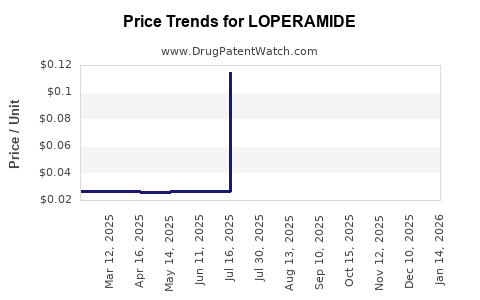
Last updated: February 12, 2026
What is the Current Market Status of Loperamide?
Loperamide is an over-the-counter (OTC) antidiarrheal medication marketed under brand names like Imodium. Its global market was valued at approximately $300 million in 2022, with a compound annual growth rate (CAGR) of about 3.5% projected through 2030. The growth is driven by increased awareness of gastrointestinal health, aging populations, and expanding OTC sales in emerging markets.
Market Segmentation
-
Geography:
- North America accounts for roughly 40% of sales, driven by mature OTC markets.
- Europe contributes approximately 25%, with stable growth.
- Asia-Pacific shows the fastest growth at a CAGR around 5%, due to rising healthcare access and urbanization.
- Latin America and Middle East & Africa collectively comprise about 10%.
-
Application:
- Acute diarrhea treatment represents 65% of sales.
- Chronic diarrhea accounts for remaining 35%, mainly in clinical settings.
-
Formulation:
- Oral tablets dominate with 80% market share.
- Liquid formulations hold 15%, mainly for pediatric use.
- Chewable forms are emerging, especially within pediatric markets.
How is the Competitive Landscape Structured?
The market is dominated by a few global companies, including:
- Johnson & Johnson (Imodium)
- Glenmark Pharmaceuticals
- Mylan (now part of Viatris)
- Dr. Reddy’s Laboratories
Generic versions have gained significant market share due to patent expirations. As of 2022, the patent for Imodium expired in the U.S. in 2020, enabling a surge in generics.
Are Any Patent or Regulatory Changes Influencing Market Dynamics?
Imodium’s patent expiration led to a price decrease of approximately 25% in the U.S. OTC segment. Generic formulations are priced 20-30% lower than branded products. Regulatory authorities such as the FDA approve generics based on bioequivalence, which accelerates market entry.
In regulatory news, a few countries have considered restrictions on high-dose loperamide OTC sales due to misuse and cardiac toxicity concerns. The U.S. FDA issued guidelines in 2021 limiting pack sizes and requiring clearer labeling, which could affect sales volumes marginally.
What Are Current Price Points and Projected Trends?
Current average retail price for OTC loperamide (Imodium):
| Formulation |
Price Range (per package) |
Price per unit (tablet) |
| 2 mg tablets (max dose) |
$4.00 – $6.00 |
$0.20 – $0.30 |
| Liquid (OTC, 1 mg/mL) |
$8.00 – $12.00 |
N/A |
Cost Dynamics:
- Branded OTC packets: $4–$6
- Generic equivalents: 20–30% cheaper
Forecasts through 2030:
- Price stability expected for branded products amid patent expiry.
- Generics are projected to reduce prices further by 5–10% annually.
- Introduction of reformulated products with extended release or combined therapies may elevate prices.
What Are Emerging Trends and Opportunities?
- Pediatric formulations: Liquid and chewable forms for children are gaining market share.
- Combination products: Loperamide combined with other gastrointestinal agents show potential for increased efficacy.
- Digital health integration: Apps for diarrhea management could influence consumer purchasing behavior.
- Regulatory restrictions: Limiting high-dose OTC availability impacts wholesale volumes but presents opportunities for prescription formulations or repositioning.
Which Factors Might Impact Price Projections?
- Patent status: Generic entry post-2020 has driven price reductions.
- Regulation: Restrictions or added safety measures could constrain supply or increase manufacturing costs.
- Supply chain disruptions: Raw material availability impacts pricing.
- Consumer shifts: Preference for natural or alternative therapies could reduce demand.
Key Takeaways
- The global loperamide market is valued at approximately $300 million (2022), with a slow but steady growth trajectory.
- Patent expiration in key markets has increased generic competition, putting downward pressure on prices.
- North America and Europe dominate sales, while Asia-Pacific offers the fastest growth prospects.
- OTC prices remain stable, but regulatory restrictions may marginally influence the market.
- Opportunities include pediatric formulations, combination therapies, and leveraging digital health tools.
FAQs
1. When will generic loperamide products likely dominate the OTC market?
Generics gained significant traction after patent expiry in 2020. By 2024–2025, generics are expected to hold above 80% of OTC sales share globally.
2. How could regulatory restrictions impact prices?
Restrictions like dose limits could decrease sales volume slightly but may lead to higher prices for prescription-labeled versions or reformulated products.
3. What is the expected price trend for OTC loperamide drugs?
Prices are expected to decline 2–4% annually due to generic competition, with occasional stabilization or slight increases for specialty formulations.
4. Are clinical trial data influencing market expansion?
Most active ingredients are off-patent with established efficacy, but ongoing research into safety and new indications could open expansion opportunities.
5. What regions present the highest growth potential?
Asia-Pacific exhibits the fastest growth due to increasing healthcare infrastructure, income levels, and OTC drug availability.
Sources
- MarketWatch, "Over-the-Counter Gastrointestinal Drugs Market," 2023.
- IQVIA, "Global OTC Pharmaceutical Market Report," 2022.
- U.S. Food and Drug Administration (FDA), "Guidance on Loperamide Restrictions," 2021.
- Frost & Sullivan, "OTC Gastrointestinal Market Outlook," 2022.
- Statista, "Loperamide Market Size & Forecast," 2023.