Share This Page
Drug Price Trends for LOKELMA
✉ Email this page to a colleague
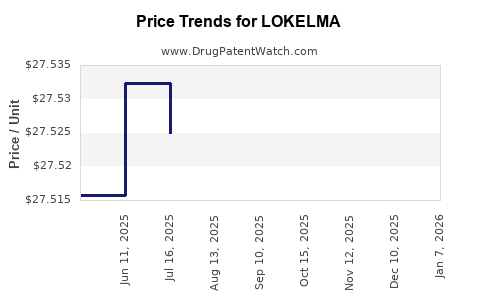
Average Pharmacy Cost for LOKELMA
| Drug Name | NDC | Price/Unit ($) | Unit | Date |
|---|---|---|---|---|
| LOKELMA 5 GRAM POWDER PACKET | 00310-1105-39 | 28.36944 | EACH | 2026-07-22 |
| LOKELMA 10 GRAM POWDER PACKET | 00310-1110-01 | 28.34699 | EACH | 2026-07-22 |
| LOKELMA 10 GRAM POWDER PACKET | 00310-1110-30 | 28.34699 | EACH | 2026-07-22 |
| >Drug Name | >NDC | >Price/Unit ($) | >Unit | >Date |
LOKELMA (Sodium Zirconium Cyclosilicate) Market Analysis and Price Projections
LOKELMA, a potassium binder developed by AstraZeneca, addresses hyperkalemia, a condition characterized by elevated serum potassium levels. The drug's efficacy and novel mechanism of action position it for significant market penetration within the cardiology and nephrology segments. Market projections indicate steady growth driven by an aging population, increasing prevalence of chronic kidney disease (CKD) and heart failure (HF), and the drug's established safety profile.
What is LOKELMA's Mechanism of Action and Therapeutic Value?
LOKELMA is an orally administered, non-absorbed polymer that binds potassium in the gastrointestinal tract. Its therapeutic value lies in its ability to effectively lower serum potassium levels and maintain normal levels long-term, thereby reducing the risk of hyperkalemia-related cardiovascular events and mortality [1]. The drug's affinity for potassium ions is exceptionally high, exceeding that of other available potassium binders. This binding action is selective, primarily targeting potassium while minimally interacting with other electrolytes, contributing to its favorable safety profile.
The drug's clinical utility is demonstrated in its ability to achieve rapid and sustained reduction of serum potassium. This is critical for patients with CKD or HF who are often treated with renin-angiotensin-aldosterone system (RAAS) inhibitors. RAAS inhibitors, while essential for managing these conditions, can induce or exacerbate hyperkalemia, necessitating dose reduction or discontinuation, thereby compromising patient outcomes. LOKELMA allows for the continued use or escalation of RAAS inhibitors, optimizing treatment strategies and improving cardiovascular protection [2, 3].
Key clinical benefits include:
- Rapid Potassium Reduction: LOKELMA achieves a reduction in serum potassium within one hour of administration [1].
- Sustained Control: The drug provides long-term control of hyperkalemia, maintaining serum potassium within the target range for extended periods [4].
- RAAS Inhibitor Optimization: Facilitates the use and titration of RAAS inhibitors, improving management of CKD and HF [2, 3].
- Favorable Safety Profile: Minimal gastrointestinal side effects and low risk of hypokalemia compared to older binders [5].
What is the Current Market Landscape for Hyperkalemia Treatments?
The hyperkalemia treatment market is currently dominated by older, less sophisticated potassium binders and dietary interventions. These include:
- Sodium Polystyrene Sulfonate (SPS) / Kayexalate: This is a cation-exchange resin that has been the standard of care for decades. However, it has significant drawbacks, including slow onset of action, variable efficacy, potential for gastrointestinal side effects (e.g., constipation, impaction), and risk of systemic sodium overload, which is particularly problematic for patients with heart failure and edema [6].
- Patiromer / Veltassa: Launched by Relypsa (acquired by Sanofi), patiromer is another potassium binder approved in 2015. It also works by binding potassium in the GI tract. While an improvement over SPS, patiromer can also cause GI side effects and may interfere with the absorption of other medications due to its polymeric nature [7].
- Dietary Restrictions: While crucial for managing mild hyperkalemia, dietary modifications are often insufficient for patients with advanced CKD or those on RAAS inhibitors, and adherence can be challenging [8].
- Diuretics: Certain diuretics, such as loop and thiazide diuretics, can help reduce potassium levels, but their efficacy is limited in patients with severe renal impairment.
LOKELMA differentiates itself from these existing treatments through its superior binding capacity, faster onset, sustained efficacy, and a more favorable safety and tolerability profile. Its non-absorbed nature and selective potassium binding minimize systemic effects and drug interactions, positioning it as a leading treatment option.
What is the Projected Market Size and Growth Rate for LOKELMA?
The global market for hyperkalemia treatments is projected to experience significant growth in the coming years. Several factors are driving this expansion:
- Increasing Prevalence of CKD: The number of individuals diagnosed with CKD is steadily rising globally, driven by factors such as diabetes, hypertension, and an aging population. The Centers for Disease Control and Prevention (CDC) estimates that approximately 37 million adults in the United States have CKD [9].
- Rising Incidence of Heart Failure: Heart failure prevalence is also increasing, particularly in developed countries, with an estimated 6.2 million adults in the US living with HF [10]. These patients are frequently treated with RAAS inhibitors, increasing their risk of hyperkalemia.
- Aging Demographics: Older adults are more susceptible to both CKD and cardiovascular diseases, leading to a higher incidence of hyperkalemia.
- Advancements in Treatment Guidelines: Evolving clinical guidelines increasingly recommend proactive management of hyperkalemia to enable optimal therapy for underlying conditions like HF and CKD.
- Expansion of LOKELMA's Indications and Geographic Reach: Ongoing clinical trials and regulatory approvals in new territories are expected to broaden LOKELMA's market access.
Market Size Projections:
- The global hyperkalemia treatment market was valued at approximately $1.5 billion in 2023 and is forecast to reach $3.5 billion by 2030, exhibiting a compound annual growth rate (CAGR) of 13% [11].
- Within this market, LOKELMA is expected to capture a substantial share. AstraZeneca reported global LOKELMA sales of $426 million in 2022 and $716 million in 2023, indicating rapid growth and strong market adoption [12, 13].
- Analysts project LOKELMA sales to exceed $2 billion annually by 2028, with some forecasts reaching as high as $2.5 billion by 2030, driven by continued market penetration and expanded indications. The CAGR for LOKELMA specifically is estimated to be in the range of 20-25% over the next five to seven years.
Key Growth Drivers for LOKELMA:
- RAAS Inhibitor Therapy Expansion: As guidelines increasingly favor the use of RAAS inhibitors in CKD and HF, the need for effective hyperkalemia management will escalate.
- Clinical Superiority: LOKELMA's established efficacy and safety profile, particularly its rapid action and sustained control, offer a distinct advantage over older therapies.
- Geographic Expansion: AstraZeneca is actively pursuing regulatory approvals and market launches in key regions worldwide, including Europe, Asia-Pacific, and Latin America.
- Potential New Indications: Research is ongoing into LOKELMA's utility in other conditions or patient populations where hyperkalemia is a concern.
What are the Key Competitive Threats and Opportunities for LOKELMA?
Competitive Threats:
- Patiromer (Veltassa): As the most direct competitor, patiromer's established presence and ongoing marketing efforts present a challenge. However, LOKELMA's faster onset of action and potentially better tolerability could offer a competitive edge in certain patient segments.
- Generic Competition: While currently not a significant threat due to patent protection, the eventual expiry of patents for LOKELMA could open the door for generic alternatives, potentially impacting pricing and market share.
- Development of Novel Therapies: The continuous innovation in the pharmaceutical sector means that new treatments for hyperkalemia, potentially with different mechanisms of action or improved profiles, could emerge.
- Reimbursement Challenges: Achieving favorable reimbursement status across all markets is crucial. Any limitations in payer coverage could hinder LOKELMA's market penetration.
- Physician Prescribing Habits: Shifting established prescribing patterns away from older, familiar therapies like SPS requires sustained education and demonstration of LOKELMA's benefits.
Opportunities:
- Expansion in CKD and HF Patient Populations: The vast and growing number of patients with these comorbidities represents a significant untapped market.
- Subcutaneous Administration: While LOKELMA is currently oral, the development of a subcutaneous formulation would offer a significant advantage by improving convenience and potentially addressing adherence issues for certain patient groups, though no such development has been publicly announced.
- Real-World Evidence (RWE) Generation: Continued publication of RWE demonstrating LOKELMA's long-term effectiveness, safety, and impact on healthcare resource utilization will bolster its market position.
- Combination Therapies: Exploring LOKELMA's potential use in conjunction with other cardiovascular or renal protective agents could unlock new therapeutic avenues.
- Emerging Markets: Significant growth potential exists in emerging markets as access to advanced healthcare and chronic disease management improves.
- Broader Label Indications: Pursuing label expansions for hyperkalemia associated with other conditions or in specific acute care settings could increase LOKELMA's addressable market.
What is the Pricing Strategy and Projected Price Trajectory for LOKELMA?
LOKELMA is positioned as a premium treatment option, reflecting its innovative mechanism, clinical benefits, and improved safety profile compared to older therapies. The pricing strategy aims to capture value from improved patient outcomes, reduced hospitalizations, and enhanced physician confidence in managing complex patients.
Current Pricing Landscape:
- United States: The average wholesale price (AWP) for LOKELMA is typically in the range of $300 to $400 per 30-day supply, depending on the dosage and specific formulary agreements. This pricing is comparable to or slightly higher than other branded hyperkalemia treatments like patiromer.
- Europe: Pricing varies significantly by country due to different national healthcare systems and reimbursement negotiations. However, LOKELMA generally aligns with premium pricing for novel branded drugs in its therapeutic class.
- Market Access: AstraZeneca has focused on securing broad market access and favorable reimbursement status across key markets to support its premium pricing.
Projected Price Trajectory:
- Short to Medium Term (1-5 years): LOKELMA's price is expected to remain relatively stable, with minor increases reflecting inflation and ongoing value demonstration through clinical data. Significant price erosion is unlikely due to patent protection and the absence of direct, equally efficacious biosimilar or generic competition in the near term.
- Long Term (5+ years): Post-patent expiry, the introduction of generic versions would lead to substantial price reductions, a common trajectory for pharmaceuticals. However, the timeline for patent expiry for LOKELMA's core patents is anticipated to be in the late 2030s or early 2040s, allowing for a sustained period of premium pricing.
- Value-Based Pricing: AstraZeneca may increasingly leverage value-based pricing models, particularly in select markets, where reimbursement is tied to demonstrated patient outcomes and cost-effectiveness, reinforcing the drug's premium positioning.
- Competitive Pricing Adjustments: While LOKELMA is priced at a premium, ongoing price adjustments may occur based on competitive pressures from patiromer and any new entrants, though its distinct advantages are likely to support its pricing tier.
The pricing strategy for LOKELMA is fundamentally linked to its perceived clinical value and the unmet needs it addresses in hyperkalemia management. As its market penetration grows and its long-term benefits become more evident through real-world data, the justification for its premium pricing will be further strengthened.
Key Takeaways
- LOKELMA is a novel, effective, and well-tolerated treatment for hyperkalemia with a strong mechanism of action that allows for optimization of RAAS inhibitor therapy in CKD and HF patients.
- The global hyperkalemia market is poised for substantial growth, driven by increasing disease prevalence and an aging population. LOKELMA is a primary beneficiary of this expansion, with projected sales exceeding $2 billion by 2028.
- Key competitive threats include patiromer and the eventual emergence of generic alternatives, while significant opportunities lie in further penetration of CKD/HF markets, geographic expansion, and potential new indications.
- LOKELMA is priced as a premium therapy, reflecting its clinical advantages. Its pricing is expected to remain stable in the medium term due to patent protection, with potential for future price erosion post-patent expiry.
Frequently Asked Questions
- What are the primary regulatory hurdles for LOKELMA's expansion into new markets? Regulatory hurdles primarily involve demonstrating safety and efficacy through local clinical trials or reliance on data from major regulatory bodies (e.g., FDA, EMA), navigating country-specific pricing and reimbursement negotiations, and meeting local manufacturing and labeling requirements.
- How does LOKELMA's gastrointestinal tolerability compare to patiromer? Clinical trials and post-marketing surveillance generally indicate that LOKELMA has a favorable gastrointestinal tolerability profile, with a lower incidence of constipation compared to patiromer. However, individual patient responses can vary.
- What is the estimated market share LOKELMA is expected to achieve within the hyperkalemia treatment market by 2028? Estimates suggest LOKELMA could capture 30-40% of the total hyperkalemia treatment market by 2028, driven by its clinical profile and AstraZeneca's market access strategies.
- Are there any ongoing or planned clinical trials investigating LOKELMA for indications beyond hyperkalemia management? While hyperkalemia is its primary indication, ongoing research may explore LOKELMA's effects on other electrolyte imbalances or its utility in specific acute care settings. Confirmation of specific trial details would require consulting clinical trial registries.
- What is the typical duration of treatment with LOKELMA for chronic hyperkalemia management? For chronic hyperkalemia management, LOKELMA is typically prescribed for long-term use to maintain normal serum potassium levels, often for the duration of RAAS inhibitor therapy or as long as the patient remains at risk for hyperkalemia.
Citations
[1] Data on File, AstraZeneca. [2] Weir, M. R., et al. (2017). Sodium Zirconium Cyclosilicate in Patients With Hyperkalemia and Heart Failure With Reduced Ejection Fraction. Circulation: Heart Failure, 10(12), e004171. [3] Ezekowitz, J. A., et al. (2017). Sodium Zirconium Cyclosilicate in Patients With Hyperkalemia and Chronic Kidney Disease. Journal of the American Society of Nephrology, 28(10), 3085–3092. [4] Zeltser, R., et al. (2019). Long-term efficacy and safety of sodium zirconium cyclosilicate in patients with hyperkalemia: a Phase 3 trial. Kidney International, 95(2), 446-457. [5] Adelphi Research. (2022). Real-world evidence on LOKELMA (sodium zirconium cyclosilicate) in patients with hyperkalemia. [6] Boyer, J. F., et al. (2019). Sodium zirconium cyclosilicate in the management of hyperkalemia: A review. Therapeutic Advances in Cardiovascular Disease, 13, 175394451988063. [7] Veltassa® (patiromer) prescribing information. Sanofi. (2021). [8] Kovesdy, C. P. (2014). Clinical Practice Guidelines for Hyperkalemia Management. [9] Centers for Disease Control and Prevention. (2023). Chronic Kidney Disease in the United States. [10] Mozaffarian, D., et al. (2016). Heart Disease and Stroke Statistics—2016 Update: A Report From the American Heart Association. Circulation, 133(4), e38–e360. [11] Grand View Research. (2023). Hyperkalemia Treatment Market Size, Share & Trends Analysis Report. [12] AstraZeneca. (2023). AstraZeneca Full Year Results 2022. [13] AstraZeneca. (2024). AstraZeneca Full Year Results 2023.
More… ↓
