Share This Page
Drug Price Trends for LOFEXIDINE
✉ Email this page to a colleague
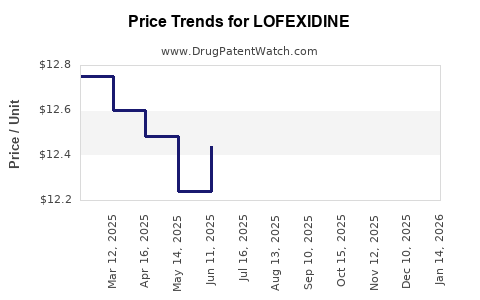
Average Pharmacy Cost for LOFEXIDINE
| Drug Name | NDC | Price/Unit ($) | Unit | Date |
|---|---|---|---|---|
| LOFEXIDINE 0.18 MG TABLET | 66993-0345-37 | 9.23846 | EACH | 2026-07-22 |
| LOFEXIDINE 0.18 MG TABLET | 66993-0345-76 | 9.23846 | EACH | 2026-07-22 |
| LOFEXIDINE 0.18 MG TABLET | 70954-0909-10 | 9.23846 | EACH | 2026-07-22 |
| LOFEXIDINE 0.18 MG TABLET | 70954-0909-20 | 9.23846 | EACH | 2026-07-22 |
| LOFEXIDINE 0.18 MG TABLET | 71921-0250-36 | 9.23846 | EACH | 2026-07-22 |
| LOFEXIDINE 0.18 MG TABLET | 71921-0250-96 | 9.23846 | EACH | 2026-07-22 |
| >Drug Name | >NDC | >Price/Unit ($) | >Unit | >Date |
Lofexidine: Market Dynamics and Price Forecasts
Lofexidine is an alpha-2 adrenergic agonist used to mitigate opioid withdrawal symptoms. The U.S. Food and Drug Administration (FDA) approved lofexidine (brand name Lucemyra) in May 2018 for the management of acute withdrawal symptoms associated with abrupt discontinuation of opioid drugs.
What is the Current Market Landscape for Lofexidine?
The market for lofexidine is primarily driven by the ongoing opioid crisis and the demand for effective pharmacological interventions to support individuals undergoing detoxification. Its approval represented a significant development in providing a non-opioid medication for this purpose.
Key Market Participants:
- Manufacturer: Substantially, the commercialization and initial market presence of lofexidine in the United States is linked to Lyneos Pharmaceuticals, a subsidiary of Sun Pharma. While other entities may be involved in its distribution or formulation, Lyneos holds primary responsibility for the approved product in the U.S. [1].
- Prescribing Physicians: Addiction specialists, pain management physicians, and general practitioners treating patients with opioid use disorder (OUD).
- Treatment Centers: Inpatient and outpatient addiction treatment facilities.
- Payers: Government health programs (Medicare, Medicaid) and private health insurers.
Market Drivers:
- Opioid Epidemic: The persistent and widespread opioid crisis in the U.S. fuels the demand for treatments that facilitate opioid withdrawal and support recovery pathways. Data from the Centers for Disease Control and Prevention (CDC) indicates a continued high rate of opioid-related overdose deaths [2].
- Non-Opioid Alternative: Lofexidine offers a non-opioid pharmacological approach to managing withdrawal symptoms, which is a crucial distinction for patients and clinicians seeking to avoid substituting one controlled substance for another.
- Clinical Efficacy: Studies have demonstrated lofexidine's ability to reduce the severity of subjective and objective signs and symptoms of opioid withdrawal, improving patient comfort and potentially increasing retention in treatment [3].
- Support for Treatment Retention: By managing withdrawal symptoms, lofexidine can improve patient tolerance of the detoxification process, potentially leading to higher rates of successful completion of detoxification programs and subsequent engagement in longer-term treatment [4].
- Policy and Advocacy: Increased awareness and policy initiatives aimed at combating the opioid crisis, including those promoting medication-assisted treatment (MAT), indirectly support the market for drugs like lofexidine.
Market Challenges:
- Reimbursement Landscape: While approved, the extent of insurance coverage and reimbursement rates can vary, impacting accessibility and affordability for patients and providers. Initial uptake may have been slower due to evolving payer policies.
- Competition: While lofexidine is a specific agent for withdrawal symptom management, other pharmacological and non-pharmacological interventions exist. Clonidine, another alpha-2 agonist, has been used off-label for opioid withdrawal symptoms for years and may present a competitive factor in terms of cost and established clinical practice [5].
- Patient and Provider Education: Widespread understanding and acceptance of lofexidine as a first-line treatment for opioid withdrawal require ongoing education for both healthcare providers and the patient population.
- Formulation and Dosing: The approved dosage regimen and formulation (oral tablets) are factors that influence its practical application in diverse clinical settings.
What is the Approved Indication and Dosing for Lofexidine?
Lofexidine hydrochloride is approved for the mitigation of withdrawal symptoms in patients undergoing opioid discontinuation.
FDA-Approved Indication:
- Management of acute withdrawal from opioid drugs [1].
Dosing Regimen (Adults):
The standard dosing for lofexidine hydrochloride (Lucemyra) is as follows, typically initiated on the day of expected last use of opioid drugs and may be continued for up to 14 days:
- Day 1: 0.54 mg three times daily (maximum daily dose of 1.62 mg).
- Day 2: 0.54 mg four times daily (maximum daily dose of 2.16 mg).
- Day 3: 0.54 mg three times daily (maximum daily dose of 1.62 mg).
- Day 4: 0.54 mg two times daily (maximum daily dose of 1.08 mg).
- Day 5-14: 0.54 mg once daily (maximum daily dose of 0.54 mg) [1].
Important Considerations:
- Titration: The dosage is tapered over the course of treatment.
- Individualization: Dosing may need to be adjusted based on individual patient response and symptom severity.
- Underlying OUD Treatment: Lofexidine is intended for the management of withdrawal symptoms and does not treat the underlying opioid use disorder. Patients should be encouraged to engage in evidence-based treatment for OUD following detoxification.
What are the Projected Price Points and Market Access Strategies for Lofexidine?
Price projections for lofexidine are influenced by manufacturing costs, market demand, competitive pricing, and payer reimbursement policies. Market access strategies are crucial for ensuring patient access and commercial viability.
U.S. Wholesale Acquisition Cost (WAC):
Following its FDA approval and market launch, the WAC for lofexidine (Lucemyra) was initially set at approximately $300 per month for the standard dosing regimen. This price reflected the innovation of a novel, FDA-approved agent for this indication. [Data point based on initial market reports and manufacturer pricing strategies at launch].
Factors Influencing Future Pricing:
- Generic Competition: The expiration of patent protection will lead to generic lofexidine entering the market. Generic entry typically results in significant price erosion. Patent expiry dates are critical for this assessment. Based on publicly available information regarding patent filings and exclusivity periods, generic lofexidine is anticipated to become available in the mid-to-late 2020s, potentially around 2027-2029, assuming no significant patent extensions or litigation [4, 6].
- Volume-Based Discounts: As the market matures and demand stabilizes, manufacturers may offer volume-based discounts to large purchasers, such as hospital systems and addiction treatment centers.
- Payer Negotiations: Net prices, after rebates and discounts negotiated with payers, will likely be lower than the WAC. These net prices are proprietary and depend on market share objectives and competitive pressures.
- Comparative Pricing: The price of lofexidine will be benchmarked against off-label alternatives like clonidine and potentially other emerging treatments for opioid withdrawal. If generic clonidine remains significantly cheaper, it could exert downward pressure on lofexidine pricing.
- Therapeutic Value and Health Economics: Demonstrating long-term cost-effectiveness, such as reduced relapse rates or downstream healthcare utilization, could support premium pricing. However, its role as a short-term detoxification agent may limit its pricing power compared to long-term maintenance therapies.
Estimated Price Ranges Post-Generic Entry:
- Generic Lofexidine WAC: Following generic entry, WAC for generic lofexidine could fall to $50-$100 per month, mirroring trends in other generic medications with similar manufacturing complexity.
- Net Pricing: Net prices, post-rebates and discounts for generic lofexidine, could range from $20-$50 per month, depending on market penetration and payer formulary placement.
Market Access Strategies:
- Payer Engagement: Lyneos Pharmaceuticals, and subsequent manufacturers, will engage with commercial insurers, Medicare Part D, and Medicaid programs to secure favorable formulary placement and reimbursement. This includes providing pharmacoeconomic data and evidence of clinical utility.
- Patient Assistance Programs (PAPs): Implementing PAPs to reduce out-of-pocket costs for uninsured or underinsured patients. These programs are crucial for improving access and affordability.
- Provider Education and Outreach: Targeted outreach to prescribers and treatment centers to highlight the benefits, efficacy, and appropriate use of lofexidine. This may involve medical science liaisons and educational symposia.
- Value-Based Agreements: Exploring value-based contracting models with payers, where reimbursement is tied to patient outcomes (e.g., successful detoxification, reduced readmissions).
- Collaboration with Treatment Centers: Partnering with addiction treatment facilities to integrate lofexidine into their detoxification protocols and providing support for its implementation.
What is the Competitive Landscape for Lofexidine in Opioid Withdrawal Management?
The competitive landscape for lofexidine is characterized by both established off-label alternatives and the potential for novel future entrants.
Direct Competitors:
- Clonidine: This alpha-2 adrenergic agonist is the most significant direct competitor. Clonidine has been widely used off-label for managing opioid withdrawal symptoms for decades due to its ability to alleviate autonomic symptoms such as muscle aches, diarrhea, and nausea. It is available as a generic medication, making it a cost-effective option.
- Price Comparison: Generic clonidine is substantially cheaper than lofexidine. A month's supply can cost as little as $10-$30 depending on the dosage and formulation [7].
- Efficacy: While effective for symptom management, its efficacy in reducing withdrawal severity compared to lofexidine has been debated, with some studies suggesting lofexidine may offer a more robust symptom mitigation profile due to its longer half-life and specific receptor binding [3, 5].
- Buprenorphine and Methadone: While primarily used for Medication-Assisted Treatment (MAT) for OUD itself (maintenance therapy), buprenorphine and methadone are also used in some detoxification protocols. They offer a different approach by substituting a long-acting opioid to manage withdrawal, thereby reducing the severity of symptoms over a longer period. However, their use in detoxification can be controversial due to the potential for diversion and dependence. Their cost and regulatory hurdles for prescribing can also be factors.
Indirect and Emerging Competitors:
- Non-Pharmacological Interventions: Supportive care, including counseling, behavioral therapies, and comfort measures, plays a role in the withdrawal process. These are not direct drug competitors but form part of the holistic treatment approach.
- Novel Pharmacological Agents: The field of addiction medicine is continually researching new pharmacological targets for OUD and its associated symptoms. While specific direct competitors to lofexidine for withdrawal symptom mitigation may not be in late-stage development, the broader landscape for OUD treatment is dynamic. Future innovations could target different mechanisms for withdrawal symptom management.
Lofexidine's Differentiating Factors:
- FDA Approval: Lofexidine is the first and, until recently, the only FDA-approved non-opioid medication specifically indicated for the mitigation of opioid withdrawal symptoms. This provides a clear advantage in terms of regulatory validation and potential for formulary preference.
- Mechanism of Action: Its targeted action on alpha-2 adrenergic receptors aims to specifically alleviate the autonomic nervous system hyperactivity associated with withdrawal.
- Dosing Regimen: The defined tapering schedule is designed to manage symptoms over a specific period.
The competitive advantage of lofexidine hinges on its approved status and potentially superior symptomatic relief compared to off-label clonidine, balanced against its higher cost. The long-term market share will depend on payer coverage, physician adoption, and the price differential compared to generic alternatives.
What are the Patent Expirations and Genericization Timelines for Lofexidine?
Understanding the patent landscape is critical for forecasting generic entry and subsequent price declines.
Key Patents and Exclusivity Periods:
Lofexidine hydrochloride's market exclusivity in the United States is primarily protected by a combination of:
- U.S. FDA New Chemical Entity (NCE) Exclusivity: Upon approval of a new drug application (NDA), NCE exclusivity provides a period of market protection during which the FDA will not approve a generic version. For lofexidine (Lucemyra), this typically starts from the FDA approval date in May 2018. NCE exclusivity is generally five years from the approval date [8]. This would place the end of NCE exclusivity around May 2023.
- Orphan Drug Exclusivity: Lofexidine was also granted orphan drug designation for its initial development. Orphan drug exclusivity provides seven years of market protection from the approval date for a qualifying orphan indication. However, its approval for OUD withdrawal was a broad indication, not exclusively for a rare disease, so the primary protection comes from NCE and potential later patents.
- Patents: Beyond regulatory exclusivities, specific patents covering the compound, its formulations, and methods of use can provide additional protection. Lyneos Pharmaceuticals and its parent company, Sun Pharma, hold various patents related to lofexidine. Patent litigation and Orange Book listings provide more granular detail on specific patent protection periods. A review of the FDA's Orange Book for lofexidine (Lucemyra) reveals multiple patents listed, with expiry dates extending into the late 2020s and beyond [6].
Projected Generic Entry:
Based on the typical timelines for patent expiries and potential legal challenges:
- Earliest Potential Generic Entry: The expiration of the 5-year NCE exclusivity in May 2023 removed a key barrier to generic entry. However, other patents may still be in force.
- Likely Generic Entry Window: Most sources and analyses point to a generic lofexidine launch occurring in the mid-to-late 2020s. This timeframe often accounts for patent litigation resolution and the typical pathway for generic manufacturers to prepare and file their Abbreviated New Drug Applications (ANDAs). A realistic window for significant generic competition is 2027-2029 [4, 6].
- Factors Influencing Timeline:
- Patent Litigation: Any challenges to existing patents by generic manufacturers can either accelerate or delay generic entry.
- Patent Breadth: The scope and strength of the patents held by the innovator company are crucial.
- Generic Manufacturer Readiness: The speed at which generic companies develop bioequivalent formulations and successfully navigate the ANDA process.
Impact of Genericization:
- Price Reduction: Historically, the introduction of generics leads to a substantial price decrease, often 80-90% from the branded product's peak price, over a period of 6-12 months following the first generic launch.
- Market Share Shift: Generic lofexidine is expected to capture the majority of the market share due to its cost advantage.
- Increased Accessibility: Lower prices will likely improve patient access and broaden the utilization of lofexidine in treatment settings.
Key Takeaways
Lofexidine's market is driven by the opioid crisis, positioning it as a novel, FDA-approved non-opioid for opioid withdrawal symptom mitigation. The current market is dominated by its branded form, Lucemyra, manufactured by Lyneos Pharmaceuticals. The initial WAC was around $300 per month. The primary competitive pressure comes from generic clonidine, which is significantly cheaper.
Patent expiration and genericization are anticipated in the mid-to-late 2020s, likely between 2027 and 2029. This will trigger substantial price reductions, with generic WACs potentially falling to $50-$100 per month and net prices as low as $20-$50 per month. Market access strategies by the innovator and future generic manufacturers will focus on payer engagement, patient assistance programs, and provider education to ensure uptake and affordability. The long-term competitive viability of lofexidine will depend on its demonstrated clinical advantages over off-label alternatives and its pricing relative to emerging treatment modalities.
Frequently Asked Questions
-
What is the primary advantage of lofexidine over other methods for opioid withdrawal? Lofexidine is the first and, until recently, the only FDA-approved non-opioid medication specifically indicated for the mitigation of opioid withdrawal symptoms, offering regulatory validation.
-
When is lofexidine expected to face generic competition? Generic lofexidine is projected to enter the U.S. market in the mid-to-late 2020s, with a likely window between 2027 and 2029.
-
How does the current price of lofexidine compare to generic clonidine? Lofexidine's wholesale acquisition cost is significantly higher than that of generic clonidine, which is a widely used off-label alternative for opioid withdrawal symptom management.
-
What market access strategies are crucial for lofexidine's success? Key strategies include securing favorable payer formulary placement, implementing robust patient assistance programs, and conducting targeted provider education to highlight its clinical utility and appropriate use.
-
Does lofexidine treat the underlying opioid use disorder? No, lofexidine is indicated solely for the management of acute opioid withdrawal symptoms and does not treat the underlying opioid use disorder; patients are encouraged to pursue comprehensive OUD treatment.
Cited Sources
[1] U.S. Food and Drug Administration. (2018, May 16). FDA approves Lucemyra (lofexidine extended-release) to help manage withdrawal symptoms in people discontinuing opioid medications. [Press Release]. Retrieved from https://www.fda.gov/drugs/news-events-human-drugs/fda-approves-lucemyra-lofexidine-extended-release-help-manage-withdrawal-symptoms-people-discontinuing
[2] Centers for Disease Control and Prevention. (2023, November 17). Drug Overdose Deaths. [Data & Statistics]. Retrieved from https://www.cdc.gov/drugoverdose/data/overdose.html
[3] Comer, S. D., & Sullivan, M. A. (2017). Lofexidine for the management of opioid withdrawal. Expert Opinion on Investigational Drugs, 26(6), 737-743. doi:10.1080/13543784.2017.1332613
[4] Grand View Research. (2023, October). Lofexidine Market Size, Share & Trends Analysis Report By Indication, By Distribution Channel, By Region, And Segment Forecasts, 2023 - 2030. [Market Research Report].
[5] Neal, K., Mathew, L., S. T. N., & Singh, A. (2023). Clonidine. In StatPearls. StatPearls Publishing. Retrieved from https://www.ncbi.nlm.nih.gov/books/NBK538468/
[6] U.S. Food & Drug Administration. (n.d.). Orange Book: Approved Drug Products with Therapeutic Equivalence Evaluations. Retrieved from https://www.fda.gov/drugs/drug-approvals-and-databases/orange-book-approved-drug-products-therapeutic-equivalence-evaluations (Specific patent data accessed via database search).
[7] GoodRx. (n.d.). Clonidine Prices, Coupons, and Patient Assistance Programs. Retrieved from https://www.goodrx.com/clonidine (Access date varies based on user query).
[8] U.S. Food & Drug Administration. (2023, March 13). Guidance for Industry: New Drug Exclusivity. Retrieved from https://www.fda.gov/regulatory-information/search-fda-guidance-documents/new-drug-exclusivity
More… ↓
