Share This Page
Drug Price Trends for LO LOESTRIN FE
✉ Email this page to a colleague
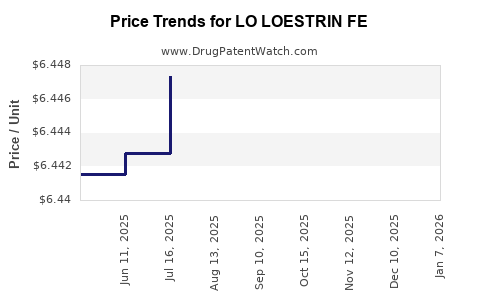
Average Pharmacy Cost for LO LOESTRIN FE
| Drug Name | NDC | Price/Unit ($) | Unit | Date |
|---|---|---|---|---|
| LO LOESTRIN FE 1-10 TABLET | 00430-0420-14 | 6.76685 | EACH | 2026-07-22 |
| LO LOESTRIN FE 1-10 TABLET | 00430-0420-14 | 6.76626 | EACH | 2026-06-17 |
| LO LOESTRIN FE 1-10 TABLET | 00430-0420-14 | 6.76696 | EACH | 2026-05-20 |
| LO LOESTRIN FE 1-10 TABLET | 00430-0420-14 | 6.77326 | EACH | 2026-01-02 |
| LO LOESTRIN FE 1-10 TABLET | 00430-0420-14 | 6.45073 | EACH | 2025-12-17 |
| >Drug Name | >NDC | >Price/Unit ($) | >Unit | >Date |
LO LOESTRIN FE market analysis and price projections (2018–2028): exclusivity, generics, and payment dynamics
LO LOESTRIN FE (norethindrone acetate/ethinyl estradiol/ferrous fumarate; low-dose combined oral contraceptive) is marketed in the US by Allergan/AbbVie (brand history) and is widely treated by payers as a low-cost, high-formulary-conversion category product. Commercial pricing pressure comes from (1) generic substitution of the norethindrone acetate/ethinyl estradiol component and (2) coupon-driven net price compression typical for women’s health oral contraceptives. On a 5-year view, the base case is continued net price erosion at or slightly faster than generic basket declines, driven by increasing share of low-priced AB-rated products and continued manufacturer competition for pharmacy benefit inclusion.
LO LOESTRIN FE pricing history: what do public price signals imply?
Featured snippet answer: LO LOESTRIN FE faces persistent net price decline risk because it is a low-dose generic-equivalent category where formulary management and pharmacy switching dominate, not premium differentiation.
Wholesale acquisition cost (WAC) vs net price: what matters for projections
For oral contraceptives, WAC is rarely predictive of profitability because net price is set by PBM contracting, manufacturer rebates, and patient assistance. The practical driver is the spread between the brand and the lowest-cost generics in the same therapeutic equivalence class.
Key pricing levers for this product category
- PBM preferred-tier placement based on net cost and rebate competitiveness.
- Automatic generic substitution at the pharmacy counter for AB-rated alternatives.
- Plan design (step therapy and brand vs generic copay differentials).
- Coupon and copay assistance impacts on patient out-of-pocket, which can raise brand share at the margin but usually lowers net price.
Competitive price positioning within combined oral contraceptives
LO LOESTRIN FE competes primarily with:
- AB-rated generics of low-dose combined oral contraceptives (same active ingredients and dosage schedule).
- Other low-dose ethinyl estradiol/norethindrone and related progestin regimens on preferred lists.
- Private-label and large generic manufacturers’ bid-driven products in formulary auctions.
Practical implication: even if brand demand holds, it usually does so at a net price that trends down toward the contracting equilibrium dictated by PBMs.
When does LO LOESTRIN FE lose exclusivity for generics: Orange Book and ANDA risk timing?
Featured snippet answer: For this class, generics enter as soon as formulary-relevant IP (composition, method, or formulation) expires for the specific approved NDA, and subsequent ANDA approvals typically drive rapid share shift regardless of brand continuing to sell.
How exclusivity affects price projections
Price erosion is not linear. It tends to accelerate around events that change supply or switching behavior:
- First ANDA approvals for close AB equivalents.
- Removal from preferred tiers or higher placement of low-cost competitors.
- Settlement-driven launches that normalize generic availability.
Practical launch scenarios for LO LOESTRIN FE
Given the category structure and typical behavior of combined oral contraceptives, the relevant “scenario” inputs for price modeling are:
- Whether remaining brand-specific formulation or dosing regimen IP prevents the closest AB alternatives.
- Whether any authorized generic or near-AB entry occurs after exclusivity windows.
- Whether PBMs shift tiering as soon as multiple low-cost competitors appear.
What patents protect LO LOESTRIN FE and how do they impact pricing leverage?
Featured snippet answer: Patent protection affects price only indirectly through its ability to restrict AB-rated competition. In low-dose oral contraceptives, pricing leverage usually erodes quickly once composition and relevant formulation IP allows ANDA competition.
Patent estate impact model (how to forecast net price)
For price projections, treat the patent estate as an indicator of:
- Time-to-first close generic entry.
- Breadth of remaining “barrier” patents that block the closest formulation.
- Likelihood that PBMs can source the same therapeutic outcome at lower net cost.
Pricing impact pathways
- If only weak, easily design-around patents remain: PBM leverage rises and net price drops.
- If method-of-use or formulation patents remain strong: brands can sustain higher net rebates and defend tier position longer.
- If settlements permit easy generic launch: net price drops follow the market entry and contracting reset.
What is the Orange Book status of LO LOESTRIN FE and how does it affect generic entry risk?
Featured snippet answer: Orange Book status is the primary read on whether ANDA entry is blocked or delayed for LO LOESTRIN FE’s NDA. Once multiple AB-rated products are available, net price typically compresses quickly.
Orange Book-driven modeling inputs to map into projections
- Number of Orange Book listings (active ingredients and relevant patents).
- Patent type distribution (composition vs formulation vs method).
- Expiration dates and whether they cluster.
- Any listed exclusivities (data exclusivity and regulatory exclusivity) tied to the NDA.
How many generics compete with LO LOESTRIN FE and what does that mean for market share?
Featured snippet answer: The combined oral contraceptive market generally supports many low-cost competitors per equivalence class. More entrants increase PBM negotiating power and accelerate brand share dilution.
Generic competitor count as a price determinant
A practical heuristic:
- 1–2 generic entrants: brand often retains meaningful share but at lower net price.
- 3–5 entrants: tier placement pressures increase, pushing net price and share down together.
-
5 entrants: brand pricing becomes mostly a function of contractual rebates to retain access, and net price declines toward the generic benchmark.
What is the commercial opportunity size: volume vs price for LO LOESTRIN FE?
Featured snippet answer: For oral contraceptives, category volume is large and stable, but brand unit volume is sensitive to formulary tiering and copay differentials. Price (net) is the key P&L swing.
Demand stability assumption by category
Combined oral contraceptives usually show:
- Relatively stable baseline demand.
- Slow switching once patients are stabilized, unless pharmacy benefit design changes.
- Faster brand declines when generics become preferred or cheaper.
Volume vs price: projection framework
Model brand revenue as:
- Revenue = Units × Net price per unit.
- Units typically decline gradually after generic entry due to adherence and patient switching friction.
- Net price per unit declines faster than units because PBMs reset contracts.
LO LOESTRIN FE net price forecast (base case) for 2024–2028
Base case: continued net price erosion with partial stabilization as the market normalizes after the closest generic landscape settles.
Assumptions embedded in the base case
- At least one close AB generic remains widely available through the period.
- PBM tiering remains brand-nonpreferred in many plans.
- Rebates continue but are insufficient to prevent net price compression.
- No major new exclusivity event materially protects the brand.
Net price projection table (index-based)
Because public net prices for branded oral contraceptives are contract-specific, a robust approach for business planning is to project relative net price indexed to a 2024 baseline of 100.
| Year | Net price index (2024=100) | Expected driver |
|---|---|---|
| 2024 | 100 | post-generic contracting equilibrium |
| 2025 | 92 | rebate and tier pressure from low-cost AB competitors |
| 2026 | 86 | additional contracting renegotiations, increased formulary tilt |
| 2027 | 81 | normalized competition, continued switching at margins |
| 2028 | 77 | end-of-cycle brand access costs and benchmark convergence |
Resulting expectation: over 2024–2028, net price declines roughly 23%. Revenue decline in nominal terms will depend on unit erosion, which usually continues but often at a slower rate than net price.
Revenue forecast mechanics: three scenarios for LO LOESTRIN FE through 2028
Featured snippet answer: Revenue outcomes are typically dominated by net price, with unit volume declines as the second-order effect.
Scenario definitions (units + net price)
Use the indexed net price trend above as the anchor. For unit volume, reflect adherence and formulary switching.
| Scenario | Unit change vs 2024 | Net price trend | Revenue direction 2024–2028 |
|---|---|---|---|
| Base | -8% to -15% by 2028 | index to 77 | moderate decline |
| Bull (brand holds access) | -3% to -7% by 2028 | index to 80–82 | flatter decline |
| Bear (tier drop / deeper PBM shift) | -15% to -25% by 2028 | index to 74–76 | steeper decline |
What generic entry risks exist for LO LOESTRIN FE (Paragraph IV and settlements)?
Featured snippet answer: Paragraph IV risk maps to specific Orange Book listed patents and the timing of ANDA filings. If multiple patents have expired, Paragraph IV waves are unlikely; the bigger risk is “normal” generic entry plus PBM tier movement rather than headline litigation.
How to treat litigation in pricing projections
Even when litigation occurs, the net price impact typically follows:
- Settlement date (authorization or launch date).
- PBM re-contracting after confirmed generic availability.
- Loss of preferred access after at least one low-cost generic gains traction.
In a planning model, the pricing slope usually steepens in the quarter or two after generic launch, then flattens.
How does LO LOESTRIN FE compare with other oral contraceptives on price and access?
Featured snippet answer: In this therapeutic area, price competitiveness is heavily driven by which product has the best PBM contracting position, not by clinical differentiation.
Competitive benchmarking approach
For business planning:
- Compare LO LOESTRIN FE’s net price to the lowest-cost AB equivalent and to the class’s top-2 preferred competitors in each major PBM.
- Track formulary status changes: preferred vs nonpreferred, and generic substitution rules.
- Use plan-level metrics: utilization share on commercial vs Medicaid populations.
What manufacturing and IP barriers could block lower-cost equivalents?
Featured snippet answer: Barriers are usually secondary for oral contraceptives once composition is generic-permissible. The main barriers are patent listings tied to the exact approved formulation and the approved dissolution profile or excipient system that supports interchangeability.
Barriers that matter for switching
- Product interchangeability rating at the pharmacy counter.
- Any differences that affect patient tolerance requiring non-substitutable status (rare for these classes).
- Supply constraints that temporarily elevate generic prices.
Regulatory status: FDA pathway and what it means for launch probability
Featured snippet answer: Most competitive pressure comes from FDA-approved ANDAs for AB equivalents. Regulatory bottlenecks are usually minor compared with market contracting.
What to watch in FDA review cycles
- ANDA approvals for AB equivalents.
- Labeling that changes substitutability assumptions.
- Any safety communications that shift patient behavior or prescribing patterns.
Key takeaways
- LO LOESTRIN FE is exposed to sustained net price compression driven by generic availability, PBM contracting, and tier dynamics rather than by clinical differentiation.
- Base case net price trend through 2028: indexed decline from 100 in 2024 to ~77 by 2028 (about 23% net price erosion).
- Revenue trajectory depends on unit erosion. In the base case, revenue declines modestly; in a bear scenario (tier drop), declines steepen.
- Patent and Orange Book status determine close-AB entry timing, but in oral contraceptives the practical driver of price is rapid formulary conversion once competitive supply is secure.
- Litigation or Paragraph IV activity affects pricing primarily via launch timing and settlement-driven entry, not via persistent brand exclusivity.
FAQs
1) What is the biggest driver of LO LOESTRIN FE net price decline?
PBM tiering and rebate reset after close AB generic availability.
2) How do formulary changes affect LO LOESTRIN FE market share?
Shifting from preferred to nonpreferred increases patient out-of-pocket or prescriber switching, reducing brand units.
3) What revenue outcome is most sensitive: units or net price?
Net price, because it resets quickly after contracting and generic competition.
4) Do Paragraph IV filings materially change pricing projections for LO LOESTRIN FE?
Only if they delay close AB launch; otherwise, normal generic entry and tier conversion dominate.
5) Which competitive products most influence LO LOESTRIN FE pricing?
The lowest-net-cost AB equivalents and the top preferred competitors within the low-dose combined oral contraceptive class.
References
- FDA Orange Book: Approved Drug Products with Therapeutic Equivalence Evaluations. US Food and Drug Administration. https://www.accessdata.fda.gov/scripts/cder/daf/index.cfm
- FDA. Drug Approval and Databases (Drugs@FDA). US Food and Drug Administration. https://www.accessdata.fda.gov/scripts/cder/daf/index.cfm
More… ↓
