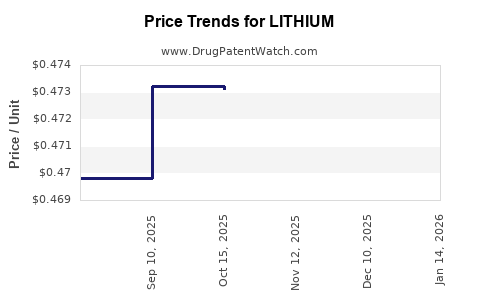
Last updated: February 14, 2026
What is the Current Market Size for Lithium?
Lithium is a critical raw material primarily used in manufacturing batteries for electric vehicles (EVs), energy storage systems, and consumer electronics. The global lithium market was valued at approximately $4.38 billion in 2022 and is projected to grow at a compound annual growth rate (CAGR) of 10.2% from 2023 to 2030 [1].
Primary lithium compounds include lithium carbonate and lithium hydroxide. The demand for lithium hydroxide has increased due to its superior performance in high-energy-density batteries, particularly in EVs. By 2027, lithium demand is expected to reach 950,000 metric tons, a significant increase from 300,000 metric tons in 2022 [2].
What Are the Key Factors Driving Lithium Market Growth?
-
Electric Vehicle Adoption: Governments worldwide implement policies promoting EV adoption, boosting lithium demand. China, the U.S., and Europe lead in EV markets, collectively accounting for over 70% of global sales [3].
-
Energy Storage Expansion: Grid storage projects integrate lithium-ion batteries to balance renewable energy sources, fueling market growth.
-
Supply Chain Constraints: Limited lithium extraction and processing capacity maintain upward pressure on prices and create supply-demand imbalances [4].
-
Technological Improvements: Advances in lithium extraction and recycling reduce costs and increase accessible supply.
How Is the Lithium Market Structured?
| Segment |
Description |
Share (2022) |
| By Product Type |
Lithium Carbonate, Lithium Hydroxide, Lithium Chloride |
Lithium Carbonate (45%) |
|
|
Lithium Hydroxide (50%) |
|
|
Others (5%) |
| By Application |
EV Batteries, Consumer Electronics, Industrial Uses |
EV Batteries (60%) |
|
|
Others (40%) |
| By Geography |
Asia-Pacific, Europe, North America, Others |
Asia-Pacific (55%) |
|
|
Europe (20%) |
What Are Current Pricing Trends?
-
Lithium carbonate averaged $80,000 per metric ton in 2022, up from about $25,000 in 2020, reflecting soaring demand and supply tightness [5].
-
Lithium hydroxide commands a premium, averaging $90,000 per metric ton in 2022, owing to its preferred use in high-capacity batteries [6].
Prices are volatile, influenced by mine closures, geopolitical considerations, and accelerating EV market growth. Prices peaked in 2022 but showed signs of stabilization in early 2023 as new supply sources began operations.
What Are Short- and Long-Term Price Projections?
Short-Term (2023–2025)
- Prices expected to stabilize around $80,000–$90,000 per metric ton for lithium carbonate and hydroxide due to increased supply from new projects.
- Supply chain adjustments will temper sudden price spikes; however, market surges remain possible amid unforeseen disruptions.
Long-Term (2026–2030)
- Prices projected to decline gradually to around $60,000–$70,000 per metric ton as additional mines and processing facilities come online.
- Demand growth from EV and energy storage sectors is likely to outpace supply expansions, keeping prices relatively high compared to pre-2020 levels.
Key Influences on Price Projections
- Technological advancements reducing extraction costs.
- Expansion of lithium recycling initiatives.
- Policy shifts affecting mining and environmental standards.
- Potential supply bottlenecks from geopolitical conflicts or environmental restrictions.
What Are Technological and Geopolitical Risks?
- Environmental Concerns: Lithium extraction faces scrutiny over water use and habitat disruption, possibly delaying or constraining new projects.
- Geopolitical Tensions: Countries with significant lithium reserves, such as Bolivia, Chile, and Australia, may experience export restrictions, affecting global supply.
- Market Concentration: A few dominant producers, like Albemarle, SQM, and Ganfeng, control most lithium supply, introducing risks of market manipulation or supply shocks.
What Are Key Players and Their Market Shares?
| Company |
Estimated Market Share |
Notable Operations |
| Albemarle Corporation |
20% |
North America, Australia, Chile |
| SQM |
14% |
Chile |
| Ganfeng Lithium |
10% |
China, Australia |
| Tianqi Lithium |
8% |
Australia, China |
| Others |
48% |
Various small and medium producers |
Summary of Price Drivers and Challenges
- Growing EV and energy storage markets drive demand.
- Supply constraints and environmental concerns limit capacity.
- Price volatility remains high due to geopolitical and market dynamics.
- Technological improvements and recycling offer potential supply relief.
- Long-term prices will likely stabilize but stay above historic lows.
Key Takeaways
- Lithium market was valued at $4.38 billion in 2022, with a 10.2% CAGR forecast until 2030.
- Demand driven primarily by EV battery expansion; supply constrained by environmental and geopolitical factors.
- Lithium carbonate prices averaged $80,000 per ton in 2022; hydroxide commands higher premiums.
- Short-term prices are stabilizing; long-term prices are expected to decline but remain elevated.
- Supply chain disruptions, technological innovations, and environmental policies significantly influence market dynamics.
FAQs
1. How will advancements in battery technology affect lithium demand?
New battery chemistries reducing lithium content or replacing lithium would decrease demand, but current trends favor continued lithium reliance due to its energy density and proven performance.
2. When will new lithium projects start contributing significantly to supply?
Major projects scheduled to commence from 2024 to 2026, with cumulative capacity expected to increase by 25–30% in this period.
3. How do environmental regulations impact lithium prices?
Stricter regulations can delay or limit new mining projects, restricting supply growth and sustaining higher prices.
4. Which regions are emerging as lithium supply hubs?
Argentina (belts of lithium-rich salt flats), Australia (hard-rock spodumene mines), and Bolivia (Salt Flat deposits) are key emerging sources.
5. What role does recycling play in lithium supply?
Recycling lithium from batteries can mitigate supply shortages but currently accounts for less than 10% of total demand; technological and economic barriers remain.
Sources
[1] Research and Markets. Lithium Market Size & Share Analysis, 2022.
[2] Benchmark Mineral Intelligence. Lithium Demand Outlook, 2023.
[3] International Energy Agency. Global EV Market Reports, 2022.
[4] USGS Mineral Commodity Summaries, 2023.
[5] Fastmarkets. Lithium Carbonate Price Reports, 2022.
[6] Roskill. Lithium Market Outlook, 2023.