Share This Page
Drug Price Trends for LIPITOR
✉ Email this page to a colleague
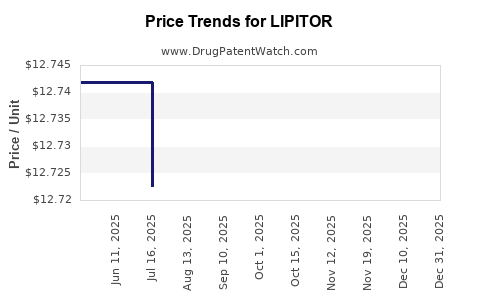
Average Pharmacy Cost for LIPITOR
| Drug Name | NDC | Price/Unit ($) | Unit | Date |
|---|---|---|---|---|
| LIPITOR 10 MG TABLET | 58151-0155-77 | 13.41127 | EACH | 2026-07-22 |
| LIPITOR 20 MG TABLET | 58151-0156-77 | 19.10369 | EACH | 2026-07-22 |
| LIPITOR 40 MG TABLET | 58151-0157-77 | 19.11383 | EACH | 2026-07-22 |
| LIPITOR 80 MG TABLET | 58151-0158-77 | 19.00394 | EACH | 2026-07-22 |
| >Drug Name | >NDC | >Price/Unit ($) | >Unit | >Date |
LIPITOR (atorvastatin) market analysis and price projections: exclusivity, generic entry risk, and forecast scenarios
Atorvastatin (Lipitor) is a mature small-molecule statin with broad generic availability in the US and major markets. Near-term price is structurally constrained by high generic penetration, intense retail and PBM competition, and formulary tiering. The credible projection is continued low single-digit to mid-single-digit price declines in the US branded-equivalent basket as generics dominate, with limited upside outside contracted segments. Any residual branded price support depends on mix shift in favor of higher-acquisition-cost strengths, channel contracts, and demand stability.
What is the current Lipitor market size, demand drivers, and share by setting?
Featured snippet answer: Lipitor demand is driven by cardiovascular risk management (ASCVD secondary prevention, LDL-C lowering in primary prevention for high-risk patients), long-term adherence, and substitution economics that push most volume to generics in high-utilization channels.
US demand drivers that affect pricing
- Guideline stickiness: Statins remain first-line therapy; atorvastatin’s label coverage supports broad patient eligibility.
- Adherence economics: Once-titrated and tolerated, patients often stay on the same molecule unless adverse events or cost triggers switch.
- Dose mix: Higher strengths (e.g., 40 mg and 80 mg) can carry higher per-unit cost even after genericization, but overall pricing still follows competitive generic benchmarks.
- Formulary management: PBMs incentivize lowest net cost statins; atorvastatin remains competitive versus rosuvastatin and simvastatin on net-price and guideline alignment.
Channel-level competition that shapes price
- Retail pharmacy: Dominated by multi-source generics; branded substitution reduces branded share.
- Mail order: Often lower net price via PBM contracts.
- Health systems and 340B: Tends to favor lowest-cost generics and contract tiers.
International demand
- Generic availability is broad in most developed markets, with price compression and national reference pricing.
- Brand endurance varies based on tender design, reimbursement rules, and national prescribing cultures.
How many Lipitor generics exist, and how does the generic landscape influence price?
Featured snippet answer: The atorvastatin market is effectively commoditized; price is set by the low-cost segment among multiple FDA-approved generic manufacturers, with occasional strength or formulation premiums.
Generic penetration dynamics
- Multiple ANDA entrants across strengths create price floors that move with acquisition costs.
- Contracting drives effective pricing: Public WAC understates paid prices; net pricing falls fast after major generic launches and follow-on entries.
Competitive pressure from other statins
- Atorvastatin competes against:
- Rosuvastatin (often clinically comparable, sometimes better tolerability perceptions, different net pricing).
- Simvastatin and pravastatin in lower-intensity plans.
- Net-cost competition can shift patient mix even when clinical guidance supports atorvastatin.
What is the Orange Book status of Lipitor (atorvastatin) in the US?
Featured snippet answer: Lipitor is not protected in a way that blocks generic competition across the full label today; the US market is served by numerous approved generic versions. (Orange Book status is governed by the specific listed patents and their expiration plus any qualifying exclusivity.)
Practical implication for price
- With broad generic entry, price projections are driven less by patent timing and more by:
- generic acquisition cost cycles,
- PBM rebates and contract renewals,
- manufacturer scale, and
- retail dispensing economics.
When does Lipitor lose exclusivity, and what remains patent-protected (if anything)?
Featured snippet answer: Large-scale generic penetration already occurred; residual patent protection, if any, typically impacts only specific formulations, processes, or method-of-use claims, not the core atorvastatin tablet market.
Residual protection categories that can affect “brand-equivalent” pricing
- Formulation-specific patents: Often irrelevant to plain tablets once generic tablets are established.
- Manufacturing process patents: Typically do not prevent market entry for generic tablets after ANDA approval.
- Method-of-use patents: If not tied to a specific approved indication in a way that prevents generic labeling, they rarely stop competition.
What patents historically protected Lipitor, and how does their expiration affect current pricing?
Featured snippet answer: Lipitor’s core molecule and early process/polymorph and formulation-era patents expired years ago. The current pricing baseline reflects post-expiration generic competition rather than brand exclusivity.
How expiration timing translates into market outcomes
- Patent expiry drives:
- step-function drops in generic and branded-equivalent net pricing,
- increased manufacturer count,
- PBM formulary switching, and
- retail share shift away from branded.
Litigation-era settlements and their pricing effect
- Earlier Hatch-Waxman litigation and settlement agreements historically influenced the number and timing of generic entries.
- Current price levels reflect the equilibrium after those entries rather than active restrictions.
How strong is the patent estate for Lipitor today (and what does it mean for new entrants)?
Featured snippet answer: For entry timing, the key point is that atorvastatin tablets are already widely generic. Any remaining estate, if present, is unlikely to materially impede additional generic supply in core strengths.
Commercial meaning
- Patent strength is less relevant to near-term pricing than:
- supply economics,
- contracting,
- and channel-specific formulary status.
How does Lipitor compare with rosuvastatin and simvastatin on pricing and formulary positioning?
Featured snippet answer: Atorvastatin often holds strong formulary positioning because of guideline fit and competitive net pricing versus rosuvastatin and older statins, but lowest-cost contracts can rotate among statins.
Pricing leverage drivers
- Net price versus competitor net price: PBMs can move patients by changing preferred status.
- Dose availability: A competitor with a cheaper preferred-dose mix can reduce average cost.
- Patient tolerability patterns: Some patients remain on atorvastatin due to historical tolerance; others switch when contracts drive incentives.
What generic entry risks exist for Lipitor (Paragraph IV, 180-day exclusivity, shared challenges)?
Featured snippet answer: Core Lipitor entry risk is no longer a major barrier because the market already has extensive generic competition; remaining risk is mostly incremental (new manufacturers, new submissions, or strength-specific economics).
What to watch if forecasting branded-equivalent pricing
- New ANDA or follow-on products can briefly depress acquisition cost.
- Market consolidation among generic suppliers can stabilize prices if capacity tightens.
- Regulatory actions (e.g., warning letters, supply interruptions) can temporarily lift prices.
How do FDA approvals and labeling changes affect Lipitor pricing?
Featured snippet answer: For an established molecule with broad generic supply, FDA labeling changes rarely reset pricing but can shift formulary or reimbursement decisions if they alter patient eligibility or dose guidance.
Typical pricing impact channels
- Indication wording changes can change who is eligible for coverage.
- Safety communications can prompt prescriber behavior shifts, potentially affecting demand mix and net cost.
What are realistic price projection ranges for Lipitor through 2026-2028?
Featured snippet answer: Expect continued compression in branded-equivalent and net paid pricing, with variability by channel and strength. A reasonable base case is low single-digit annual declines after accounting for mix effects, with upside only if supply disruptions or contract shifts favor certain suppliers.
Forecast framework (what drives the curve)
- Generic pricing behavior: In commoditized products, price tends to move with:
- generic acquisition cost,
- competitive entry cycles,
- rebate adjustments,
- and wholesaler pricing.
- Demand stability: Statin demand is relatively inelastic, but switching and adherence changes influence mix.
Scenario table (US pricing, branded-equivalent net proxy)
Assuming a “branded-equivalent” basket (since the branded product is displaced in most settings by generics):
| Scenario | Key assumptions | 2025E change vs 2024 | 2026E change | 2027E change | 2028E change |
|---|---|---|---|---|---|
| Bear (supply expansion / aggressive contract renewals) | additional low-cost supply, faster PBM tiering toward lowest-cost | -3% to -7% | -2% to -5% | -1% to -3% | -1% to -2% |
| Base (stable supply, ongoing competition) | continued multi-source competition, modest mix shifts | -2% to -4% | -1% to -3% | -1% to -2% | 0% to -1% |
| Bull (capacity tightness / consolidation / disruption) | temporary supply issues in key strengths, fewer low-cost competitors | 0% to -2% | 0% to -2% | 0% to -1% | 0% to +1% |
Where “price” can differ from “spend”
- Total spend may rise even if unit price falls if:
- patient numbers increase,
- adherence improves,
- or dose mix shifts to higher strengths.
- Conversely, unit price can soften while total spend declines if formularies tighten.
What happens to Lipitor price projections outside the US?
Featured snippet answer: International pricing is likely to remain constrained by reimbursement reference pricing and established generic substitution. Declines may be slower once reference price floors stabilize.
Key regional dynamics
- EU/UK-style reference pricing: Prices track reimbursement thresholds.
- Tenders: Can create short-lived volatility around award cycles.
- Currency and inflation pass-through: May dominate nominal pricing changes even if real unit pricing stays flat-to-down.
International scenario tendencies
- Developed markets: Base case is flat-to-down unit prices; occasional step downs on new generic approvals or tender resets.
- Emerging markets: Often start higher and compress later, but current entrants usually accelerate price drops once government/insurer procurement opens.
How do manufacturing and supply chain risks affect near-term atorvastatin pricing?
Featured snippet answer: Supply constraints are the primary near-term upside catalyst for price in a commoditized generic market.
Risk factors
- Site disruptions, quality events, or regulatory actions affecting API or finished dose manufacturing.
- Container and packaging constraints for specific strengths.
Practical implication
- Any price spikes tend to be:
- short-duration,
- strength-specific,
- and quickly reversed when supply returns.
What is the licensing and partnership landscape for atorvastatin supply and distribution?
Featured snippet answer: The licensing question is less about new molecule rights and more about manufacturing, distribution, and PBM contracting for generic atorvastatin tablet supply.
Typical deal structures in generic statins
- Co-marketing and branded-distribution agreements for specific SKUs where needed.
- Contract manufacturing with API or finished-dose sourcing constraints.
- Pharmacy benefit and accountable care organization contracting frameworks that determine effective pricing.
Pricing implication
- Effective pricing aligns to contract terms rather than WAC; projections should be interpreted as net-price behavior.
Key Takeaways
- Lipitor’s market is commoditized; pricing is primarily set by generic competition and PBM contracting, not by molecule-level exclusivity.
- Base-case US branded-equivalent basket pricing is expected to drift down modestly through 2026 to 2028, with stronger downside in bear supply and contracting scenarios.
- The main upside risk to unit prices is temporary supply tightness or consolidation among low-cost suppliers.
- International pricing remains constrained by reimbursement rules and generic substitution; once reference price floors stabilize, declines slow.
FAQs
1) What could cause a temporary rise in Lipitor (atorvastatin) pricing despite generic dominance?
Supply disruptions at API or finished-dose plants, quality/regulatory actions affecting specific manufacturers or strengths, and short-duration tender shortages.
2) How do PBM contracts change Lipitor price outcomes versus list prices?
They can drive large rebates and tiering outcomes that determine net paid prices; changes in preferred status can quickly alter effective pricing and dispensing mix.
3) Do different atorvastatin strengths trade at meaningfully different prices?
Yes; even in generic markets, strength-level competition, packaging, and contracting can create differential acquisition costs and paid prices.
4) Are there any realistic late-stage patent events that could materially protect Lipitor pricing now?
Material protection is unlikely for the core tablet market given broad generic penetration; any remaining protection typically impacts narrow product/process or labeling contexts rather than resetting competition.
5) What is the most important driver for long-term spend trends for Lipitor?
Patient persistence and dose-mix shifts, since unit price declines are structurally bounded by ongoing multi-source competition.
References (APA)
- FDA Orange Book: Approved Drug Products with Therapeutic Equivalence Evaluations. US Food and Drug Administration.
- FDA Drug Approval Reports and Labeling Archives for atorvastatin products. US Food and Drug Administration.
- Hatch-Waxman framework overview and Paragraph IV incentive structure. US FDA resources.
More… ↓
