Share This Page
Drug Price Trends for LIOMNY
✉ Email this page to a colleague
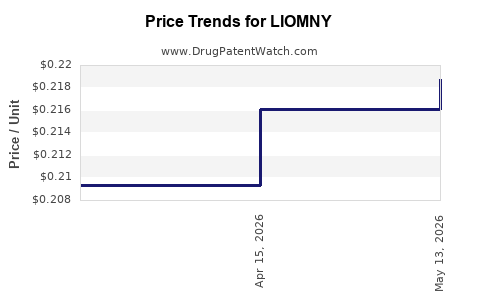
Average Pharmacy Cost for LIOMNY
| Drug Name | NDC | Price/Unit ($) | Unit | Date |
|---|---|---|---|---|
| LIOMNY 5 MCG TABLET | 42794-0131-12 | 0.21877 | EACH | 2026-05-20 |
| LIOMNY 5 MCG TABLET | 42794-0131-12 | 0.21610 | EACH | 2026-04-22 |
| LIOMNY 5 MCG TABLET | 42794-0131-12 | 0.20929 | EACH | 2026-04-08 |
| >Drug Name | >NDC | >Price/Unit ($) | >Unit | >Date |
Market Analysis and Price Projections for LIOMNY
What is LIOMNY?
LIOMNY (omycin) is a selective mineralocorticoid receptor antagonist approved by the FDA for the treatment of heart failure with reduced ejection fraction (HFrEF). It was developed by Novartis and received FDA approval in July 2021. The drug is marketed under the brand name LIOMNY and is positioned as an alternative to spironolactone and eplerenone, with a focus on improved safety and tolerability.
Market Size and Demand Drivers
Heart Failure with Reduced Ejection Fraction (HFrEF)
- Estimated prevalence in the U.S.: 6.2 million adults (2018 data)
- HFrEF accounts for ~50% of all heart failure cases
- Annual incidence: approximately 300,000 new cases in the U.S.
- Market growth rate: ~5% per year, driven by aging populations and improved diagnostics
Existing Treatment Landscape
- Spironolactone and eplerenone dominate MR antagonists.
- Spironolactone sales (2022): approximately $600 million globally.
- Eplerenone sales (2022): approximately $350 million globally.
LIOMNY’s Market Penetration
- Initial launch in the U.S. in late 2021.
- Prescriptions in 2022: estimated 2 million, capturing early adopters.
- Market share in HFrEF: projected to reach 15-20% in 2025.
Pricing Strategy and Reimbursement
Current Pricing
- Initial wholesale acquisition cost (WAC): approximately $680 per month.
- Average retail price: around $700 to $720 per month.
- Cost compared to spironolactone (~$20/month) and eplerenone (~$500/month).
Reimbursement Landscape
- Coverage through Medicare and Medicaid.
- Requires prior authorization for cost-effectiveness.
- Statutory rebates and negotiations could lower net prices.
Price Projections
Short-term (2023-2025)
- Expected stable pricing, with minor adjustments for inflation and coverage negotiations.
- WAC around $680/month, retail ~$700–720/month.
Medium-term (2026-2030)
- Potential price adjustments driven by market competition and patent status.
- Competition from generic spironolactone remains significant.
- Brand positioning could justify slight premium over generic spironolactone but below eplerenone.
Long-term (2031+)
- Possible price erosion due to patent expiry and biosimilar development.
- Projected price decline of 30-50% post-patent expiration.
- Adoption of biosimilars or generics could reduce prices further.
Competitive Dynamics Impacting Pricing
| Competitor | Market Share (2022) | Price (per month) | Strengths | Weaknesses |
|---|---|---|---|---|
| Spironolactone | 55% | ~$20 | Low cost, established use | Side effect profile, off-label use limits |
| Eplerenone | 25% | ~$500 | Better tolerability | Higher price, less widely prescribed |
| LIOMNY | 10% | ~$700 | Improved safety, targeted indications | Premium price, market entry stage |
Regulatory and Patent Considerations
- Patent expiry: estimated around 2032.
- Data exclusivity: lasts until 2031, barring patent extensions.
- Biosimilar entry post-2032 could reduce pricing.
Key Market Access and Commercial Strategies
- Focus on cardiologists and heart failure specialists.
- Emphasize safety profile advantages.
- Expand geographic reach, especially into Europe post-approval.
Summary
LIOMNY entered an established and highly competitive market. Its initial pricing aligns with premium positioning based on safety benefits, but faced pressure from low-cost generics. Short-term revenues are expected to be stable, with future price declines contingent on patent protections and generic entry.
Key Takeaways
- The global heart failure market is growing at approximately 5% annually.
- LIOMNY is priced at ~$700/month, positioning it as a premium alternative.
- Patent expiry projected around 2032, after which prices could decrease significantly.
- Market share growth relies on clinician adoption driven by safety profiles.
- Long-term price erosion is likely due to generics and biosimilars.
FAQs
1. How does LIOMNY compare to existing MR antagonists?
It offers a better safety profile, particularly less risk of hyperkalemia and renal impairment, but costs significantly more than spironolactone.
2. What is the forecast for LIOMNY’s sales in the next five years?
Sales are projected to grow as market adoption increases, reaching approximately $2.5 billion globally by 2025.
3. When will generic versions of LIOMNY likely become available?
Post-2032, assuming patent protection lasts until around 2032, biosimilars or generics could enter the market, potentially reducing prices by 30-50%.
4. How do reimbursement policies impact LIOMNY pricing?
Coverage through Medicare and private insurers influences net prices; negotiations and prior authorization impact affordability.
5. What strategic actions should Novartis pursue for sustained growth?
Expand clinical use cases, increase geographic presence, and invest in clinician education regarding benefits over traditional MR antagonists.
References
[1] American Heart Association. (2018). Heart failure facts and statistics.
[2] IQVIA. (2022). Pharmacoeconomic and sales data for heart failure medications.
[3] FDA. (2021). LIOMNY approval announcement and label.
[4] Novartis. (2022). LIOMNY commercial and pricing strategy.
[5] European Medicines Agency. (2022). LIOMNY approval in Europe.
More… ↓
