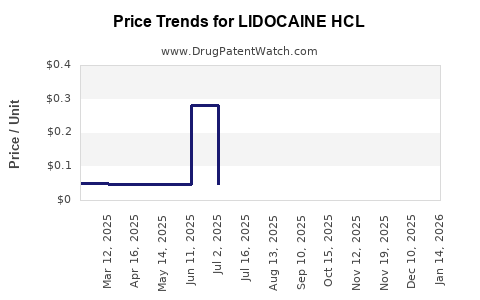
Last updated: February 20, 2026
What Is the Current Market Landscape for Lidocaine HCl?
Lidocaine HCl, a local anesthetic and antiarrhythmic agent, is used in various medical settings, including anesthesia, cardiology, and post-operative pain management. The drug's global market is driven by increased surgical procedures, expanding healthcare infrastructure, and rising demand for minimally invasive procedures.
Market Size and Growth
- The global lidocaine market was valued at approximately USD 1.2 billion in 2021.[1]
- Compound annual growth rate (CAGR) is projected at 3.5% from 2022 to 2028.[1]
- The North American region holds the largest market share, driven by high healthcare expenditure and advanced medical facilities.
- Asia-Pacific market exhibits significant growth potential due to expanding healthcare infrastructure and increasing surgical procedures.
Segmentation by Formulation
- Injectable formulation accounts for over 60% of sales.
- Topical formulations, such as patches and gels, dominate OTC and dermatological markets.
- Creams and patches are experiencing increased adoption due to patient preference for non-invasive administration.
Key Market Drivers
- Growing prevalence of chronic pain and cardiovascular diseases.
- Rising volume of outpatient and minimally invasive procedures.
- Increasing approvals for generic formulations reducing prices and expanding access.
- Technological advancements enhancing drug delivery systems.
Competitive Landscape
- Major pharmaceutical companies include Aspira Pharma, Novartis, and Mylan.
- Generic versions dominate the market, with patent expirations for key formulations since 2018.
- The entry of biosimilar and alternative drug delivery systems is a notable trend.
What Are Current Price Trends for Lidocaine HCl?
Pricing Dynamics
- US retail pharmacy prices for branded injectable Lidocaine HCl range from USD 2.50 to USD 4.00 per 100 mg dose depending on supplier and packaging size.[2]
- Generic formulations are 20-30% cheaper, with prices approximately USD 1.80 to USD 2.50 per 100 mg dose.
- OTC topical formulations like patches range between USD 10 and USD 25 per pack, depending on the dosage and brand.
Factors Influencing Prices
- Patent expiration increases generic competition and reduces prices.
- Manufacturing costs fluctuate with raw material prices, notably benzene derivatives.
- Regulatory policies influence pricing, especially in markets with price controls.
- Supply chain disruptions, as seen during the COVID-19 pandemic, temporarily increased prices for certain formulations.
What Are Price Projections for the Next Five Years?
Predicted Trends
- Prices for branded injectables are expected to decline by approximately 10% over five years, driven by generic competition and manufacturing efficiency.
- The average price for generic Lidocaine HCl is projected to decrease by 15-20%.
- Topical formulations are anticipated to see a modest price decline of 5-10%, largely due to increased competition and OTC availability.
- Overall, an average reduction of 12% in retail prices is expected by 2028.
Influencing Factors
- Broader adoption of biosimilars and generic drugs.
- Continued patent expirations and regulatory support for low-cost generics.
- Advances in formulation technologies reducing production costs.
- Policy shifts toward price regulation, especially in European and Asian markets.
How Do Regulatory and Market Policies Impact Pricing?
- In the US, the Medicare and Medicaid programs limit reimbursement for certain formulations, pressuring prices downward.
- European countries implement price caps, restricting maximum allowable prices for generic and brand-name formulations.
- India and China employ aggressive pricing strategies to expand access, resulting in lower retail prices but potentially impacting profitability.
What Are Investment and R&D Opportunities?
- Development of long-acting topical formulations and sustained-release injectables can command premium pricing.
- Innovations in drug delivery systems, such as nanotechnology, offer potential to increase efficacy and market share.
- Biosimilar entries are expected to intensify price competition, but also open new markets for cost-effective alternatives.
Conclusion
The Lidocaine HCl market is expected to experience a gradual decline in prices over the next five years, influenced by patent expirations, increasing generic penetration, and technological innovations. Growth prospects remain solid, supported by expanding procedural volumes and innovations in delivery methods.
Key Takeaways
- The market for Lidocaine HCl was valued at approximately USD 1.2 billion in 2021, with a CAGR of 3.5%.
- Prices for branded injectables range from USD 2.50 to USD 4.00 per 100 mg dose; generic versions are 20-30% cheaper.
- Overall retail prices are projected to decrease by around 12% by 2028 due to increased generic competition.
- Regulatory policies in major markets will continue to influence pricing trends.
- Investment opportunities exist in sustained-release formulations and delivery system innovations.
FAQs
-
What factors most significantly affect Lidocaine HCl pricing?
Patent status, manufacturing costs, regulatory policies, and market competition primarily influence prices.
-
Are there regional differences in pricing?
Yes. US prices tend to be higher, reflecting higher healthcare costs, while Asian markets offer lower prices driven by price regulation and generic competition.
-
How might new formulations impact market prices?
Innovations like long-acting patches or injectables could command premium prices but could also lead to price competition if patent rights are challenged.
-
What regulatory challenges could influence future pricing?
Price caps, reimbursement limitations, and approval processes impact market entry costs and prices.
-
Is the demand for Lidocaine HCl expected to increase?
Yes. The demand is driven by rising procedures and expanding applications in pain management and cardiology.
References
[1] MarketResearch.com. (2022). Global Lidocaine Market Report.
[2] GoodRx. (2023). Lidocaine Prices Comparison.