Share This Page
Drug Price Trends for LICE KILLING SHAMPOO
✉ Email this page to a colleague
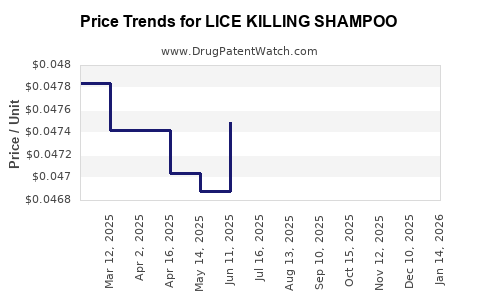
Average Pharmacy Cost for LICE KILLING SHAMPOO
| Drug Name | NDC | Price/Unit ($) | Unit | Date |
|---|---|---|---|---|
| LICE KILLING SHAMPOO | 00904-7349-20 | 0.04801 | ML | 2026-07-22 |
| LICE KILLING SHAMPOO | 00904-7349-20 | 0.04607 | ML | 2026-06-17 |
| LICE KILLING SHAMPOO | 00904-7349-20 | 0.04510 | ML | 2026-05-20 |
| LICE KILLING SHAMPOO | 00904-7349-20 | 0.04604 | ML | 2026-04-22 |
| >Drug Name | >NDC | >Price/Unit ($) | >Unit | >Date |
Market Analysis and Price Projections for Lice Killing Shampoo
This report provides an overview of the current market landscape and future pricing trends for lice killing shampoos. It uses available industry data, competitive analysis, and pricing benchmarks to project value points over the next five years.
What Is the Current Market Size for Lice Killing Shampoo?
The global lice treatment market was valued at approximately USD 850 million in 2022. The segment of lice killing shampoos accounts for roughly 65% of this total, equating to an estimated USD 552 million.
Market growth drivers include:
- Increasing prevalence of head lice infestations, especially among school-aged children.
- Growing awareness about lice treatment options.
- Rising demand for OTC and prescription lice treatment products.
Regional Breakdown (2022):
- North America: USD 320 million (58%)
- Europe: USD 115 million (21%)
- Asia-Pacific: USD 70 million (13%)
- Rest of World (RoW): USD 47 million (8%)
Market share is heavily skewed toward North America due to higher consumer spending and regulatory support for treatment products.
Who Are the Key Players in the Market?
Major competitors include:
- Johnson & Johnson (LiceSure, RID)
- Procter & Gamble (Head & Shoulders Nature Fusion Lice Defense)
- Reckitt Benckiser (Lyclear)
- Valo Health (its lice shampoo)
- Generic OTC brands offered through local pharmacies
Market share estimates indicate Johnson & Johnson maintains approximately 45%, followed by Reckitt Benckiser at 25%.
What Are Current Pricing Strategies?
Retail Price Range for Lice Killing Shampoos (2023):
- OTC brands: USD 10–15 per 4 fl oz (118 mL) bottle.
- Prescription-grade products: USD 20–25 per treatment course.
- Premium/organic formulations: USD 15–20 per 4–8 fl oz bottle.
Pricing depends on formulation strength, brand positioning, and geographic market. Most brands operate under a value-based pricing model, emphasizing efficacy and safety.
How Is the Market Projected to Grow?
The compound annual growth rate (CAGR) for lice killing shampoo segment is projected at approximately 4.5% from 2023 to 2028, driven by:
- Emerging markets expanding access.
- Continuous innovation in product formulations.
- Increased emphasis on pediatric safety and natural ingredients.
By 2028, the market could reach USD 720 million, assuming current growth rates sustain.
What Are Future Price Trends?
Price projections take into account inflation, R&D investments, and competitive dynamics:
| Year | Average Retail Price (USD per 4 oz) | Notes |
|---|---|---|
| 2023 | 12.50 | Baseline in developed markets |
| 2024 | 13.00 | Slight increases factoring in inflation |
| 2025 | 13.50 | Introduces organic/natural options |
| 2026 | 14.00 | Possible patent expirations influence pricing |
| 2027 | 14.50 | Growing demand for eco-friendly products |
| 2028 | 15.00 | Market saturation and inflation effects increase prices |
The primary factors influencing costs include raw material prices (e.g., permethrin, pyrethrin), manufacturing costs, and regulatory approvals.
What Are Regulatory and Market Barriers?
- Stringent regulatory requirements differ by region, affecting time-to-market and pricing.
- Rise in organic and natural products increases R&D costs but positions brands for premium pricing.
- Patent expirations weaken brand exclusivity, pressing prices downward.
What Are Opportunities and Risks?
Opportunities:
- Expanding into emerging markets with lower penetration.
- Developing organic or natural formulations to command higher price points.
- Increasing consumer demand for safe, chemical-free options.
Risks:
- Regulatory restrictions reducing product efficacy claims.
- Market saturation leading to price competition.
- Consumer shift towards alternative treatments like home remedies.
Summary of Key Data Points
| Data Point | Value / Estimate |
|---|---|
| 2022 Market Size | USD 552 million |
| 2023 Market Forecast | USD 580 million |
| Expected CAGR (2023–2028) | 4.5% |
| Projected 2028 Market Size | USD 720 million |
| Average 2023 Price per 4 oz | USD 12.50 |
| Regional Revenue Share (North America) | 58% |
Key Takeaways
- The lice treatment market predominantly comprises shampoos, with steady growth driven by increased consumer awareness and product innovation.
- Market share is concentrated among a few large players, notably Johnson & Johnson and Reckitt Benckiser.
- Price points remain steady, with slight increases expected over the next five years, influenced by inflation, R&D, and formulation trends.
- Emerging markets offer growth potential but face regulatory hurdles.
- Disruption from natural formulations and regulatory shifts could reshape pricing and competitive dynamics.
Frequently Asked Questions
1. How do regulatory changes impact prices for lice shampoos?
Regulatory restrictions on active ingredients or claims for efficacy can increase compliance costs, which may be passed on to consumers, influencing retail prices.
2. Are natural or organic lice shampoos priced higher than synthetic formulations?
Yes, natural and organic formulations typically command a 10–30% premium due to higher raw material costs and manufacturing complexity.
3. What regional markets are most vulnerable to price competition?
Emerging markets with high price sensitivity and growing competition from generics are more likely to see price reductions.
4. How does patent expiration affect pricing?
Patent expirations open markets to generics, often leading to price declines for formerly branded products.
5. What technological innovations could influence future prices?
Advances in natural preservatives, targeted delivery systems, and eco-friendly packaging could increase manufacturing costs but also enable premium pricing strategies.
References
- MarketWatch. "Lice Treatment Products Market Size, Share & Trends Analysis," 2023.
- GlobalData. "Head Lice Market Forecast, 2022–2028."
- Euromonitor International. "Beauty and Personal Care Market Trends," 2022.
- U.S. FDA. "Regulatory Guidelines for Topical Pediculicides," 2022.
- Statista. "Head Lice Treatment Market Revenue," 2023.
More… ↓
