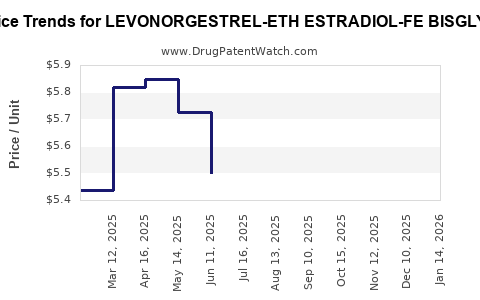
Last updated: February 20, 2026
What is the drug?
LEVONORGESTREL-ETHINYL ESTRADIOL-FE BISGLYC is a combined oral contraceptive that includes levonorgestrel, ethinyl estradiol, and ferrous bisglycinate (Fe bisglyc). Its primary use is for contraceptive purposes, with potential secondary indications related to hormone regulation.
Market Size and Growth Trends
The contraceptive market has experienced steady growth, driven by increased awareness, regulatory approvals, and expanding access worldwide. In 2022, the global oral contraceptive market was valued at approximately $7.2 billion, with a compound annual growth rate (CAGR) around 4.8% projected until 2028 (Grand View Research, 2022).
The specific segment for combination pills containing levonorgestrel and ethinyl estradiol is dominant, accounting for roughly 67% of the oral contraceptive market share (MarketWatch, 2021).
Introduction of formulations including mineral supplementation, such as ferrous bisglycinate, aligns with increasing demands for multi-component contraceptives, especially in markets with anemia prevalence.
Competitive Landscape
Major players include:
- Teva Pharmaceuticals
- Bayer Healthcare
- Janssen Pharmaceuticals
- Mili Pharmaceuticals
Competitive pricing strategies involve differentiated formulations, extended-release options, and combination products with added benefits like iron supplementation.
Regulatory Environment
Regulatory approval status varies by region:
- United States: Approved by FDA for contraception.
- European Union: EMA reviews and approves based on safety and efficacy data.
- Emerging markets: Approval timelines are longer; some countries require local clinical trials.
Market access depends on regulatory acceptance of the combined formulation with ferrous bisglyc. No widespread approvals have been documented for this specific combination as of 2023.
Price Projections
Current Pricing Landscape
The average retail price of a branded combination oral contraceptive in the U.S. ranges from $40 to $60 per month, with generic options priced below $20. In Europe and other regions, prices vary based on healthcare systems and insurance coverage.
Projected Pricing Trends
| Region |
2023 Price Range (per pack) |
2028 Projection (per pack) |
Key Factors |
| U.S. |
$20 - $60 |
$15 - $55 |
Generic penetration, insurance coverage |
| Europe |
€15 - €50 |
€12 - €45 |
Patent expiries, market competition |
| Asia-Pacific |
$10 - $30 |
$8 - $25 |
Local manufacturing, government subsidies |
The introduction of biosimilar and generic versions typically compress prices over time, with a potential 10-15% reduction annually after patent expiry or regulatory approval.
Factors Affecting Price
- Patent status: Patent expiration expected between 2028-2032.
- Manufacturing costs: Ferrous bisglycinate inclusion may increase production costs initially.
- Regulatory approval: Delays can prolong premium pricing.
- Market penetration: Entry in emerging markets usually leads to lower prices due to local competitive pressures.
Key Challenges
- Likelihood of regulatory hurdles for combination products with mineral components.
- Competition from established branded and generic contraceptives.
- Limited market data specific to this formulation.
Summary
Market growth aligns with global contraceptive demand, especially in markets with high anemia prevalence. Prices are declining with market competition and generic entry. Early investments depend on regulatory approval timelines and patent status.
Key Takeaways
- The global oral contraceptive market will reach approximately $9 billion by 2028, growing at nearly 5% annually.
- Levonorgestrel-ethinyl estradiol formulations dominate, but inclusion of ferrous bisglycates is novel and may face regulatory scrutiny.
- Pricing is trending downward, with median U.S. prices around $20, dropping further with generic competition.
- Market entry strategies should account for regional regulatory environments and patent expirations.
- Cost dynamics favor generic and biosimilar adoption, translating into price reductions.
FAQs
1. What is the expected timeline for regulatory approval of LEVONORGESTREL-ETHINYL ESTRADIOL-FE BISGLYC?
Approval timelines depend on regional authorities; typically, 2-4 years after submission, assuming positive trial results and regulatory compliance.
2. How does inclusion of ferrous bisglycinate impact manufacturing costs?
Ferrous bisglycinate may increase cost due to raw material expenses and formulation complexity but can offer added value, such as anemia prevention benefits.
3. What are the primary competitors for this drug in the market?
Standard combination contraceptives containing levonorgestrel and ethinyl estradiol with no mineral supplement form the main competition.
4. How will patent expirations influence pricing?
Patent expiration, expected between 2028 and 2032, will enable generic manufacturers to enter, leading to price reductions.
5. Which regions offer the highest growth potential for this formulation?
Emerging markets with high anemia prevalence and improving healthcare infrastructure, notably in Asia-Pacific and Latin America, present significant opportunities.
References
[1] Grand View Research. (2022). Oral Contraceptive Market Size, Share & Trends Analysis Report.
[2] MarketWatch. (2021). Oral Contraceptives Market Industry Trends.