Share This Page
Drug Price Trends for LEVETIRACETAM ER
✉ Email this page to a colleague
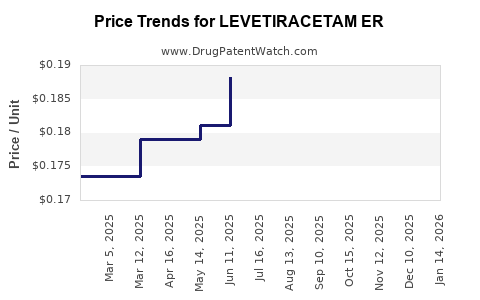
Average Pharmacy Cost for LEVETIRACETAM ER
| Drug Name | NDC | Price/Unit ($) | Unit | Date |
|---|---|---|---|---|
| LEVETIRACETAM ER 500 MG TABLET | 43547-0345-06 | 0.16872 | EACH | 2026-07-22 |
| LEVETIRACETAM ER 500 MG TABLET | 50228-0189-60 | 0.16872 | EACH | 2026-07-22 |
| LEVETIRACETAM ER 500 MG TABLET | 60505-3280-06 | 0.16872 | EACH | 2026-07-22 |
| LEVETIRACETAM ER 500 MG TABLET | 68001-0113-06 | 0.16872 | EACH | 2026-07-22 |
| LEVETIRACETAM ER 500 MG TABLET | 68180-0117-07 | 0.16872 | EACH | 2026-07-22 |
| LEVETIRACETAM ER 500 MG TABLET | 69367-0332-60 | 0.16872 | EACH | 2026-07-22 |
| >Drug Name | >NDC | >Price/Unit ($) | >Unit | >Date |
What Is Levetiracetam ER?
Levetiracetam extended-release (ER) is a formulation of the antiepileptic drug levetiracetam designed to improve patient compliance through once-daily dosing. It is indicated primarily for partial-onset seizures in adults with epilepsy and is marketed under various brand names, including Keppra XR in the U.S. and other regional variants.
Market Overview
Current Market Size
The global antiepileptic drug (AED) market was valued at approximately $4.5 billion in 2022. Levetiracetam accounts for around 20-25% of that market, translating to an estimated $900 million to $1.1 billion.
Growth Drivers
- Rising prevalence of epilepsy: estimated 50 million worldwide.
- Increasing adoption of AEDs with improved compliance profiles.
- Patent expirations of older drugs (e.g., phenytoin, carbamazepine).
- Growing use of extended-release formulations to reduce dosing frequency.
Market Share of Levetiracetam ER
Levetiracetam ER’s market share is projected to reach approximately 35-40% of the total levetiracetam market by 2025. This is influenced by:
- The convenience of once-daily dosing.
- Favorable safety profile.
- Expanding indications, including monotherapy and adjunct therapy, in adult and pediatric populations.
Regional Dynamics
- North America: Dominates with about 50-55% of the market.
- Europe: Accounts for approximately 25-30%.
- Asia-Pacific: Rapid growth driven by rising epilepsy incidence and increasing healthcare access.
Competitive Landscape
- Leading brands: Keppra XR (U.S.), Briviact XR, and generic formulations.
- Patent protections for some formulations expire, encouraging generics.
- Pipeline includes novel formulations and biosimilars.
Price Projections
Current Pricing Landscape
- Brand-name Keppra XR: Approx. $500–$600/month.
- Generics: Prices range from $200–$300/month.
- Discounted pharmacy prices for cash or assistance programs may reduce costs.
Price Trends
- Short-term: Slight decline in brand-name prices due to generic competition.
- Long-term: Prices could stabilize or slightly decline as generics dominate.
Forecast Scenarios (Next 5 Years)
| Year | Estimated Avg. Monthly Price | Notes |
|---|---|---|
| 2023 | $450–$550 | Brand dominance remains, generics gaining ground |
| 2024 | $400–$500 | Increased generic availability |
| 2025 | $350–$450 | Significant generic penetration; slightly reduced prices |
Factors Affecting Pricing
- Patent expiration dates: The U.S. patent for Keppra XR expired in 2020. Pending generics may reduce prices further.
- Regulatory approvals: Introduction of new generic versions can intensify price competition.
- Manufacturing costs: Innovations in synthesis may influence costs and pricing.
- Insurance reimbursement policies: Changes can significantly impact patient out-of-pocket costs.
Regulatory and Patent Environment
- US Patent Status: The primary patent for Keppra XR expired in 2020, leading to increased generic competition.
- European Patent Protection: Extended until 2023 in some jurisdictions, delaying generic entry.
- Regulatory approvals for generics: Pending or approved in key markets, impacting pricing dynamics.
Strategic Insights
- Companies should monitor patent timelines to anticipate generic entry.
- Pricing strategies must adapt to regional reimbursement landscapes.
- Marketing emphasis on adherence and safety can support premium pricing for branded formulations.
- Cost reductions in manufacturing could allow more competitive pricing as generics enter the market.
Key Takeaways
- The global levetiracetam ER market was valued at approximately $900 million to $1.1 billion in 2022.
- Market share growth hinges on the expansion of generic options and increasing adoption driven by convenience.
- Prices are expected to decline from an average of $450–$550/month in 2023 to approximately $350–$450/month by 2025.
- Patent expirations and regulatory approvals significantly influence pricing trends.
- Competitive dynamics favor rapid generic proliferation, likely compressing profit margins for brand-name products.
FAQs
What factors influence the pricing of levetiracetam ER?
Patent expirations, generic market entry, manufacturing costs, regulatory approvals, and insurance reimbursement policies directly impact the drug’s pricing.
How does generic competition affect the market?
The entry of generics typically reduces prices by 30–50%, increasing accessibility but decreasing revenue for brand-name manufacturers.
What is the outlook for levetiracetam ER's market share?
Sales are projected to grow through increased adoption of once-daily formulations, especially in regions favoring improved compliance.
Are there new formulations or indications expected for levetiracetam ER?
Research continues into expanded indications, including bipolar disorder and migraine prevention, but these are not yet widespread.
When will significant price declines occur?
Price declines are likely to be most pronounced after patent expiration, expected around 2023–2024 in key markets.
References
- Global Data. (2022). Epilepsy Drugs Market Report.
- IMS Health. (2022). Prescriptions Data and Market Share.
- U.S. Patent and Trademark Office (USPTO). (2020). Patent expiration dates for Keppra ER.
- EvaluatePharma. (2023). Top-selling drugs and pricing analysis.
More… ↓
