Last updated: February 27, 2026
What Is the Current Market for Levalbuterol Tartrate HFA?
Levalbuterol Tartrate inhalation aerosol (HFA) is marketed primarily as a bronchodilator in the treatment of asthma and chronic obstructive pulmonary disease (COPD). It acts as a selective β2-adrenergic receptor agonist. The drug gained approval in the early 2000s and competes within a class including albuterol and other bronchodilators.
The global inhaled bronchodilators market was valued at approximately $15 billion in 2022, with a compound annual growth rate (CAGR) of roughly 6% expected through 2030 [1]. Levalbuterol, as a branded option primarily produced by generic manufacturers, accounts for a modest segment of this market, estimated at below $500 million annually in 2022.
Sanofi's Xopenex (levalbuterol) inhaler is the main marketed brand in the U.S. and Europe, with generic versions increasingly penetrating the market since patent expirations.
What Are the Key Factors Influencing Market Dynamics?
Patent and Regulatory Environment
Levalbuterol HFA inhalers lost patent exclusivity in the U.S. in 2010; subsequent introduction of generic equivalents diminished brand market share. Regulatory pathways favor generic market entry, increasing competition.
Competitive Landscape
The major competitors include:
- Branded: Xopenex (Sanofi)
- Generics: Multiple manufacturers produce generic levalbuterol inhalers.
Generic market penetration exceeds 80% in the U.S. for inhaled bronchodilators, pressuring pricing for branded products.
Clinical Usage Patterns
Levalbuterol HFA is positioned as a first-line rescue medication. Prescribing trends favor cost-effective generics; branding offers limited differentiation. Usage remains stable among asthma and COPD patients.
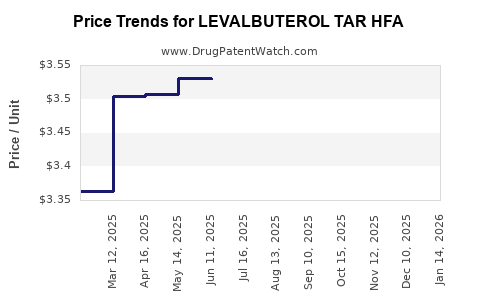
Price Trends
- Brand (Xopenex): Average wholesale price (AWP) around $250 for a 6-pack of inhalers (90 mcg/200 inhalations) in 2022.
- Generic equivalents: Price reduced to approximately $150, resulting in a substantial cost saving for payers.
Market Penetration and Growth
In the context of high generic penetration, the branded levalbuterol HFA faces minimal growth. However, new formulations and delivery systems can provide niche advantages.
What Are the Projections for Future Pricing?
Short-Term (Next 1-2 Years):
Pricing will stabilize at generic levels due to patent expiry and market saturation. The average wholesale price is expected to hover around $140-$160 per inhaler pack.
Medium to Long-Term (3-5 Years):
No significant price increase anticipated. Market volume may slightly decline as inhaler use shifts toward combination therapies and as new delivery devices emerge. Price erosion could push average wholesale prices below $130.
Factors Influencing Future Prices:
- Regulatory initiatives to control inhaler pricing.
- Emergence of new inhalers with improved delivery or reduced side effects.
- EHR and formulary dynamics favoring or discouraging use of brand versus generic.
How Do Price Projections Compare to Other Bronchodilators?
| Drug |
Market Year |
Average Wholesale Price (AWP) |
Market Share |
Notes |
| Levalbuterol (brand) |
2022 |
$250 |
Low (~10%) |
Primarily prescribed as rescue inhaler |
| Levalbuterol (generic) |
2022 |
$150 |
High (>80%) |
Major volume of prescriptions |
| Albuterol (generic) |
2022 |
$50-$70 |
Highest |
Most widely prescribed bronchodilator |
| Formoterol (brand) |
2022 |
$300-$350 |
Niche |
Long-acting beta-agonist (LAMA) for COPD, not bronchodilator |
Summary of Key Market Data
- Market size (2022): <$500 million for levalbuterol inhalers.
- Growth trajectory: Stable or declining due to generic competition.
- Pricing: Branded prices reduced significantly post-patent expiry; future prices likely stable or decreasing marginally.
Key Takeaways
- The levalbuterol HFA market is mature with high generic penetration.
- Pricing has declined steadily, with little upside for brand manufacturers.
- Future pricing will closely mirror generic inhaler market trends.
- Recent innovations are unlikely to alter the long-term pricing landscape significantly.
- Competitive pressures and regulatory initiatives pose ongoing risks to pricing.
FAQs
1. How does levalbuterol compare to albuterol in terms of price?
Levalbuterol inhalers cost roughly twice as much as generic albuterol inhalers, which are priced around $50-$70 per package.
2. Are there new formulations of levalbuterol being developed?
No significant new formulations are currently in advanced development for levalbuterol; focus remains on existing inhalers.
3. What factors could lead to price increases in the future?
Price increases are unlikely unless patent protections are re-established through reformulation or new delivery methods are approved.
4. How does the market share of levalbuterol compare internationally?
Levalbuterol has limited market share outside the U.S. and Europe due to competition from other bronchodilators and lack of licensing agreements.
5. What is the main driver of inhaler prices?
Pricing is primarily driven by generic market penetration, manufacturing costs, and payer negotiations.
References
[1] Markets and Markets. (2023). Inhaled Bronchodilators Market by Drug Class, Application, and Region.
[2] IQVIA. (2022). U.S. Prescriptions Data for Short-acting Bronchodilators.
[3] Evaluate Pharma. (2022). Global Drug Price Database.
[4] FDA. (2010). Patent expiry and generic approval data.