Last updated: February 20, 2026
What is the Market Size and Growth Potential for Levalbuterol?
Levalbuterol is a bronchodilator used primarily for managing asthma and chronic obstructive pulmonary disease (COPD). It is the R-enantiomer of albuterol, delivering targeted effects with potentially fewer side effects. The global respiratory drugs market was valued at approximately USD 27 billion in 2022, with inhaled bronchodilators accounting for nearly 70% of this figure [1].
The rising prevalence of asthma and COPD drives demand. The World Health Organization estimates that over 300 million people have asthma worldwide, and COPD affects roughly 200 million [2]. Market growth is projected at a compound annual growth rate (CAGR) of about 4% through 2028, with inhaled bronchodilators, including levalbuterol, expanding proportionally.
The adoption of newer formulations and delivery systems, along with increased diagnosis rates, bolster market size. However, levalbuterol's share remains limited relative to racemic albuterol because of branding, patent status, and cost considerations.
What Are Price Trends and Projections for Levalbuterol?
Historical Pricing Trends
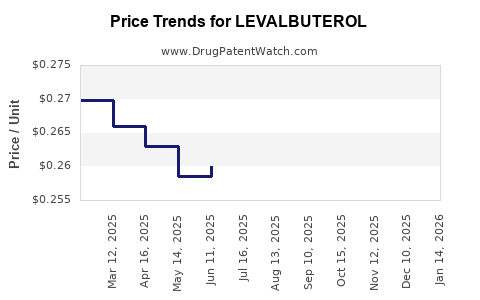
Levalbuterol inhalers have experienced price volatility due to patent litigation, generic entry, and manufacturing costs. Brand-name products, such as Xopenex (United States), have historically ranged between USD 250 and USD 350 per inhaler. Generic versions introduced in the early 2010s have reduced prices by 20-40%, depending on the market and pharmacy discounts.
Factors Influencing Future Prices
- Patent Status: The Xopenex patent expired in 2019 in the U.S., enabling generic entry. This has led to a price decline for brand equivalents.
- Market Competition: Several generics are available globally, pressuring prices downward.
- Manufacturing Costs: Improvements in API synthesis and manufacturing efficiency may decrease costs over time.
- Reimbursement Policies: Insurance coverage fluctuations influence patient out-of-pocket expenses, affecting market dynamics.
- Regulatory Approvals: Entry of biosimilars or new formulations can reshape pricing.
Price Projections (2023-2028)
| Year |
Estimated Avg Price per Inhaler (USD) |
Notes |
| 2023 |
200 – 300 |
Post-patent expiry, generic competition stabilizes prices. |
| 2024 |
180 – 280 |
Increased generic penetration; slight downward trend. |
| 2025 |
170 – 250 |
Market saturation; cost reductions continue. |
| 2026 |
160 – 230 |
Potential new delivery systems or formulations may influence pricing. |
| 2027 |
150 – 220 |
Further generic availability and manufacturing efficiencies. |
| 2028 |
140 – 210 |
Price stabilization expected; market approaches cost-driven pricing. |
Competitive Landscape and Market Dynamics
The market features multiple generic manufacturers across North America, Europe, and emerging markets. Branded products like Xopenex retain a licensing advantage for a time, but generics dominate volume sales.
The key players include:
- Sunovion Pharmaceuticals (original patent holder)
- Teva Pharmaceuticals
- Mylan (now part of Viatris)
- Sandoz
- Dr. Reddy’s Laboratories
Generic penetration exceeds 70% in the U.S. by volume, leading to significant price erosion for the branded product.
Regulatory and Manufacturing Considerations
- Regulatory approvals: Limited barriers post-patent expiry facilitate generic market entry.
- Manufacturing: Advances in chemical synthesis, such as chiral separation, reduce costs.
- Biosimilars: No biosimilars exist for levalbuterol, but similar bronchodilators are under development.
Key Takeaways
- Levalbuterol is positioned within a growing respiratory market, propelled by disease prevalence.
- The market is increasingly competitive, with prices declining due to generic entry.
- Price projections suggest a gradual decrease, with brand-name inhalers potentially falling below USD 200 per inhaler by 2025.
- Industry factors such as patent expiries, regulatory policies, and manufacturing efficiencies significantly influence future pricing.
- Strategic positioning by generic manufacturers will likely continue exerting downward pressure on prices.
FAQs
1. How does levalbuterol differ from racemic albuterol?
Levalbuterol contains only the R-enantiomer of albuterol, which is the pharmacologically active form. It potentially offers similar bronchodilation with fewer side effects, but clinical superiority over racemic albuterol remains debated.
2. What countries are major markets for levalbuterol?
The U.S., European Union, Japan, and several emerging markets like Brazil and India are key markets. The U.S. dominates with high inhaler utilization and advanced healthcare infrastructure.
3. How does patent status affect pricing?
Patents protect brand exclusivity, enabling higher prices. Post-expiration, generic competition reduces prices, often by 50% or more within a year.
4. Are biosimilars expected for levalbuterol?
No biosimilars exist currently, as levalbuterol is a small-molecule drug. Biosimilars pertain mainly to biologics.
5. What are the key drivers for levalbuterol market growth?
Increasing prevalence of asthma and COPD, improved diagnosis, and expanding access to inhaled therapies drive growth. Innovation in delivery mechanisms also impacts market expansion.
Citations
[1] Grand View Research. (2022). Respiratory Drugs Market Size, Share & Trends Analysis Report.
[2] WHO. (2021). Global surveillance, prevention and control of chronic respiratory diseases.
[3] U.S. Food and Drug Administration. (2019). Xopenex patent status and market data.