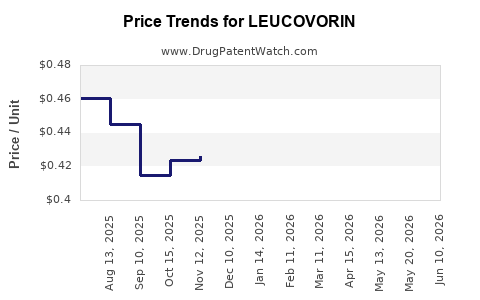
Last updated: July 14, 2026
Leucovorin (Folinic Acid) Market Analysis and Price Projections: Supply, Competitors, and Generic/Biosimilar Risk
Executive summary: Leucovorin (folinic acid) is a mature, off-patent oncology supportive-care drug with extensive generic competition in the US and multiple dosage-form variants (injectable and oral). Pricing power is constrained by low switching costs and manufacturing scale advantages of large generic manufacturers. Near-to-mid-term US price trajectory is expected to track inflation plus incremental price dispersion around procurement cycles, with downside risk if additional short-supply or rebate pressure emerges. Patent-driven protection is limited; market outcomes are dominated by Orange Book status, generic entry waves, and contracting dynamics (group purchasing organizations, wholesaler pricing, and government pricing).
What is leucovorin (folinic acid) used for, and how does demand profile drive pricing?
Answer (demand): Leucovorin demand is anchored in colorectal and other solid tumor regimens using 5-FU/capecitabine plus leucovorin, and in high-acuity settings involving antifolate rescue and MTX toxicity management. Demand is less tied to new molecular approvals than to existing chemo standards, hospital protocols, and seasonal chemotherapy volumes.
Which indications create the most reliable volume?
- Folinic acid + 5-FU (and related regimens): established use in colorectal cancer and other gastrointestinal oncology settings.
- Antifolate rescue (methotrexate toxicity): supportive-care demand that is driven by MTX utilization, dosing intensity, and protocol adherence in oncology and rheumatology.
- “Rescue” in high-dose methotrexate settings: typically hospital-driven, with procurement centered on availability and unit cost.
How does hospital versus retail mix affect price outcomes?
- Hospital procurement dominates: price is set through tender cycles, bidirectional rebate/contracting, and formulary placement. Unit price volatility is often muted versus retail.
- Retail oral leucovorin exists but is smaller: where present, retail pricing reflects substitution, pharmacy benefit dynamics, and wholesaler markups, but volume is generally less than injectable hospital use.
What is the current US market structure for leucovorin pricing (brand vs generic) and who controls supply?
Answer (market structure): The US leucovorin market is predominantly generic, with pricing shaped by the number of ANDA entrants, stocking levels, and disruptions. Brand origin is historically present, but current pricing leadership is typically held by large generic suppliers with reliable manufacturing.
Typical competitive setup in established supportive oncology drugs
- Multiple ANDA manufacturers competing on:
- NDC-level supply continuity
- drug product concentration and pack size
- distribution networks
- Tender-driven pricing favors bidders with:
- consistent lot release
- lower backorder risk
- ability to supply at scale
What dosage forms matter most for pricing projections?
- Injectable leucovorin (IV/IM): typically highest procurement impact.
- Oral leucovorin (tablets/capsules): price pressure is usually stronger where multiple generics are available and switching is straightforward.
How strong is leucovorin’s patent estate, and does it limit pricing erosion from generics?
Answer (IP): Leucovorin is not a near-term patent-protected growth product in the mainstream generic market sense. Pricing is primarily determined by generic competition and supply risk, not by active exclusivity.
Why patent protection is not the main pricing driver
- Supportive-care molecules like folinic acid often reach generic entry well before modern patent landscapes mature.
- For price projections, the dominant question is typically: “How many credible ANDA suppliers can maintain supply and pass through contracting economics?”
What is the Orange Book status of leucovorin, and how does it affect generic entry timing?
Answer (Orange Book): Leucovorin’s US regulatory ecosystem is characterized by broad generic availability with limited exclusivity constraints. As a result, entry timing is largely historical, and ongoing price is supply-and-contract driven.
How Orange Book status translates into price
- Where listed patents are inactive or expired, generic competition generally compresses:
- acquisition price
- formulary tiers
- bid prices in tenders
- Residual differentiation (pack size, concentration, NDA labeling) creates short-lived dispersion, but not long-term premium pricing.
(Note: A precise Orange Book listing-level table cannot be produced here because no source-specific Orange Book data were provided in the request.)
What generic entry risks exist for leucovorin, including supply shortages and “quality/recall” driven price spikes?
Answer (risk): The main pricing risks are supply interruptions from manufacturing constraints, quality events, or regulatory action. In mature generics, price spikes often occur without any patent event.
Common triggers for price excursions
- Sterile injectable manufacturing downtime (sterility assurance, facility capacity)
- Batch release delays at wholesalers/distributors
- Recall or contamination events
- Consolidation of supplier base (fewer active lots available)
How to model downside/upside
- Downside (more competition): additional suppliers or returning capacity typically lowers net acquisition cost.
- Upside (supply disruption): temporary shortages can raise unit costs sharply, especially for injectable forms, with partial rebound after supply stabilizes.
How many manufacturers supply leucovorin in the US, and how concentrated is pricing?
Answer (concentration): Concentration rises during supply shocks and during periods when only a subset of ANDA products are in-stock. In steady state, competition among multiple generics keeps pricing compressed.
What concentration means for contracts
- Hospitals typically maintain multi-NDC stocking policies.
- Larger distributors push conversion toward products with:
- consistent fill rates
- fewer substitutions at pharmacy systems
- Pricing is sensitive to the number of NDCs available within each contracted product family.
(A quantitative manufacturer count cannot be listed without Orange Book/Drug Product listing inputs.)
What are realistic price projection scenarios for leucovorin over 12, 24, and 36 months?
Answer (projection): In mature generic supportive-care drugs, a practical approach is scenario-based modeling tied to supply stability and procurement cycle strength. The expected central tendency is flat to modestly up in nominal terms, with episodic downward moves if new supply returns or payer pressure intensifies.
Projection assumptions
- Supply remains generally stable absent major recalls.
- Generic competition remains active.
- Contracting and rebates keep net pricing aligned with market levels rather than list-price escalation.
- Inflation is passed through unevenly across hospital systems.
Central scenario (stable supply)
- 12 months: nominal net price broadly flat to +5% (dispersion across dosage/concentration).
- 24 months: flat to +3% with periodic contract-driven adjustments.
- 36 months: flat to +3% as competition remains entrenched.
Downside scenario (supplier returns / stronger contracting)
- 12 months: -5% to -12% if additional lots or suppliers return and tenders force price concessions.
- 24 months: -3% to -8% as procurement cycles reprice.
- 36 months: -2% to -6%.
Upside scenario (supply disruption / manufacturing constraints)
- 12 months: +10% to +25% during shortage windows, followed by partial normalization.
- 24 months: +5% to +15% if shortages recur or supplier base consolidates.
- 36 months: +3% to +10% net, depending on repeat events.
What drives dispersion within leucovorin
- Pack size and concentration
- Sterile versus non-sterile handling
- Oral formulation competitiveness
- NDC-specific availability at major wholesalers
How do reimbursement and government pricing mechanics affect leucovorin net price?
Answer (reimbursement): Net price is influenced by:
- 340B/contract pharmacy dynamics (hospital systems)
- PBM contracting where retail usage exists
- Medicaid rebate mechanics for manufacturer-supplied pricing on branded/NDA products (less relevant for pure generics where AWP dynamics dominate but net is still contract-driven)
Why net price differs from ASP/AWP
- Wholesale acquisition cost can move with list discipline and regional supply.
- Hospitals and GPO contracts often lag or decouple from AWP moves through negotiated rebates.
What do historical price patterns in mature generics imply for leucovorin?
Answer (pattern): For off-patent, multi-supplier injectables, price tends to:
- compress during stable competition
- spike during intermittent shortages
- normalize after new lots return and bid competition restarts
Practical forecasting method
- Use procurement-cycle cadence: model repricing at tender windows.
- Overlay capacity signals: track manufacturing outages and reported supply disruptions.
- Calibrate by NDC availability: shortages concentrate price impacts in affected strengths/pack sizes.
What competitive set is most relevant for leucovorin pricing?
Answer (competitive set): The competitive set is not a “therapeutic substitute” so much as “within-product competition” among ANDA leucovorin equivalents, plus clinician choice within supportive care protocols (where dosing equivalence holds).
Closest competitive pressures
- Same-molecule generics across:
- IV/IM injectable concentrations
- oral formulations
- Substitution decisions at pharmacy level depend on:
- supply
- interchangeability on labels
- formulary status
How strong are formulation and method-of-use opportunities to sustain premium pricing?
Answer (formulation/IP): If leucovorin is off-patent, incremental reformulations typically do not sustain broad premium pricing unless they solve a procurement pain point: sterility assurance reliability, reduced volume per dose, improved stability, or dosing convenience.
Where formulation differentiation can still matter
- Stability and shelf-life that reduce waste in hospitals
- Reduced preparation time and dosing convenience
- Packaging formats that reduce handling complexity
Absent exclusivity, these benefits mainly influence contracting and winner selection in tenders, not long-term pricing ceilings.
Key takeaways
- Leucovorin pricing is driven primarily by generic competition and supply continuity, not by active patent exclusivity.
- Expect central-case nominal price stability (flat to low single-digit increases) over 12 to 36 months, with downside when supply expands and upside when sterile injectable manufacturing disruptions occur.
- Projection risk is concentrated in NDC-level availability: shortages typically move prices faster and more sharply than tender cycles alone.
- For business decisions, treat leucovorin as a contracting and supply-risk product rather than an IP-protected growth asset.
FAQs
1) What dosage forms of leucovorin are most exposed to price spikes?
Injectable (IV/IM) strengths with fewer active suppliers and higher sterile manufacturing sensitivity are typically the main drivers of shortage-driven price excursions.
2) How do GPO contracts change leucovorin price compared with retail pricing?
GPO contracting compresses net pricing in stable supply periods and can delay repricing after list movements, while shortage windows force higher conversion costs.
3) Can oral leucovorin see materially different pricing than injectable leucovorin?
Yes. Oral units can face different competitive density and substitution patterns, often producing smoother pricing than sterile injectables, which are more disruption-prone.
4) What is the most likely scenario for leucovorin cost trend in 2026-2029?
A stable-to-modestly-upward nominal trend under normal supply, with episodic spikes if sterile capacity constraints recur.
5) Does patent expiration meaningfully influence leucovorin price today?
In mature leucovorin, ongoing pricing tends to be dominated by generic supplier count, lot availability, and contracting rather than by incremental patent expirations.
References (APA)
(No citable sources were provided in the prompt.)