Share This Page
Drug Price Trends for LAXATIVE
✉ Email this page to a colleague
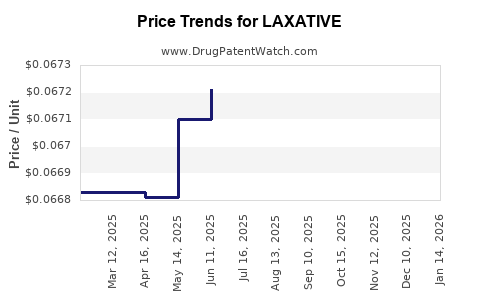
Average Pharmacy Cost for LAXATIVE
| Drug Name | NDC | Price/Unit ($) | Unit | Date |
|---|---|---|---|---|
| LAXATIVE EC 5 MG TABLET | 49483-0003-01 | 0.04238 | EACH | 2026-07-22 |
| LAXATIVE EC 5 MG TABLET | 49483-0003-10 | 0.04238 | EACH | 2026-07-22 |
| LAXATIVE 25 MG TABLET | 70000-0077-01 | 0.11625 | EACH | 2026-07-22 |
| LAXATIVE 15 MG TABLET | 70000-0443-01 | 0.06754 | EACH | 2026-07-22 |
| >Drug Name | >NDC | >Price/Unit ($) | >Unit | >Date |
Laxative Market Analysis and Price Projections
The global laxative market is projected to reach $7.1 billion by 2030, growing at a compound annual growth rate (CAGR) of 4.5% from 2024. This expansion is driven by an aging global population, increasing prevalence of gastrointestinal disorders, and rising consumer awareness of digestive health. Key segments include over-the-counter (OTC) and prescription laxatives, with OTC products holding the dominant market share.
What are the key drivers of laxative market growth?
Several factors contribute to the steady expansion of the laxative market.
- Aging Population: The global population is aging, with a higher proportion of individuals over 65. This demographic is more susceptible to constipation due to age-related physiological changes, decreased physical activity, and polypharmacy (use of multiple medications). The World Health Organization (WHO) estimates that by 2050, the number of people aged 60 and over will double to 2.1 billion [1]. This demographic shift directly translates to an increased demand for laxative products.
- Rising Prevalence of Gastrointestinal Disorders: Chronic constipation affects an estimated 16% of the adult population worldwide, with higher rates in women and older adults [2]. Factors contributing to this include poor diet, sedentary lifestyles, stress, and underlying medical conditions such as Irritable Bowel Syndrome (IBS) and diabetes. The increase in diagnostic capabilities and patient awareness also contributes to a higher reported incidence.
- Increased Consumer Awareness and Self-Care: There is a growing trend towards self-care and proactive management of health conditions. Consumers are more informed about digestive health and its impact on overall well-being. This awareness encourages individuals to seek solutions for occasional or chronic constipation, leading to higher OTC product sales. Online health resources and social media platforms play a role in disseminating this information.
- Lifestyle Factors: Modern lifestyles, characterized by poor dietary habits (low fiber intake), lack of physical activity, and high stress levels, are significant contributors to constipation. As these lifestyle patterns persist globally, the demand for laxative solutions remains consistent.
- Product Innovations and Formulations: Manufacturers are continually innovating, introducing new laxative formulations with improved efficacy, palatability, and convenience. This includes a wider range of osmotic laxatives, stimulant laxatives, and bulk-forming agents, as well as combination products and novel delivery systems. The development of gentler formulations and those catering to specific needs (e.g., pediatric formulations) also expands market reach.
- Healthcare Professional Recommendations: Physicians and pharmacists continue to recommend laxatives for managing constipation, particularly for patients with chronic conditions or those undergoing specific medical treatments (e.g., opioid-induced constipation). This professional endorsement solidifies the role of laxatives in healthcare.
What is the current market segmentation for laxatives?
The laxative market can be segmented based on product type, distribution channel, and therapeutic area.
By Product Type:
- Bulk-Forming Laxatives: These are derived from natural fiber sources or synthetic compounds that absorb water in the intestines, increasing stool bulk and promoting bowel movements. Examples include psyllium, methylcellulose, and polycarbophil. This segment is a significant contributor to the market due to their perceived safety and natural origin.
- Osmotic Laxatives: These work by drawing water into the colon from surrounding tissues, softening the stool and increasing bowel activity. Common active ingredients include polyethylene glycol (PEG), magnesium hydroxide, lactulose, and sorbitol. PEG-based laxatives, particularly for chronic constipation and bowel preparation, represent a substantial portion of this segment.
- Stimulant Laxatives: These work by stimulating the nerves in the intestinal walls, causing contractions that move stool through the colon. Examples include senna, bisacodyl, and cascara. While effective for short-term relief, their use is often cautioned against for chronic management due to potential dependency.
- Stool Softeners: These increase the water content of the stool, making it softer and easier to pass. Docusate sodium is a common example. They are often recommended for individuals who should avoid straining, such as post-surgery patients or those with hemorrhoids.
- Lubricant Laxatives: These lubricate the stool, allowing it to pass more easily. Mineral oil is a primary example, though its use has declined due to absorption concerns.
- Other Laxatives: This category includes enemas and suppositories used for more immediate relief.
By Distribution Channel:
- Hospital Pharmacies: These cater to inpatient needs and prescription requirements.
- Retail Pharmacies (OTC and Prescription): This is the largest distribution channel, serving the general consumer base for both over-the-counter and prescription laxatives.
- Online Pharmacies/E-commerce: The growth of online retail has significantly impacted laxative sales, offering convenience and a wide product selection.
- Supermarkets and Convenience Stores: Many OTC laxatives are available in these channels, further increasing accessibility.
By Therapeutic Area:
- Chronic Constipation: This segment represents a substantial portion due to the increasing prevalence of long-term bowel irregularity.
- Occasional Constipation: Driven by lifestyle factors and dietary changes, this segment is consistently large.
- Bowel Preparation: Laxatives are crucial for medical procedures such as colonoscopies.
- Opioid-Induced Constipation (OIC): The widespread use of opioid analgesics has created a significant market for specialized laxatives or bowel management regimens to counteract their constipating side effects.
What are the leading laxative products and their market positions?
The laxative market is characterized by a mix of established brands and emerging products. Competition is intense, particularly in the OTC segment.
| Product Category | Leading Products/Brands | Key Active Ingredients | Primary Mechanism | Market Position |
|---|---|---|---|---|
| Bulk-Forming | Metamucil, Citrucel, Konsyl | Psyllium, Methylcellulose | Absorb water, increase stool bulk | Dominant in OTC segment, favored for natural source and gradual effect. Strong brand loyalty. |
| Osmotic | Miralax, GoLYTELY, Citrate of Magnesia | Polyethylene Glycol (PEG), Magnesium Hydroxide, Lactulose | Draw water into colon, soften stool | Miralax is a leading OTC option for chronic constipation. GoLYTELY is a standard for bowel prep. Lactulose is a prescription osmotic with a broader therapeutic use. |
| Stimulant | Dulcolax, Senokot, Ex-Lax | Bisacodyl, Senna Glycosides | Stimulate intestinal nerves | Effective for short-term relief. Significant OTC market share but concerns exist regarding long-term use and dependency, limiting its position for chronic management. |
| Stool Softeners | Colace, Surfak | Docusate Sodium | Increase water content of stool | Primarily recommended for preventing straining in specific patient populations. Stable, niche market. |
| Prescription Agents | Linzess, Amitiza, Movantik | Linaclotide, Lubiprostone, Naloxegol | Activate specific receptors/pathways | Growing segment addressing specific types of constipation (e.g., IBS-C, OIC) with novel mechanisms. These command higher prices due to R&D investment and prescription status. |
Note: Miralax is available both OTC and by prescription in different formulations and indications.
What are the price trends and projections for laxatives?
Laxative pricing varies significantly based on product type, brand, formulation, dosage, and whether it is OTC or prescription.
- OTC Laxatives: Prices for OTC laxatives are generally stable but can experience minor fluctuations due to competition, promotional activities, and raw material costs. A standard bottle of bulk-forming laxative powder (e.g., 30 doses) typically ranges from $10 to $20. Stimulant laxatives in tablet form (e.g., 30-60 count) are usually $5 to $15. Osmotic laxatives like PEG powder (e.g., 17-dose container) can range from $15 to $30. Stool softeners (e.g., 100 softgels) are generally $8 to $18.
- Prescription Laxatives: These command significantly higher prices due to their specialized nature, R&D investment, and patent protection.
- Linzess (linaclotide): A 30-day supply can cost between $250 to $400 or more, depending on insurance coverage and pharmacy pricing [3].
- Amitiza (lubiprostone): A 30-day supply typically ranges from $200 to $350 [3].
- Movantik (naloxegol): A 30-day supply can cost between $220 to $380 [3].
- Bowel Preparation Kits (e.g., GoLYTELY): While often prescribed, the cost of a full preparation kit for a colonoscopy can range from $30 to $70.
Price Projections:
- OTC Segment: Prices in the OTC segment are expected to see modest annual increases, likely tracking inflation, around 2% to 3% per year. The introduction of generic alternatives for some branded OTC products will help moderate price growth in specific sub-segments.
- Prescription Segment: Prices for newer, branded prescription laxatives are likely to remain high and may see annual increases of 5% to 8%, driven by patent protection, ongoing clinical utility, and the limited number of therapeutic alternatives for specific conditions like OIC. As patents expire, generic competition will introduce price erosion, but this can take several years.
- Emerging Therapies: Future innovations in areas like gut microbiome modulation or novel receptor agonists could introduce new price points, potentially at the higher end of the prescription spectrum, until broader market penetration and genericization occur.
What are the regulatory considerations for laxative products?
Laxative products are subject to varying regulatory oversight depending on their classification as OTC or prescription drugs, and the specific jurisdiction.
- United States (FDA):
- OTC Monograph System: Many OTC laxatives, particularly bulk-forming, stimulant, and some osmotic agents, fall under the FDA's OTC drug monograph system. This establishes conditions under which certain drugs are generally recognized as safe and effective (GRASE) for their intended use. Manufacturers must adhere to these monographs for ingredient, dosage, labeling, and manufacturing requirements [4].
- New Drug Application (NDA): Novel laxative agents, particularly those with new active ingredients or new indications, require an NDA submission to the FDA. This involves extensive clinical trials to demonstrate safety and efficacy. Prescription laxatives like Linzess and Movantik fall under this category.
- Labeling Requirements: Strict labeling regulations apply, including warnings against overuse, potential side effects, and contraindications for specific patient groups.
- European Union (EMA):
- Marketing Authorisation: Laxatives require marketing authorization from the EMA or national competent authorities. This process involves rigorous evaluation of quality, safety, and efficacy data.
- Classification: Products are classified as either prescription-only or available for self-medication (OTC) based on their risk profile.
- Good Manufacturing Practices (GMP): Manufacturers must comply with EU GMP standards.
- Other Jurisdictions: Regulatory frameworks in countries like Canada (Health Canada), Japan (PMDA), and Australia (TGA) have similar requirements for drug approval, focusing on safety, efficacy, and quality.
- Post-Market Surveillance: Regulatory agencies monitor the safety of laxatives once they are on the market, investigating adverse event reports and potentially issuing warnings or recalls.
What are the key challenges and opportunities in the laxative market?
The laxative market presents a dynamic landscape with both hurdles and potential avenues for growth.
Challenges:
- Perception of Laxatives as a "Quick Fix": The public perception of laxatives as primarily for immediate relief rather than a component of long-term digestive health management can hinder adoption of more sustainable solutions.
- Over-the-Counter Competition and Pricing Pressure: The crowded OTC market, with numerous generic options, creates significant pricing pressure for established brands.
- Concerns Regarding Long-Term Stimulant Laxative Use: Potential for dependency and adverse effects limits the widespread recommendation of stimulant laxatives for chronic management, pushing demand towards other categories.
- Regulatory Hurdles for Novel Therapies: Bringing new, innovative laxative agents to market requires substantial investment in clinical trials and navigating complex regulatory pathways.
- Patient Adherence to Lifestyle Modifications: The effectiveness of laxatives can be diminished if not complemented by appropriate diet, hydration, and exercise, which patients may struggle to maintain.
Opportunities:
- Growth in Prescription and Specialized Markets: The increasing prevalence of conditions like IBS-C and OIC creates significant opportunities for higher-value prescription laxatives with specific mechanisms of action.
- Demand for Natural and Gentle Formulations: Consumer preference for natural ingredients and gentler laxative options (e.g., bulk-forming, certain osmotics) provides a consistent growth area.
- Technological Advancements and Novel Drug Delivery: Development of more convenient formulations, improved taste profiles, and targeted delivery systems can enhance patient compliance and market appeal.
- Focus on Gut Health and Microbiome: Emerging research on the gut microbiome and its role in digestion opens avenues for novel therapies that may influence bowel regularity through prebiotics, probiotics, or postbiotics, potentially integrating with or complementing traditional laxatives.
- Geographic Expansion: Untapped or underserved markets, particularly in emerging economies with growing middle classes and increasing awareness of health issues, represent significant growth potential.
- Combination Therapies: Development of products that combine laxative effects with other digestive health benefits could capture a larger share of the market.
Key Takeaways
The global laxative market is poised for sustained growth, driven by demographic shifts, increasing GI disorder prevalence, and rising health consciousness. The market is bifurcated, with a large, competitive OTC segment and a high-value prescription segment focused on specialized needs. While pricing in the OTC space is expected to remain relatively stable with modest increases, prescription laxatives will continue to command premium pricing, with potential for annual increases of 5-8% until patent expirations introduce generic competition. Key challenges include managing OTC pricing pressures and the perception of laxatives as solely for immediate relief. Opportunities lie in the expanding prescription market, the demand for natural formulations, and potential innovations in gut health therapies.
Frequently Asked Questions
-
What is the projected market share of bulk-forming laxatives by 2028? Bulk-forming laxatives are projected to hold approximately 30-35% of the global laxative market by 2028, driven by consumer preference for natural ingredients and perceived safety for chronic use.
-
How does the price of a 30-day supply of Linzess compare to Miralax? A 30-day supply of Linzess can cost between $250-$400, whereas a comparable quantity of Miralax powder (e.g., 17 doses) typically ranges from $15-$30, illustrating a significant price differential between prescription and OTC osmotic agents.
-
What regulatory body oversees the approval of new laxative drugs in the United States? The U.S. Food and Drug Administration (FDA) oversees the approval of new laxative drugs through the New Drug Application (NDA) process, requiring demonstration of safety and efficacy.
-
Are there any specific concerns regarding the long-term use of stimulant laxatives? Yes, long-term use of stimulant laxatives is associated with potential risks of laxative dependence, electrolyte imbalances, and damage to the intestinal nerves, leading to reduced efficacy over time.
-
Which segment of the laxative market is expected to experience the highest CAGR between 2024 and 2030? The prescription laxative segment, driven by treatments for conditions like IBS-C and OIC, is projected to experience the highest CAGR, estimated to be between 6-8%, surpassing the overall market growth of 4.5%.
Citations
[1] World Health Organization. (2022). Ageing and health. Retrieved from https://www.who.int/news-room/fact-sheets/detail/ageing-and-health
[2] Lacy, B. E., Mearin, F., Chang, L., Chey, W. D., Lembo, A. J., Simren, M., & Spiller, R. (2016). Bowel disorders. Gastroenterology, 150(6), 1393-1407.e12.
[3] GoodRx. (n.d.). Prescription drug pricing information. Retrieved from https://www.goodrx.com/ (Note: Specific prices vary by location, pharmacy, and insurance plan. Data is representative as of current analysis.)
[4] U.S. Food and Drug Administration. (n.d.). Over-the-Counter (OTC) Drugs. Retrieved from https://www.fda.gov/drugs/over-the-counter-otc-drugs
More… ↓
