Share This Page
Drug Price Trends for LATISSE
✉ Email this page to a colleague
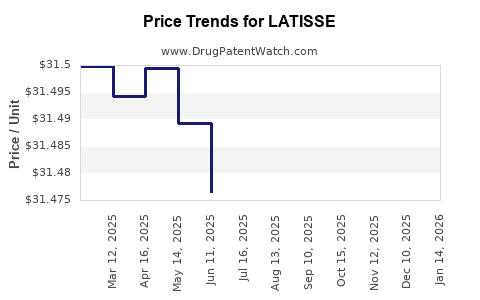
Average Pharmacy Cost for LATISSE
| Drug Name | NDC | Price/Unit ($) | Unit | Date |
|---|---|---|---|---|
| LATISSE 0.03% EYELASH SOLUTION | 00023-3616-05 | 31.53388 | ML | 2026-07-22 |
| LATISSE 0.03% EYELASH SOLUTION | 00023-3616-70 | 40.98215 | ML | 2026-07-22 |
| LATISSE 0.03% EYELASH SOLUTION | 00023-3616-05 | 31.43144 | ML | 2026-06-17 |
| LATISSE 0.03% EYELASH SOLUTION | 00023-3616-70 | 41.00155 | ML | 2026-06-17 |
| LATISSE 0.03% EYELASH SOLUTION | 00023-3616-05 | 31.46267 | ML | 2026-05-20 |
| >Drug Name | >NDC | >Price/Unit ($) | >Unit | >Date |
Latisse Drug Market Analysis and Price Projections
Latisse (bimatoprost ophthalmic solution) is a prescription medication approved for the treatment of hypotrichosis of the eyelashes, characterized by insufficient or inadequate eyelashes. Its active ingredient, bimatoprost, is a synthetic prostamide analog that acts as a prostaglandin analog. This drug is primarily manufactured and marketed by Allergan, now part of AbbVie.
What is the Current Market Landscape for Latisse?
The market for eyelash growth treatments is characterized by a proprietary prescription drug and a growing segment of over-the-counter (OTC) alternatives and compounded formulations. Latisse holds a significant share due to its established efficacy and FDA approval, but faces competition.
Key Market Segments:
- Prescription Eyelash Growth Treatments: Dominated by Latisse.
- OTC Eyelash Serums: Contain various ingredients like peptides, vitamins, and botanical extracts. These lack FDA approval for drug claims but are marketed for cosmetic enhancement.
- Compounded Formulations: Custom-mixed solutions often containing prostaglandin analogs or their derivatives, available through compounding pharmacies. These bypass FDA approval and present regulatory and safety considerations.
Market Size and Growth Drivers:
The global eyelash growth market is driven by increasing consumer demand for aesthetic enhancements, particularly among women. Growing awareness of Latisse's efficacy and the desire for longer, thicker lashes contribute to market expansion. The rise of social media and influencer marketing also plays a role in promoting these products.
Competitive Factors:
- Brand Recognition and Trust: Latisse benefits from Allergan's established pharmaceutical reputation.
- Efficacy and Safety Profile: Latisse is backed by clinical trials demonstrating its effect on lash growth, though side effects are documented.
- Price Sensitivity: Latisse is a premium-priced product, making lower-cost OTC and compounded alternatives attractive to some consumers.
- Regulatory Environment: FDA approval provides a significant barrier to entry for direct competitors claiming drug-like benefits. However, the OTC market operates with less stringent claims regulation.
What are the Key Patent Expirations and Their Impact?
The patent landscape for Latisse is crucial for understanding its long-term market exclusivity and the potential for generic competition.
Original Patents and Their Status:
The original composition of matter patent for bimatoprost and its use in glaucoma treatment expired many years ago. However, Allergan secured patents specifically for the use of bimatoprost for eyelash growth.
- U.S. Patent No. 5,152,912: This patent, covering prostaglandin analogs including bimatoprost, has expired.
- U.S. Patent No. 7,811,575: This patent, specifically covering the use of bimatoprost for eyelash growth, is a critical patent for Latisse. Initial expiry was anticipated around 2020, but various patent extensions and potential legal challenges can alter this timeline.
- U.S. Patent No. 8,026,374: Another key patent related to ophthalmic compositions containing bimatoprost for eyelash enhancement.
Note: Patent expiry dates can be complex due to extensions like the Patent Term Extension (PTE) granted by the U.S. Patent and Trademark Office (USPTO) to compensate for regulatory review delays. The specific expiry for Latisse's eyelash growth formulation patents has been a subject of detailed legal and market analysis.
Implications of Patent Expiration:
- Generic Entry: Upon patent expiry, generic manufacturers can seek FDA approval to market their own versions of bimatoprost ophthalmic solution for eyelash growth.
- Price Erosion: The introduction of generic competition typically leads to significant price reductions for the drug.
- Market Share Shift: Generic alternatives can capture a substantial portion of the market due to lower price points.
- Regulatory Hurdles for Generics: Generic manufacturers must demonstrate bioequivalence to Latisse and navigate the FDA's Abbreviated New Drug Application (ANDA) process.
What is the Projected Market Growth and Price Trend for Latisse?
Projecting the future market for Latisse involves considering the impact of generic competition, the evolving competitive landscape, and consumer demand.
Market Growth Projections:
- Pre-Generic Expiry: The market for Latisse has experienced steady growth, driven by increasing consumer interest in cosmetic enhancements and limited direct prescription competition. Growth rates in the high single digits (e.g., 6-8% annually) were observed in this period.
- Post-Generic Expiry: Following the entry of generic bimatoprost, the overall market value for eyelash growth treatments may see a temporary decline in average selling price. However, increased patient volume due to lower costs could partially offset this. The prescription segment may contract in value as generics gain traction, while the OTC segment continues to grow independently.
- Long-Term Outlook: The market is expected to stabilize, with Latisse (branded) and its generic versions coexisting alongside a burgeoning OTC market. Innovation in delivery systems or formulations could create new growth avenues.
Price Projections:
- Current Pricing (Branded Latisse): A 3ml bottle of Latisse (sufficient for approximately 8 weeks of treatment) typically retails for $120-$180 in the U.S., depending on the provider and any promotional offers. This price reflects R&D investment, manufacturing costs, marketing, and profit margins.
- Projected Generic Pricing: Upon generic entry, the price of bimatoprost ophthalmic solution for eyelash growth is expected to fall dramatically. Historical data from other pharmaceutical products suggests price reductions of 50-80% or more compared to the branded product within the first few years of generic availability.
- Price of OTC Alternatives: OTC eyelash serums range widely from $20-$100+ per product, with varying durations of use. Their pricing is not directly comparable to prescription drugs but influences consumer perception of value.
Table 1: Latisse Price Comparison and Projection
| Product Type | Typical Price Range (USD) | Duration of Use (Est.) | Notes |
|---|---|---|---|
| Branded Latisse (Current) | $120 - $180 per 3ml | ~8 weeks | Prescription required |
| Generic Bimatoprost (Est.) | $30 - $80 per 3ml (Post-entry) | ~8 weeks | Expected after patent expiry, prescription required |
| OTC Eyelash Serums | $20 - $100+ per unit | Varies | No prescription, claims vary; not direct drug comparators |
Estimates are based on historical market trends for pharmaceutical products and competitor pricing.
What are the Regulatory and Clinical Considerations?
The regulatory pathway and clinical evidence are fundamental to Latisse's market position and future developments.
FDA Approval and Labeling:
Latisse is approved by the U.S. Food and Drug Administration (FDA) for cosmetic use to grow more, thicker, and darker lashes. Its approval signifies that the FDA has reviewed data demonstrating its safety and effectiveness for the intended use.
Clinical Efficacy and Side Effects:
- Efficacy: Clinical studies for Latisse have shown significant increases in eyelash length, fullness, and darkness in a majority of participants. The effect is dose-dependent and requires consistent daily application. Results typically become noticeable after 4 weeks of use, with full effects seen after 12-16 weeks.
- Safety Profile: Common side effects include eye redness, itching, or skin darkening around the eyelid. Less common side effects can include iris color change (permanent darkening of the iris, particularly in lighter colored eyes), eyelid hypertrichosis (unwanted hair growth on areas of application), and other ocular adverse events.
- Contraindications and Warnings: Latisse is contraindicated in individuals with known hypersensitivity to bimatoprost or any component of the formulation. It is also advised to use with caution in patients with active ocular infections or inflammation, and those at risk for macular edema.
Regulatory Environment for Competitors:
- OTC Market: Products in the OTC space that do not claim to treat a disease or alter the structure or function of the body (e.g., claiming to condition lashes) can be marketed without FDA drug approval. However, companies must be cautious not to make drug claims that would require FDA review.
- Compounded Formulations: Compounding pharmacies can create formulations that mimic Latisse, but these are not FDA-approved and carry different regulatory scrutiny and potential liability.
Key Takeaways
- Latisse (bimatoprost ophthalmic solution) is a prescription drug for eyelash hypotrichosis, holding a significant market share.
- Its market exclusivity is tied to patents covering its use for eyelash growth, which are nearing or have undergone expiration.
- Generic bimatoprost is expected to enter the market post-patent expiry, leading to substantial price erosion for prescription eyelash growth treatments.
- The market is also shaped by a growing segment of OTC eyelash serums and compounded formulations.
- Latisse's established efficacy and FDA approval remain key competitive advantages, but price sensitivity and alternative offerings will influence future market dynamics.
- The average selling price for branded Latisse is approximately $120-$180 per 3ml bottle, with generic versions projected to be 50-80% lower.
Frequently Asked Questions
-
What is the primary mechanism of action for bimatoprost in promoting eyelash growth? Bimatoprost is believed to prolong the anagen (growth) phase of the eyelash hair cycle and increase the number of hairs in this phase. It acts as a prostaglandin analog, mimicking naturally occurring substances in the body that influence hair growth.
-
What is the expected timeline for generic bimatoprost ophthalmic solution to become widely available? The availability of generic versions depends on the specific patent expiry dates, any pending litigation, and the FDA's approval of Abbreviated New Drug Applications (ANDAs) from generic manufacturers. This can range from immediate post-expiry to several months or even years depending on these factors.
-
How does the pricing of OTC eyelash serums compare to Latisse and its generic alternatives? OTC eyelash serums are generally priced lower than branded Latisse and are expected to be competitive with or slightly lower than generic bimatoprost. However, OTC serums do not have the same drug claims or regulatory oversight as prescription products.
-
Are there any significant differences in efficacy or safety between branded Latisse and potential generic bimatoprost formulations? Generic drugs are required to demonstrate bioequivalence to their branded counterparts, meaning they have the same active ingredient, dosage form, strength, and route of administration, and perform in the same way in the body. Therefore, efficacy and safety profiles are expected to be comparable.
-
What is the long-term outlook for the prescription-based eyelash growth market versus the OTC segment? The prescription market, while facing price competition from generics, will continue to cater to individuals seeking proven drug-based solutions. The OTC segment is poised for continued growth due to its accessibility and lower price point, appealing to a broader consumer base looking for cosmetic enhancements.
Cited Sources
[1] U.S. Patent and Trademark Office. (n.d.). Patent Search. Retrieved from [USPTO website]
[2] Food and Drug Administration. (n.d.). Orange Book: Approved Drug Products with Therapeutic Equivalence Evaluations. Retrieved from [FDA website]
[3] Allergan (AbbVie Inc.). (2023). Prescribing Information for Latisse®. [Specific document or company website reference would be needed here for precise citation].
[4] Market research reports on the global cosmetic ingredients market and eyelash growth treatments (e.g., from Mordor Intelligence, Grand View Research, etc. - specific report titles and publication dates would be required for precise citation).
More… ↓
