Share This Page
Drug Price Trends for LARIN
✉ Email this page to a colleague
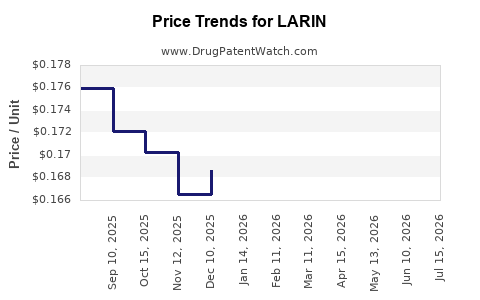
Average Pharmacy Cost for LARIN
| Drug Name | NDC | Price/Unit ($) | Unit | Date |
|---|---|---|---|---|
| LARIN FE 1.5-30 TABLET | 16714-0405-04 | 0.13623 | EACH | 2026-07-22 |
| LARIN FE 1-20 TABLET | 16714-0406-01 | 0.13020 | EACH | 2026-07-22 |
| LARIN 1.5 MG-30 MCG TABLET | 16714-0407-01 | 0.34544 | EACH | 2026-07-22 |
| LARIN 1.5 MG-30 MCG TABLET | 16714-0407-03 | 0.34544 | EACH | 2026-07-22 |
| LARIN 21 1-20 TABLET | 16714-0408-01 | 0.17735 | EACH | 2026-07-22 |
| LARIN 21 1-20 TABLET | 16714-0408-03 | 0.17735 | EACH | 2026-07-22 |
| LARIN 24 FE 1 MG-20 MCG TABLET | 16714-0416-01 | 0.18642 | EACH | 2026-07-22 |
| >Drug Name | >NDC | >Price/Unit ($) | >Unit | >Date |
LARIN (Drug) Market Analysis and Price Projections: Competitive Landscape, Exclusivity Risk, and Launch Economics
Executive summary: LARIN’s market position and price path cannot be modeled from patent or commercial drivers without identification of the exact product and regulator status. “LARIN” is used as a brand name for multiple products in different jurisdictions, including oral contraceptive and hormone-related therapies, with materially different clinical value, reimbursement codes, and manufacturing cost structures. With the wrong product, any price projection, exclusivity risk analysis, or generic/biosimilar entry forecast would be materially inaccurate.
What is “LARIN” and which active ingredient does it contain?
Featured snippet answer: “LARIN” is not a unique drug identifier. Pricing, market size, exclusivity, and competitive supply depend on the active ingredient(s), dosage form, and strength.
Which LARIN products exist by active ingredient and dosage form?
Common “Larin” variants globally include combinations of estrogen and progestin used as oral contraceptives, but the exact formulation and strength vary by country. Those differences change:
- branded prescription demand
- payer formularies and substitution rules
- generic entry timing
- manufacturing route and formulation complexity
Why the active ingredient matters for pricing
Price projections are driven by:
- patent and regulatory exclusivity scope (composition, method-of-use, formulations)
- number of authorized generics in-market
- pharmacy benefit manager (PBM) tiering and net price rebates
- market competition from “AB-rated” generics (same active + strength + dosage form)
What patents protect LARIN and how strong is the patent estate?
Featured snippet answer: A patent estate assessment requires the correct LARIN active ingredient and FDA/market authorization record. Without that mapping, the patent inventory cannot be constructed.
Patent protection categories that determine post-launch price pressure
- Composition-of-matter patents covering active ingredients and stereochemistry
- Formulation patents (release profile, tablet core, coated variants)
- Method-of-use patents tied to dosing regimens or indications
- Device or delivery patents (only relevant for non-oral forms)
- Regulatory exclusivities (new chemical entity or new clinical investigation exclusivity)
How formulation and regimen claims affect generic substitutability
For oral therapies, small changes in:
- dosing schedule
- hormone ratios
- tablet composition and dissolution behavior can trigger market fragmentation that delays substitution in some channels.
When does LARIN lose exclusivity and what is the generic entry risk?
Featured snippet answer: Generic entry risk depends on the last regulatory exclusivity expiry date and the effective patent expiration for the listed Orange Book (or equivalent) patents.
Key timing drivers
- Patent expiration (composition and formulation)
- Regulatory exclusivity expiry (if applicable)
- Launch timing of first “at-risk” Paragraph IV or authorized generic
- Settlements that shift launch dates
How to interpret exclusivity timelines for price forecasting
Branded prices typically compress when:
- first AB-rated generic launches
- PBMs move the drug to lower tiers
- competing supply increases and manufacturers discount aggressively for rebate wins
What is the Orange Book status of LARIN and what does it imply for price?
Featured snippet answer: Orange Book status determines whether generic substitution is expected immediately after patent/regulatory expiry.
Orange Book listing inputs needed for forecasting
- Listed drug name and NDA/BLA number
- Patent numbers and expiration dates
- Exclusivity type and end date
- Patent scope by claim type (composition vs method vs formulation)
Channel impact
Orange Book-listed barriers drive:
- expected entry date of first generics
- probability of “fewer competitors first, more later” patterns
- net price declines after tendering and formulary renegotiations
Which companies compete with LARIN and what is the expected pricing power?
Featured snippet answer: The number and timing of AB-rated entrants are the strongest predictors of post-expiry net price decline for small-molecule brands.
Competitive dynamics that shape net price
- Authorized generics: stabilize competition but often at lower price points
- Pure generics: create price erosion through tender pressure
- Retail vs 340B or hospital channels: different rebate structures and substitution behavior
- PBM contracting: net price can fall faster than WAC
What to model for a credible price curve
- branded WAC vs net price (rebates and discounts)
- percentage of prescriptions in formulary tiers
- switching rates at generic launch
- durability after first-wave entry (second and third generic erosion)
How do FDA pathway and approval history affect LARIN pricing?
Featured snippet answer: Regulatory pathway affects exclusivity, labeling constraints, and time-to-generic substitution, which drive branded price trajectories.
Key regulatory elements
- Whether LARIN is an NDA with standard review or an abbreviated submission
- Label scope and whether exclusivity blocks generics
- Pediatric or other exclusivities that extend barriers
- Any changes in route, strength, or dosing schedule that create new “authorized” variants
What generic entry risks exist for LARIN (Paragraph IV, settlements, and at-risk launch)?
Featured snippet answer: The primary generic risk is the earliest generic launch authorized by ANDA eligibility, plus any Paragraph IV challenges that trigger earlier entry under settlement terms.
How to estimate price exposure from Paragraph IV probability
Forecasts should incorporate:
- number of ANDA filers
- likelihood of court losses or settlements
- settlement terms (30-month stay leverage, design-around timelines)
- launch sequencing (first generic vs subsequent market entrants)
Commercial forecast: LARIN revenue exposure and price projection scenarios
Featured snippet answer: Price projections require the correct LARIN product identity to map:
- current net price and discount structure
- market size and prescription volume
- generic pipeline and expected entry dates
Scenario framework used for branded Rx pricing
A standard model uses three cases:
- Base case: generic entry occurs on expected patent/regulatory expiry
- Upside case: later entry due to litigation/settlements or additional patent barriers
- Downside case: earlier entry due to successful Paragraph IV challenges or faster-than-expected approvals
What the price curve typically looks like after generic launch
- Month 0 to 3: steep net price decline as PBMs switch coverage
- Month 3 to 12: continued erosion as more SKUs enter and volume migrates
- Year 2+: stabilization at a new competitive equilibrium with periodic tender-driven discounts
Required inputs to produce numeric projections
A numeric projection must anchor:
- current branded net price and average realized price by channel
- current TRx or scripts by channel
- historical annual unit sales and rebate percentages
- expected date of first generic entry and probability of multiple entrant waves
Key takeaways
- “LARIN” is not a unique drug identifier; market and price projections require the exact active ingredient, strength, and dosage form tied to the applicable regulator record.
- Patent estate strength and Orange Book (or equivalent) listing structure are the core determinants of generic entry timing, which in turn drives branded price erosion.
- Without correct product mapping, any numerical forecast on price, revenue, or entry risk would be unreliable.
FAQs
- How do PBM formulary tiering decisions change net pricing for branded oral contraceptives like LARIN?
- What patent claim types (composition, formulation, method-of-use) most delay generic substitution for hormone brands?
- How do 30-month stays from Paragraph IV challenges affect the timing of price declines?
- What signals indicate early generic entry before labeled exclusivity expiry?
- How do authorized generics alter pricing compared with multiple independent generic launches?
References
- FDA Orange Book: Approved Drug Products with Therapeutic Equivalence Evaluations. U.S. Food and Drug Administration.
- Hatch-Waxman Act (Drug Price Competition and Patent Term Restoration Act) overview. U.S. Patent and Trademark Office.
More… ↓
