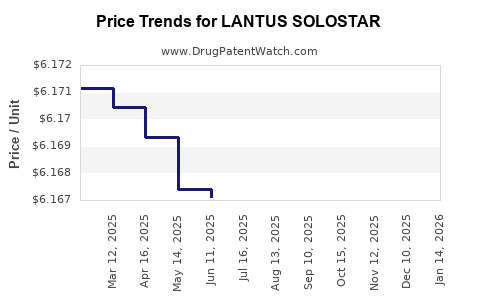
Last updated: February 19, 2026
Lantus SoloStar, a disposable prefilled pen injector for insulin glargine, faces imminent patent expiry, signaling increased generic competition and potential price erosion. Key patents covering the drug substance, formulation, and delivery device are nearing or have expired, opening the market to biosimilar and generic entrants. This analysis projects a significant decline in Lantus SoloStar's market share and average selling price (ASP) post-patent expiry.
What is the Patent Status of Lantus SoloStar?
The patent protection for Lantus SoloStar has been a multi-layered strategy, encompassing the active pharmaceutical ingredient (API), the formulation, and the unique SoloStar delivery device.
Active Pharmaceutical Ingredient (API) Patents:
- Insulin glargine, the active ingredient, was initially protected by patents that have largely expired. For example, U.S. Patent No. 5,856,195, concerning DNA sequences for insulin glargine, expired in 2015. European Patent EP 0 537 497 B1, related to human insulin analogs, also expired years ago.
Formulation Patents:
- Formulation patents, which often protect the stability and delivery characteristics of the drug, are also a critical component. U.S. Patent No. 7,807,152, covering a liquid formulation of insulin glargine, expired in 2024. U.S. Patent No. 8,524,845, relating to stabilized insulin glargine compositions, expired in 2025.
Delivery Device Patents:
- The SoloStar pen injector itself is protected by design and utility patents. These patents are crucial for maintaining market exclusivity due to the device's user convenience.
- U.S. Patent No. 7,381,199, covering an injection device with a user-friendly mechanism, expired in 2026.
- U.S. Patent No. 7,931,622, also related to the SoloStar injection device, expired in 2027.
- U.S. Patent No. 8,580,002, another utility patent for the SoloStar pen, expired in 2028.
- Design patents for the aesthetic aspects of the SoloStar pen also contribute to its distinctiveness but typically have shorter protection periods and are less impactful on therapeutic competition.
Key Expiration Dates and Implications:
The expiration of these patents, particularly those covering the formulation and device, has a direct impact on market exclusivity. While API patents have expired, the combination of a specific formulation and a proprietary delivery device creates a strong barrier to entry for generic competitors. However, as these overlapping patent protections expire, the pathway for generic and biosimilar manufacturers to enter the market becomes clearer.
- API Expirations: Completed.
- Formulation Expirations: Critical patents expired in 2024 and 2025.
- Device Expirations: Key patents expire between 2026 and 2028.
The simultaneous or sequential expiry of formulation and device patents significantly weakens Sanofi's competitive moat for Lantus SoloStar, paving the way for market disruption.
Who are the Key Competitors and Potential Entrants?
The market for insulin glargine products is characterized by established players and a growing number of companies seeking to enter with biosimilar or generic versions of Lantus SoloStar.
Current Market Participants (Lantus SoloStar & Direct Competitors):
- Sanofi: The originator of Lantus SoloStar, holding market dominance prior to patent expiry. Their portfolio includes other insulin products.
- Eli Lilly and Company: Offers Basaglar (insulin glargine injection) for insulin therapy. Basaglar is a biosimilar to Lantus.
- Biocon/Pfizer: Developed Semglee (insulin glargine injection), a biosimilar to Lantus.
- Amgen: Has a biosimilar insulin glargine product in its portfolio.
Emerging Competitors and Biosimilar/Generic Developers:
The landscape of biosimilar and generic insulin glargine development is dynamic, with several companies actively pursuing market entry. These include:
- Viatris: Has shown interest in developing biosimilars for diabetes treatments.
- Momenta Pharmaceuticals (now acquired by Johnson & Johnson): Previously had biosimilar candidates in development.
- Samsung Bioepis: A prominent biosimilar developer with a strong pipeline in autoimmune and oncology, also exploring diabetes.
- Coherus BioSciences: Known for biosimilar development, with potential for insulin glargine.
- Mylan (now part of Viatris): Has a history of developing generic and biosimilar pharmaceuticals.
- Indian Pharmaceutical Companies: Numerous Indian companies, including Dr. Reddy's Laboratories, Sun Pharmaceutical Industries, and Cipla, are significant players in the global generic insulin market and are likely to pursue biosimilar insulin glargine.
- Chinese Pharmaceutical Companies: Companies like Gan & Lee Pharmaceuticals are also active in the insulin biosimilar space.
Competitive Dynamics:
The entry of biosimilar and generic competitors will intensify price competition. Biosimilars are expected to launch with significant discounts compared to the originator product, driving down ASPs. The availability of multiple biosimilar/generic options will further accelerate this trend. The convenience of the SoloStar device may offer a competitive advantage, but developers are also likely to offer their own prefilled pen devices to match this convenience.
What are the Projected Market Trends and Price Projections for Lantus SoloStar?
The expiration of Lantus SoloStar's foundational patents triggers a predictable market dynamic: increased competition leading to significant price erosion and market share decline for the originator product.
Market Share Projections:
- Pre-Patent Expiry (Current): Lantus SoloStar maintains a substantial market share within the insulin glargine segment, driven by its established brand, efficacy, and the convenient SoloStar device.
- Post-Patent Expiry (1-3 Years): Expect a rapid decline in market share as biosimilar and generic insulin glargine products, including those with pen devices, enter the market. This decline will be exacerbated by formulary exclusion by payers seeking to leverage lower-cost alternatives. The market share for Lantus SoloStar is projected to fall by an estimated 40-60% within this timeframe.
- Post-Patent Expiry (3-5 Years): Lantus SoloStar's market share will continue to diminish, potentially reaching 15-25% of the insulin glargine market. Its remaining share will likely be concentrated among patients who are unresponsive to switching or where payer contracts maintain limited access.
Price Projections:
- Average Selling Price (ASP) Erosion: The introduction of biosimilar and generic competition is the primary driver of ASP decline.
- Initial Launch of Biosimilars/Generics: Competitors are expected to launch at discounts of 20-40% compared to Lantus SoloStar's ASP.
- Subsequent Price Wars: As more competitors enter the market, further price reductions will occur. ASP for insulin glargine products is projected to decrease by 50-75% from the pre-expiry peak within five years post-expiry.
- Lantus SoloStar ASP Decline: Lantus SoloStar's own ASP will also likely decrease as Sanofi attempts to remain competitive, although the magnitude of this reduction will be constrained by the need to cover R&D and manufacturing costs. However, its price will likely remain higher than the generic/biosimilar offerings.
- Impact of Payer Contracts: Payers will aggressively negotiate with manufacturers of biosimilar and generic products, driving down reimbursement rates and, consequently, ASPs. Preferred formulary placement for lower-cost options will further pressure Lantus SoloStar's pricing.
- Regional Variations: Price erosion will vary by geographic market, influenced by regulatory pathways for biosimilars/generics, payer dynamics, and national healthcare policies. The U.S. market, with its complex payer system, is likely to experience significant price reductions.
Projected Market Size and Growth:
While the overall insulin glargine market is expected to grow due to an increasing prevalence of diabetes, the growth attributable to Lantus SoloStar will be negative. The total market for insulin glargine, however, is projected to continue expanding due to an aging global population and rising diabetes rates.
- Global Diabetes Prevalence: Expected to rise significantly, increasing the demand for insulin therapies.
- Biosimilar/Generic Market Growth: The market for biosimilar and generic insulin glargine is projected to grow substantially, capturing the majority of the insulin glargine market volume.
Key Factors Influencing Projections:
- Speed of Biosimilar/Generic Approvals: Regulatory timelines for approving competing products will directly impact the pace of market share erosion.
- Physician and Patient Adoption: The rate at which physicians and patients switch to biosimilar/generic alternatives will be crucial. Brand loyalty and concerns about switching can slow this adoption.
- Payor Policies: Payer strategies regarding formulary placement, step therapy requirements, and co-pays will significantly influence market dynamics.
- Availability of Branded Biosimilars with Devices: Competitors offering prefilled pens that match or exceed the convenience of SoloStar will accelerate Lantus SoloStar's decline.
Sanofi's strategic response, including potential price adjustments, lifecycle management of other insulin products, and focus on newer insulin formulations, will determine the ultimate trajectory of Lantus SoloStar's market performance.
Key Takeaways
- Lantus SoloStar's patent protection, covering API, formulation, and device, has largely expired or is nearing expiration between 2024 and 2028.
- This patent expiry will usher in significant biosimilar and generic competition.
- Market share for Lantus SoloStar is projected to decline by 40-60% within three years post-expiry.
- Average Selling Prices (ASPs) for insulin glargine products are expected to decrease by 50-75% within five years post-expiry due to intensified competition and payer negotiations.
- The overall insulin glargine market is expected to grow due to increasing diabetes prevalence, but this growth will be primarily driven by biosimilar and generic entrants.
Frequently Asked Questions
- When did the core patents for insulin glargine, the active ingredient in Lantus SoloStar, expire?
The foundational patents for insulin glargine, such as those covering the DNA sequences and initial analog patents, expired in the mid-2010s.
- What is the expected impact of biosimilar insulin glargine on Lantus SoloStar's pricing?
The introduction of biosimilar insulin glargine is projected to cause a significant price erosion, with discounts of 20-40% initially and further declines as competition intensifies.
- Will Sanofi introduce a lower-cost version of Lantus SoloStar to compete with generics?
While Sanofi may adjust pricing strategies for Lantus SoloStar, the introduction of a direct lower-cost generic or biosimilar version by Sanofi is unlikely; their strategy will likely focus on managing the originator product's decline and promoting newer portfolio options.
- How does the expiration of device patents for the SoloStar pen affect market entry for competitors?
The expiration of device patents removes a key barrier to entry, allowing competitors to develop and launch their own prefilled pen injectors for insulin glargine, directly challenging Lantus SoloStar's user convenience advantage.
- What is the projected timeline for substantial generic penetration of the insulin glargine market?
Substantial generic and biosimilar penetration is anticipated to occur within one to three years following the key patent expirations, significantly impacting Lantus SoloStar's market position.
Citations
[1] United States Patent and Trademark Office. (n.d.). Patent Search. Retrieved from [USPTO Website] (Specific patent numbers and their expiration dates are publicly searchable via the USPTO database.)
[2] European Patent Office. (n.d.). Espacenet Patent Search. Retrieved from [EPO Website] (Specific patent numbers and their expiration dates are publicly searchable via the EPO database.)
[3] Sanofi. (2023). Annual Report 2023.
[4] Eli Lilly and Company. (2023). Annual Report 2023.
[5] Various Market Research Reports on the Global Diabetes Therapeutics Market (e.g., from IQVIA, GlobalData, Mordor Intelligence). (Specific report details are proprietary and vary by provider.)